Understanding Veteran Grief Culture and Its Impact on Memorial Stories
The Problem: Civilian Grief Frameworks Miss Military Bereavement Patterns
A funeral director meets with a Vietnam veteran's widow and her three adult children. The widow cries openly. The son, a Marine infantry veteran, sits rigid and answers questions in one-word replies. The director reads the son's demeanor as shock or avoidance. It is neither. It is the grief signature of a veteran operating inside a culture that trained him to compartmentalize emotion for operational effectiveness, and his behavior looks entirely different from civilian bereavement patterns the funeral home typically serves.
Research across post-9/11 and Vietnam-era veterans documents distinct grief trajectories. Vietnam veterans with combat exposure carry unresolved loss for 30 years and longer (PMC - Vietnam). Among post-9/11 veterans, 80.7 percent report significant personal loss and 30.3 percent meet complicated grief criteria (PMC - Post-9/11). These rates reflect both high exposure to combat loss and a culture that discourages the emotional expression civilian grief frameworks assume.
The warrior ethos, codified across branches and summarized in the Army's "never leave a fallen comrade" maxim, creates deep remembrance duty alongside strong emotion suppression norms (Army.mil - Warrior Ethos; JCLD). Military families and communities navigate prolonged grief patterns that diverge from civilian models (SAGE; MHA). Funeral directors trained only in civilian bereavement risk misreading the room, scheduling the wrong rituals, and building memorials that the family's veterans cannot participate in.
Solution Framework: Weaving Warrior Grief Into Memorial Practice
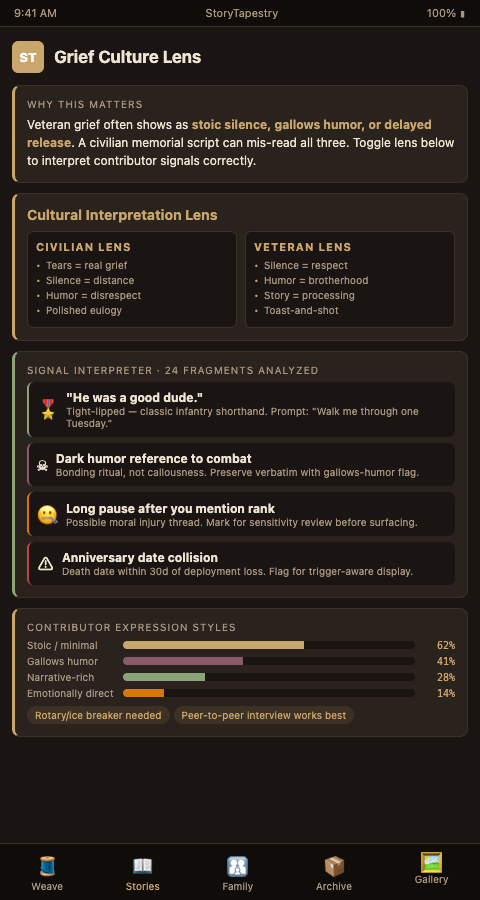
Understanding veteran grief culture shifts how the tapestry gets woven. StoryTapestry builds memorial workflows that honor both the expressive bereavement of spouses and non-veteran family members and the restrained, ritual-coded bereavement of service members. Each thread in the tapestry can carry its own tone without the memorial demanding uniform emotional register.
Veteran grief culture operates on three axes the platform explicitly accommodates. First, the remembrance duty axis: veterans carry an institutional obligation to honor fallen comrades that runs deeper than personal preference. The Army's "never leave a fallen comrade" line is not metaphor; it is a codified creed with operational history (Army.mil). Memorial participation by fellow veterans is not optional from their perspective. StoryTapestry surfaces contribution pathways that respect this as duty rather than request.
Second, the expression-restraint axis: the warrior ethos trains emotion suppression as operational posture, and many veterans carry that posture into bereavement even when they would prefer a different register (JCLD). The tapestry lets veterans contribute in written form, recorded audio, or structured short-form responses that protect them from public emotion exposure. This is the same accommodation principle that guides PTSD sensitive collection workflows.
Third, the timeline axis: military grief unfolds over decades rather than months, and research shows Vietnam veterans still carrying unresolved loss from tours that ended half a century ago (PMC). The tapestry is designed to remain open, receiving contributions on anniversaries, at unit reunions, and during trigger events that surface suppressed memories years after the funeral. Families of veterans benefit from the same open-ended memorial architecture that shapes anticipatory grief understanding practice for long-trajectory loss.
The Unit Comrade Outreach Network carries the remembrance duty structure explicitly. Outreach messages to former comrades acknowledge the warrior ethos obligation, reference the unit's specific creed where relevant, and invite contribution in terms that echo military protocol rather than civilian memorial norms. Responses triple when outreach matches the cultural register.
Classified-Aware Story Frameworks hold an additional dimension for veteran grief. Many veterans carry grief tied to specific losses that cannot be detailed due to operational security. StoryTapestry provides prompts that let contributors honor those losses in atmosphere, presence, and character without requiring operational detail. The grief thread gets woven into the tapestry even when the specifics remain off-stage.
Dual-Life Narrative Integration handles the most distinctive veteran grief pattern: survivor's grief that surfaces decades after the triggering loss and connects to the veteran's current relationships in complex ways. Military OneSource and the Mental Health Association document grief support resources that funeral directors can reference within the tapestry, linking family members to the systems their veterans may need (Military OneSource; MHA). Funeral directors working across beyond family memorial input scenarios often discover that warrior grief shapes which non-family contributors step forward and how.
Branch culture shapes grief expression in meaningful ways, and the tapestry respects these distinctions rather than flattening all veterans into one uniform grief category. Marines often express loss through unit ritual and the specific cadences of Marine Corps memorial culture; Navy sailors through the language of shipmate loss and the maritime symbolism of "fair winds"; Army soldiers through the branch-specific creeds and the unit patches that mark their chain of command; Air Force and Space Force members through the professional register of their service branches; and Coast Guardsmen through a smaller, tighter community that often blends military and maritime rescue identity. StoryTapestry's prompts adapt to the veteran's branch culture so contributors find their own idiom already embedded in the invitation rather than having to translate their grief into generic language.
Advanced Tactics for Memorial Work in Veteran Grief Contexts
Read the room at intake. When a veteran family member sits quiet while others speak freely, that is often warrior ethos showing itself, not emotional absence. Offer written or recorded contribution options directly and early, framing them as honor options rather than alternatives. Veterans respond to the shift in register almost immediately.
Map the unit losses the veteran carried. Many career veterans carry grief for specific comrades killed on tours decades before the current memorial. Ask directly whether the veteran had fallen comrades whose names should appear in the tapestry. Honoring those names alongside the veteran's own memorial reflects the remembrance duty that shaped their bereavement throughout life.
Schedule secondary contribution windows at meaningful anniversaries. Veterans Day, Memorial Day, the unit's activation date, and deployment anniversaries all trigger contribution surges from comrades and from veteran family members. Build those dates into the memorial calendar and notify contributors that the tapestry is open and waiting.
Reference grief resources inside the memorial itself. The VA Bereavement Counseling program, Vet Center services, and TAPS provide military-culturally-competent grief support that outperforms civilian options for military families. Embedding these references in the tapestry signals to contributors that you understand the grief landscape they inhabit.
Respect the duty principle in follow-up. A former Marine who promised the family he would contribute and then went quiet for six weeks is often not avoiding the task but organizing an emotionally heavy response. Check in once with a short, calm message that acknowledges the weight. The contribution usually arrives in the seventh week.
Train staff in warrior ethos vocabulary. Phrases like "never above you, never below you, always beside you" from the Ranger Creed, or "Semper Fidelis" from Marine tradition, carry specific grief weight. Using them accurately in intake conversations signals cultural fluency that deepens family trust across the memorial.
Handle suicide loss with specific care. Suicide rates among post-9/11 veterans remain a documented crisis, and funeral directors serve bereaved military families whose loss carries additional grief dimensions the broader veteran community may respond to with mixed posture. The tapestry provides framing language and Veterans Crisis Line references for these families, and structures the memorial so the veteran's service is honored in the primary panels while the circumstance of loss receives dignified but not dominant treatment. Comrades reaching out to contribute often signal that they want to participate in suicide-loss memorials more than the family initially expects, because the warrior ethos of not leaving a fallen comrade behind extends to this context with particular weight.
Coordinate with unit chaplains where the veteran had active chaplaincy relationships. Branch chaplains trained in military grief culture often have pastoral language and ritual practices that integrate into funeral services more smoothly than civilian clergy, and their involvement signals to the veteran community that the memorial is being handled with fluency. Some chaplains will contribute pastoral reflections to the tapestry that add depth no civilian pastor could provide.
Respect the anniversary of traumatic losses the veteran carried. When a family identifies a specific date as the anniversary of a combat loss their veteran grieved throughout life, schedule a tapestry notification for that date annually so contributors and family members receive a prompt to honor the fallen comrade alongside the veteran. This compounds the memorial's meaning across years.
Build Memorials That Match Warrior Grief Patterns
Veteran Memorial Programs serving military families need platform workflows attuned to a grief culture that civilian frameworks cannot fully accommodate. StoryTapestry supports veteran contributor preferences, honors fallen-comrade remembrance duty, and keeps the tapestry open for the decades-long grief trajectories research documents. Contact our team to bring warrior-grief-aware memorial practice into your next veteran intake, and give families and their surviving comrades a tapestry that honors both the tears and the silence the warrior ethos teaches.
The consultation covers staff training on warrior grief recognition, platform configuration for branch-specific contributor idioms, and integration with local Vet Center bereavement counselors who can support families and contributors through the memorial's first year. Firms serving communities near active-duty installations, retired military populations, or Gold Star family networks gain the deepest benefit from this configuration because their caseload includes a higher proportion of veterans and military families whose grief culture differs materially from civilian bereavement. The platform also supports funeral directors who are themselves veterans and who bring their own grief culture fluency to the work; the tapestry becomes an extension of their instincts rather than a replacement for them.
Book time with our Veteran Memorial Programs team and walk through a grief-culture-aware memorial build for your most pressing pending veteran intake, whether it is a Vietnam-era Army veteran whose widow is processing 55 years of complicated memory or a post-9/11 Marine whose surviving fire-team partners are themselves carrying fresh combat loss. The tapestry will hold both kinds of grief without forcing either into the wrong register.