Best Practices for Collecting Stories from Veterans with PTSD Sensitivity
The Problem: Well-Meaning Interviewers Reopen Wounds They Cannot Close
When Sergeant First Class Rodney Hale's grandson brought a tripod and a list of questions to the family's Thanksgiving gathering, his grandfather, a Vietnam infantry platoon sergeant, agreed to sit for an hour. The grandson opened with "tell me about the worst thing you saw," and within ten minutes Rodney was breathing hard, excused himself, and did not come back to the table. The grandson called his mother that night, and his mother called the veteran's VA therapist the next morning to report the relapse.
This is not a fringe risk. The VA estimates seven percent of veterans develop PTSD at some point in their lives, and Iraq and Afghanistan veterans show 11 to 20 percent prevalence rates. The VA's trauma-informed care guidance stresses that any system interacting with veterans should be designed to reduce re-traumatization rather than assume veterans can handle whatever questions come their way. Moral injury, which differs from PTSD and involves acts or witnessed acts that violated moral standards, adds a second dimension often missed by standard PTSD screening, a distinction supported by peer-reviewed moral injury research.
Voice of Witness documents how interviewer training materially changes trauma outcomes in oral history work, and the National Park Service oral history guidance specifies pre-interviews and multiple short sessions over single long ones. StoryCorps' Military Voices Initiative uses a specific protocol developed with military mental health clinicians. Memorial programs whose volunteers open with "tell me about combat" operate at a standard below every professional oral history organization working in this space. Families and veterans deserve better intake.
Best Practices for Collecting Veteran Stories with PTSD Sensitivity
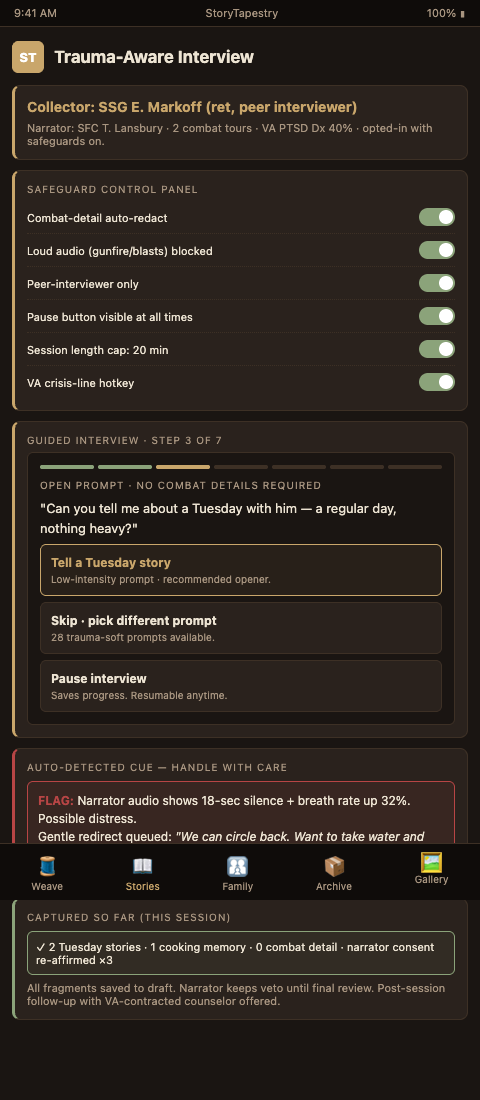
StoryTapestry's trauma-informed intake rests on three principles drawn directly from VA and professional oral history practice: the veteran controls the session, questions open wide before narrowing, and the platform makes it easier to stop than to continue. These best practices govern collecting stories with built-in sensitivity to every PTSD profile the program encounters. The framework then weaves these principles into a structured protocol every memorial program volunteer runs before any recording begins.
The first protocol element is the pre-interview conversation. Before any recording, the interviewer has a 20 to 30 minute phone call with the veteran (or, if the veteran has died, with the closest surviving comrade or family member) to discuss what topics are welcome, what topics are off-limits, and what signals will end a session. NPS oral history guidance recommends this step for difficult topics, and the VA's trauma-informed framework stresses that control over the interaction is itself therapeutic. StoryTapestry ships a pre-interview checklist with 12 questions covering recent life events, current mental health care, known triggers, and preferred session length.
The second element is the widening funnel. Sessions open with biographical breadth (where did you grow up, when did you enlist, what was boot camp like) before any combat or loss content. Voice of Witness training materials note that opening with the hardest question puts the veteran into the defensive posture their nervous system spent decades managing, while opening wide lets the body settle into the conversation. The funnel pairs well with unit member interviews because comrades can corroborate the easier material first and introduce harder topics only when the veteran signals readiness, and coordinators often build on unit member interview workflows to identify supportive comrades in advance.
The third element is the multiple-short-session default. NPS guidance recommends breaking long interviews into 45 to 60 minute sessions across multiple days rather than one three-hour sitting. StoryTapestry schedules sessions accordingly and caps session length at 60 minutes unless the veteran explicitly requests more. Interviewers who push past the cap report more relapses and more subsequent session cancellations than interviewers who hold the cap firmly. The tapestry treats the cap as a platform rule, not a suggestion.
The fourth element is the explicit stop signal. Veterans are taught a two-finger gesture that pauses the recording and triggers a 10-minute break. The platform indexes the pause so the final tapestry can either skip the paused section entirely or, with veteran permission, include it with a note ("Sergeant Hale chose to pause here and returned to this topic in a later session"). The stop signal must be practiced before the first question, not explained in passing. Interviewers who skip the practice find veterans never use the signal even when they need it.
The fifth element is the post-session wind-down. Every session closes with 10 minutes of biographical breadth and a scheduled check-in call 48 hours later. The check-in is non-negotiable. The VA's trauma-informed framework stresses that the hours after disclosure often carry more acute risk than the disclosure itself, and programs that skip the check-in see material mental health consequences among veterans who seemed fine when the session ended. The framework also supports authentic story balance by acknowledging that a story stopping short of combat disclosure is not a lesser story, drawing on authentic story balance practice that pushes back against heroism-first narrative defaults.
Advanced Tactics: Mental Health Coordination, Moral Injury, and Family Interviewer Support
Memorial programs handling veterans with known PTSD diagnoses, active VA mental health care, or moral injury histories need three additional practices beyond the baseline protocol.
The first is mental health coordination. Veterans receiving active VA mental health treatment can, with their consent, have their therapist briefed on upcoming memorial interview sessions so the therapist can prepare supportive context for the next appointment. StoryTapestry includes a coordination form that captures consent, therapist contact, session schedule, and topic list. Therapists consistently report that a two-sentence advance heads-up ("Mr. Hale has an oral history session Thursday covering his 1969 platoon") changes how they structure the following week's appointment. This parallels the medical staff story gathering approach used in other clinically-adjacent memorial contexts, and the NICU medical staff stories playbook translates directly to clinician-backed veteran intake.
The second practice is moral injury acknowledgment. The VA defines moral injury as distress arising from acts that violated deeply held moral standards, and current screening tools often miss it while capturing PTSD. Interviewers should be trained to recognize moral injury cues (expressions of guilt, shame, or self-blame that do not match what the veteran witnessed as a passive observer) and to route those sessions toward resources rather than probing deeper. StoryTapestry includes a moral injury cue sheet in every interviewer training module and escalation pathways that loop in VA resources.
The third practice is family interviewer coaching. Grandchildren, spouses, and children often become the most natural interviewers for veterans, but they also carry relational weight that professional interviewers do not. A granddaughter who asks about combat may trigger protective silencing from a veteran who would answer a stranger. StoryTapestry offers a 90-minute family interviewer coaching module covering the funnel, the stop signal, post-session care, and the difference between questions a family member can ask and questions better left to a trained third-party volunteer. Programs that run the coaching see meaningfully fewer Thanksgiving relapses.
Coordinate Trauma-Informed Veteran Memorials with StoryTapestry
Veteran memorial programs working with families of Vietnam, Gulf War, Iraq, Afghanistan, and Global War on Terror veterans use StoryTapestry to run trauma-informed intake that protects contributors while still capturing meaningful story. Schedule a coordinator consultation to review your current interview protocol, and bring a recent interview recording (with veteran or family consent) for a protocol audit. Programs typically complete full trauma-informed setup within three weeks, including volunteer training, and the check-in call cadence alone reduces post-session distress reports by a meaningful margin. Reach out through the StoryTapestry program coordinator portal to begin a trauma-informed intake review.
The consultation covers your current interview script, a trauma-informed protocol audit against the recording you bring, the mental health coordination workflow that routes distressed contributors to your local Vet Center, the moral injury sensitivity framework, and the family-interviewer support program that protects spouses who conduct family-side interviews. Pilot engagements include volunteer training for your three lead interviewers, a supervised first-memorial deployment with a trauma-informed specialist on the call, and a 72-hour post-session check-in cadence we configure for your first 10 interviews. Most programs begin running trauma-informed intake on their next Vietnam, Gulf War, or GWOT memorial within 21 days of the consultation. Bring your lead coordinator, one family-services director, and one Vet Center or VA behavioral health contact — the consultation produces a referral-ready workflow the three of them can activate before the next veteran intake.