Essential Considerations for Cross-Cultural Funeral Storytelling
Why Cultural Grief Norms Diverge So Sharply
A Conversation article on death and dying across cultures reports that Egyptian cultures view tearful grieving seven years after a loss as emotionally healthy, while American psychiatric frameworks would pathologize the same behavior. Neither culture is "right." Both are responses to grief shaped by centuries of cultural context.
The Association for Death Education and Counseling explicitly promotes diversity in grief counseling for this reason. NCBI research on sociocultural influences documents how cultural norms shape every aspect of grief expression, from volume of public weeping to length of mourning dress to forms of ancestral communication. AMA Journal of Ethics guidance on culturally competent end-of-life care warns clinicians not to ignore legitimate cultural variations.
A PMC cross-cultural bereavement study by Kokou-Kpolou compared practices following death across 14 countries and found systematic differences in mourning duration, ritual intensity, and ancestor communication. Frontiers in Sociology research proposes a four-dimensional cultural ritual framework that helps funeral directors map the cultural load of any given family.
For funeral homes working with blended cultural tribute planning, the implication is clear: a memorial that honors one tradition while ignoring another is not neutral; it is an implicit declaration that one culture's grief is legitimate and another's is not.
A Tapestry Framework for Navigating Funeral Customs Across Cultures
The tapestry metaphor solves the blended-heritage problem by refusing to force families to pick. Multiple cultural traditions can coexist within the same memorial fabric, each governing its own section, with the whole held together by the shared love for the person being remembered.
StoryTapestry implements multicultural eulogy best practices through four layered capabilities. First, parallel tradition zones let different sides of the family structure their contributions according to their own cultural practices. An Egyptian section observes extended tearful grief expression; a Polish section observes restrained dignity; an American section offers shorter reflective tributes. The platform hosts all three simultaneously without making any feel secondary.
Second, cultural guidance pop-ups help both staff and contributors understand what each tradition expects. When an in-law is about to contribute to the Egyptian section, they see a brief guidance note: "In this family's Egyptian tradition, expressing vivid emotion publicly is expected and honored. Restraint may read as coldness." These intercultural memorial etiquette tips prevent well-meaning contributions that inadvertently violate norms.
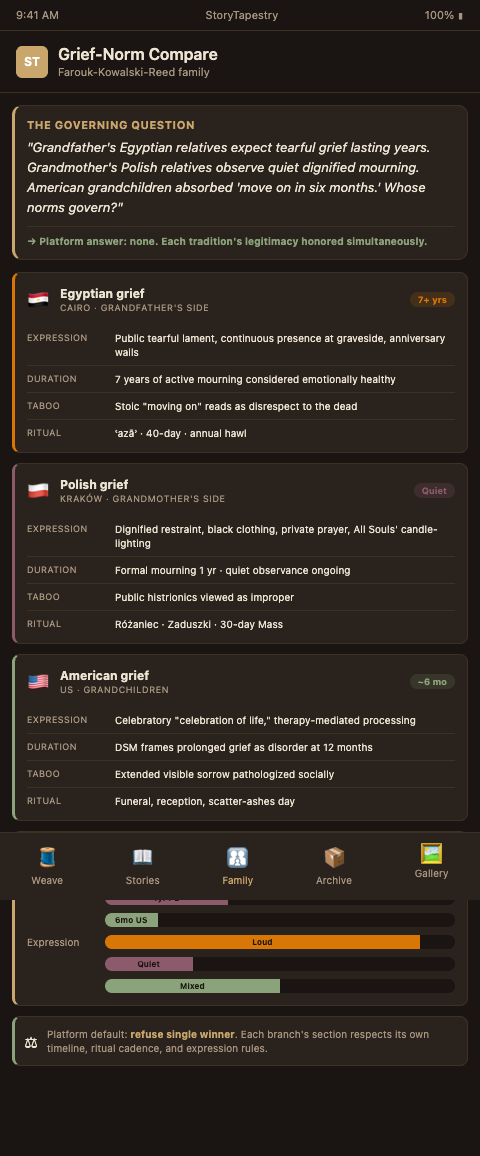
Third, ritual calendar merging displays all observance dates relevant to each tradition without privileging any. The memorial's anniversary page shows the Egyptian 40-day milestone, the Polish second-anniversary Mass, and the American one-year anniversary, each with appropriate messaging for contributors from that tradition. Drawing on culturally adaptive platforms principles, the platform respects each calendar without forcing them to merge.
Fourth, cultural consultant access is built into the platform. Funeral homes using StoryTapestry can invite a designated cultural consultant (a clergy member, community elder, or cultural association leader) to review contributions flagged as potentially needing cultural expertise. The consultant sees only flagged items, not the whole memorial, preserving family privacy while providing expert guidance.
Honor You's research on cultural sensitivity emphasizes that thoughtful questions build trust far more effectively than assumptions based on surface indicators. A family with a Latino surname might practice Catholic, Pentecostal, Santeria, Jewish, Buddhist, or secular traditions, and only asking reveals which.
Building religious storytelling customs into the platform architecture means supporting interfaith families without forcing them to pick one faith tradition as "primary." A Catholic-Jewish family, a Muslim-Hindu family, a Christian-Buddhist family each deserve a memorial that treats both traditions with full dignity rather than relegating one to "also included."
The blended memorial also accommodates cultural mixing within a single individual's identity, which is increasingly common for second and third-generation diaspora. A Japanese-Brazilian-American woman may feel genuinely connected to Buddhist, Catholic, and secular traditions without any of them being dominant. A Persian-Venezuelan-Canadian man may have been formally Zoroastrian, culturally Catholic, and personally humanist at different life stages. StoryTapestry's framework does not force contributors to label the deceased with a single religious identity; it lets the memorial reflect the actual lived plurality of their spiritual life. Different family members can contribute to different sections without contradiction, because the deceased themselves lived across all of them.
Advanced Tactics for Blended Cultural Tribute Planning
Funeral directors working with cross-cultural families add several layers of intentional practice. First, conduct a cultural mapping intake for every blended-heritage family. Ask explicit questions: Which traditions are in the family? Which were actively practiced? Which were inherited but not continued? Which were gained through marriage? The map that emerges guides platform configuration and staff cultural consultation needs.
Second, invite each cultural branch to designate a tradition liaison. The family member most fluent in the Egyptian side's observance practices serves as the liaison for that section; similarly for the Polish side and the American side. Liaisons make judgment calls on platform configuration, flag issues to the funeral director, and buffer well-meaning-but-misguided contributions from other branches.
Third, invest in staff cultural education proportional to your service area. If 40% of your services involve Latino families, invest in deep staff training on the spectrum of Latino cultural practices, not generic "Hispanic heritage" training. If 15% involve Muslim families, ensure staff understand the variation between Sunni and Shia, between immigrant and native-born, between Arab and South Asian Muslim cultural norms. This parallels how military funeral terminology training creates fluency for veteran families; the same principle applies across every cultural community you serve.
Fourth, never assume a cultural practice based on surname or appearance. An "Italian" family might be secular, devoutly Catholic, Sikh (by marriage), or Jewish (by ancestry). Ask every family, every time. Families with mixed heritage often appreciate the question because it signals genuine interest rather than lazy assumption.
Fifth, handle grief-norm conflicts transparently. When one branch of the family expects year-plus public mourning and another expects rapid return to normalcy, the memorial can offer both without forcing them to merge. A "mourning timeline" page lets each branch display its observance dates, reassuring relatives from each tradition that their rhythm is respected.
Sixth, document the blended memorial itself as a family artifact. The resulting cross-cultural tapestry often becomes the first time a family has seen their heritage map laid out coherently. Grandchildren especially report that the memorial taught them things about their heritage they did not know. The memorial serves as the family's first formal cultural archive, not only a grief processing tool.
Seventh, account for the cultural grief load on mixed-heritage grandchildren who may feel caught between traditions. A Korean-Mexican-American teenager grieving a grandmother she loved may struggle to know how loudly to grieve: the Korean side expects reserved dignity, the Mexican side expects emotional expression, and the American side expects something in between. Memorial design that acknowledges her in-between position, through optional reflection prompts about bicultural grief and invitations to contribute in whatever register feels honest, helps her find her own voice rather than feeling pulled toward a single tradition's norms. Funeral directors who notice these dynamics and gently validate the complexity typically gain lifelong loyalty from mixed-heritage younger relatives who often become the family coordinators of the next generation.
Eighth, recognize that each tradition's grief load falls differently on different family members. The Egyptian side's extended tearful grieving may feel validating to one cousin and exhausting to another; the Polish side's stoic composure may feel dignified to one relative and cold to another. A thoughtful funeral director checks in with each branch mid-process rather than assuming the tradition's norm represents every individual's preference. StoryTapestry includes private feedback mechanisms that let family members flag concerns to the coordinator without needing to confront a relative publicly.
Honor Every Culture in Every Family
Families with blended heritage often leave traditional funeral services feeling that one side of their story was welcomed and the other barely acknowledged. StoryTapestry lets you run the first service where every cultural branch feels fully honored. Contact our diaspora services team for a walkthrough focused on the cultural combinations most common in your client base. We will design a sample blended memorial using your actual local demographics, and you will see how different the service feels when no culture has to apologize for its grief norms. The walkthrough includes parallel tradition zone configuration for your specific cultural mix, cultural guidance pop-up templates, ritual calendar merging logic, and the consultant review workflow.
Funeral homes serving multicultural regions typically see the clearest differentiation here: families compare providers, and the home that treats Egyptian grief and Polish grief with equal architectural respect wins the referral even when the family's closest cultural match is elsewhere. We can usually have your blended-memorial configurations production-ready within six to eight weeks, and your first blended-heritage service using the new architecture tends to become the case study you reference in every community outreach conversation for the next year. Your mixed-heritage families have been telling each other for years which funeral homes get it right; make sure yours is on their short list.