Essential Military Terminology for Funeral Directors Building Vet Memorials
The Problem: Civilian Vocabulary Mismatches Military Family Expectations
A funeral director meets with the widow of a retired Sergeant Major. She wants her husband's memorial card to show "SGM" and list his decorations accurately, including the "CIB" he earned in Vietnam. The director types "SGT Major" on the draft and lists "Combat Infantry Badge" without the period and without the V-device notation on his Bronze Star. The widow corrects each error politely, but the meeting's trust ceiling drops from the start, and the memorial conversation narrows to logistics rather than story.
Research on civilian providers serving veterans documents exactly this gap. Many civilian professionals lack confidence navigating military terminology, which affects service delivery across healthcare, bereavement, and funeral contexts (PubMed). The official vocabulary exists in accessible form: Army rank hierarchies, DoD insignia guides, and military jargon references are publicly documented (Army.mil - Ranks; Military OneSource; Military.com).
Decorations carry even more specific vocabulary. The Wikipedia cross-referenced list of awards and decorations, combined with the DoD Valor Awards descriptions and the MOS code translations available through veteran resource sites, provides the primary reference material any memorial builder needs (Wikipedia; DoD Valor; Veteran.com). The gap is not information availability but workflow integration into funeral practice.
Solution Framework: The Memorial Terminology Tapestry
Building terminology fluency into memorial work starts with treating military vocabulary as a tapestry reference rather than a standalone glossary. StoryTapestry integrates terminology across six categories, each feeding directly into memorial content the funeral director produces. Getting vocabulary right at intake compounds through every subsequent memorial asset the family receives.
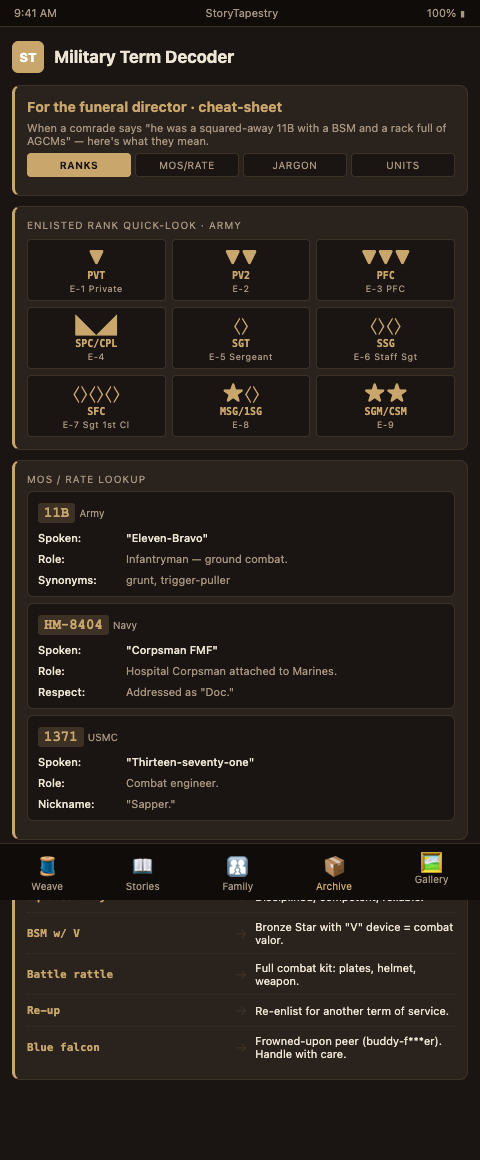
The six categories form the vocabulary weave. Ranks and rating structure run across all branches and appear in every memorial. The Army's official rank page documents the enlisted, warrant officer, and officer hierarchy for the most common branch served, while Military OneSource provides a cross-branch insignia guide that identifies chevrons, bars, and oak leaves that appear on photographs in every memorial packet (Army.mil; Military OneSource). StoryTapestry renders rank correctly with abbreviation, full title, and pay grade attached.
Awards and decorations carry the deepest memorial weight. The Bronze Star, Silver Star, Distinguished Flying Cross, Navy Cross, and Medal of Honor each have specific criteria, issuing authorities, and honor weights. The V device distinguishes awards for valor from awards for meritorious service, and the oak leaf cluster indicates subsequent awards (Wikipedia; DoD Valor). The platform renders each decoration with correct name, abbreviation, date of action where available, and citation text where published.
MOS codes and ratings translate the veteran's occupational specialty into readable career description. An Army 11B becomes "Infantryman"; a Navy HM becomes "Hospital Corpsman"; a Marine 0311 becomes "Rifleman." These translations run on reference tables cross-checked against current veteran resources (Veteran.com). The memorial reads accurately without requiring the grandchild to Google every abbreviation. This terminology-aware rendering directly supports funeral military digital honors practice.
Unit designations follow formal nomenclature with specific spacing and capitalization. The Army writes "3rd Battalion, 187th Infantry Regiment" with comma and numeric ordinals; the Marines write "1st Battalion, 8th Marines" without "Regiment"; the Navy references "USS Enterprise (CVN-65)" with hull number in parentheses. StoryTapestry enforces these conventions so unit names render accurately across memorial text.
Campaign and expedition terminology matters for veteran eras. Vietnam Service Medal, Gulf War Service Medal, Global War on Terrorism Expeditionary Medal, and Iraq Campaign Medal each designate specific operational participation, and campaign stars on service medals mark individual operations within the broader conflict. Getting this right distinguishes the funeral home that understands service from the one that generalizes it, which shapes the veteran grief culture environment that drives family trust.
Common jargon and acronyms fill the last category. NCO, CO, XO, OIC, EOD, SOF, PCS, TDY, and dozens of others appear in veterans' own stories. The platform glosses these inline so family readers get the meaning without the contributor having to explain everything twice. This mirrors how careful vocabulary awareness supports care staff memorial roles in related professional contexts.
Classified-Aware Story Frameworks respect the vocabulary of operational security, recognizing when "Joint Task Force" rather than a specific unit name is the right memorial rendering for contributions that cannot be more specific. Dual-Life Narrative Integration keeps vocabulary consistent across the service and post-service sections of the tapestry so the voice of the memorial remains coherent.
Regional and era-specific vocabulary matters just as much as the headline terminology. A Vietnam-era veteran used terms like "LBJ" for the Long Binh Jail, "in-country" for in-theater service, "DEROS" for the departure date from overseas, and "Uncle Ho" in ways that carry specific cultural weight for that generation. A post-9/11 veteran uses "downrange" for deployed service, "fobbit" for personnel who stayed on forward operating bases, and "rack time" for sleep in ways that date the vocabulary to that era. StoryTapestry's glossary draws from era-specific reference material so the memorial renders vocabulary accurate to the veteran's service window rather than flattening all veterans into uniform language. The grandchildren who inherit the tapestry in 2060 will understand what "DEROS" meant to their Vietnam-veteran grandfather because the glossary preserves the era-specific sense.
Advanced Tactics for Terminology Fluency at Intake
Keep a branch-specific rank chart at the intake station. The Army, Marine Corps, Navy, Air Force, Space Force, and Coast Guard each have distinct rank structures, and the chart lets staff confirm correct abbreviation and full title while the family is present (Army.mil; Military OneSource). Asking "is it Gunnery Sergeant or Gunner's Mate" with the chart visible signals care rather than ignorance.
Photograph and annotate the veteran's rack of medals at intake when the family brings a shadow box. Each ribbon has a known order of precedence, and identifying "Silver Star, Bronze Star with V device, Purple Heart with oak leaf cluster" from the ribbons in the box gives the family an immediate demonstration that their firm understands their husband's service. Wikipedia's decorations reference and the DoD Valor Awards description provide the necessary precedence map (Wikipedia; DoD Valor).
Validate MOS codes before they reach print materials. Typing "68W - Combat Medic" into the memorial program without cross-reference occasionally produces the wrong title when MOS codes changed across eras. The veteran's DD-214 is the primary source; Veteran.com and DoD references are the secondary (Veteran.com).
Confirm unit nomenclature with the DD-214 rather than family spelling. "82nd Airborne" and "Eighty-Second Airborne" are both colloquially correct but the memorial should follow the unit's own formal rendering, which the DD-214 typically provides. Getting the comma placement right in "3rd Battalion, 187th Infantry Regiment" matters to veterans who spent careers with that designation.
Never abbreviate "Noncommissioned Officer" without the period. NCO is standard; N.C.O. is wrong; non-commissioned-officer with hyphens is wrong. The same care applies to "Commanding Officer" as CO, not C.O., and to all standard military abbreviations. Style guides in every branch publication follow this convention.
Flag cultural compound terms. "Gold Star family," "Blue Star family," "Bronze Star recipient," and "Purple Heart recipient" each carry specific community meanings that matter to veteran families. Use the correct term for each context, and never conflate Gold Star (combat loss) with general bereavement.
Respect rating structure differences across branches. The Navy and Coast Guard use "rate" and "rating" for enlisted occupational specialties, not "MOS"; a Navy Boatswain's Mate Second Class is BM2 with rate and rating terminology, while an Army Staff Sergeant is SSG with an MOS designation like 88M (Motor Transport Operator). Conflating these structures signals ignorance even in well-intentioned memorial text. The platform's branch-aware rendering enforces the correct structure for each service so the memorial respects the internal taxonomy of each branch the veteran served in.
Handle retirement ranks with precision. An Army Command Sergeant Major who retired in 2008 continues to hold that rank in veteran context, and the memorial should render the rank with full formality: "CSM, U.S. Army, Retired" in formal text, "Command Sergeant Major Robert Keller, USA Ret." in more conversational memorial prose. Navy flag officers retain "USN (Ret.)" designation; Marine Corps retirees use "USMC (Ret.)"; Air Force and Space Force follow similar conventions. Veterans and their families notice when the memorial uses the correct retirement designation, and the absence of "Ret." or its incorrect placement reads as a cultural miss.
Guard against decoration inflation. Bronze Stars without V device are awarded for meritorious service, which is honorable but distinct from valor-specific awards. Campaign medals are earned for presence in a theater of operations and are not combat decorations in the colloquial sense. Family members sometimes describe a relative's service using inflated decoration language, and the funeral director's job is to honor the actual decorations precisely rather than amplifying them beyond what the DD-214 documents. Veterans and their comrades notice decoration inflation immediately, and the memorial's credibility depends on this precision.
Put Memorial-Grade Military Vocabulary in Your Staff's Hands
Veteran Memorial Programs need staff fluency with military terminology that most funeral training programs do not cover at depth. StoryTapestry embeds rank charts, decoration references, MOS translators, unit nomenclature validators, and inline glossaries directly into memorial workflow so every staff member produces accurate content without needing to memorize the full Armed Forces vocabulary. Schedule time with our Veteran Memorial Programs team to see the terminology tooling in practice, and build memorial materials that speak correctly to every veteran family you serve.
The terminology module also supports ongoing staff development through bite-sized training modules your team can work through during quieter intake windows. Each module covers one terminology domain: Army rank structure, Marine Corps decorations, Navy rating systems, Air Force unit nomenclature, Coast Guard traditions, Space Force conventions, and cross-service joint-command vocabulary. Staff complete the modules at their own pace and the platform tracks which team members have covered which domains so you can route specific veteran intakes to the staff member with matching fluency. Firms that operate with one or two veteran-specialist staff often find that the module system allows them to extend veteran-memorial competence across the broader team, which supports growth without requiring every new hire to have prior military background.
Contact the Veteran Memorial Programs team to schedule a walkthrough that covers both the live memorial workflow and the staff development module library, so your next veteran family sees the result of the full system rather than the platform alone.