5 Ways Funeral Homes Can Honor Military Service in Digital Memorials
The Problem: Veteran Families Expect a Digital Standard Funeral Homes Rarely Meet
A funeral director in a 70-call-volume firm receives a veteran family on a Tuesday. The widow opens the meeting by asking whether the firm can mirror the detail she has seen on the VA Veterans Legacy Memorial for her cousin, and whether photos and stories will appear on the memorial website the way the VVMF Wall of Faces pairs a face with every name (VA; VVMF). The director confirms the service will include folded flag presentation, taps, and the obituary page on the firm's website. The widow leaves unsure whether her husband's digital memorial will meet the standard she has grown up with as a military family.
The gap is structural. The VA maintains nearly 10 million digital memorial pages, the DoD's In Lasting Tribute memorial honors every active-duty service member killed since 1985, and Public Law 106-65 entitles every eligible veteran to military funeral honors, all of which families now take as baseline (DoD; VA NCA). Funeral homes still building static obituary pages are competing against federal memorial infrastructure built to narrative depth.
Funeral directors also carry the logistical weight: burial scheduling at national cemeteries, coordinating Honors details, retrieving DD-214s, and completing VA forms (VA). Adding a digital memorial of matching depth without a platform is a sixth full-time task. Families add photos and biographies to VLM after the funeral when they should have been doing it with funeral home support (VA News).
Solution Framework: Five Ways to Weave Military Honor Into Digital Memorial
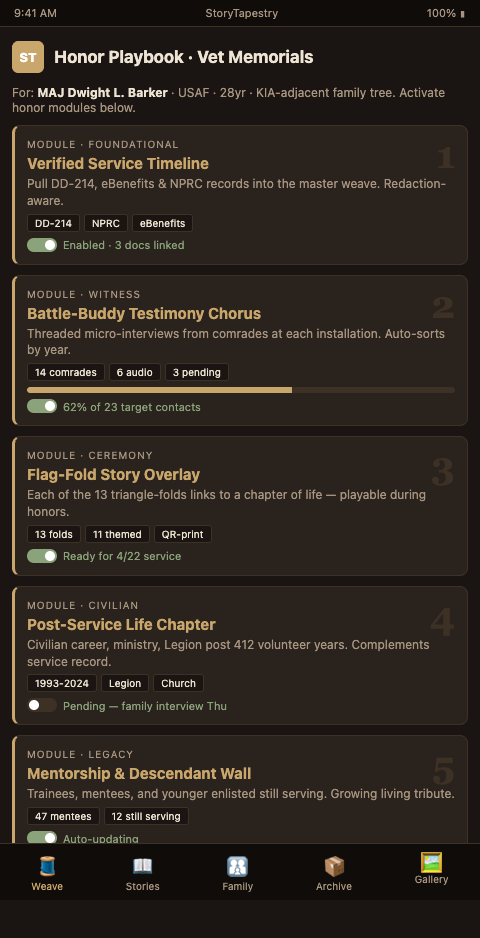
Digital memorial work for veterans is a five-threaded weave, and StoryTapestry gives funeral homes the loom. Each thread connects to a practice the firm already performs in physical service, and the tapestry metaphor makes the connection visible to families who have lived inside military honor culture their whole lives.
First, thread the DD-214 into the timeline spine. The service record holds duty stations, campaigns, awards, and unit designations that populate the memorial with verifiable structure. StoryTapestry pulls those data points into a chronological tapestry that sits alongside the VLM entry rather than duplicating it. Families see the discharge paper they have guarded for decades rendered as narrative scaffolding rather than bureaucratic artifact.
Second, weave Honors detail into the funeral record. Every eligible veteran is entitled to military funeral honors under Public Law 106-65, including flag folding, taps, and rifle volley when available (VA NCA). StoryTapestry captures the honor ceremony as a memorial panel: photos of the flag presentation, the Honors detail identification, the bugler's name, and a note on whether the veteran received taps live or recorded. The family returns to this panel on anniversaries and sees the ceremony recorded with the same dignity the service held.
Third, integrate the VA and DoD digital memorials rather than competing with them. The tapestry links outward to the VLM page and inward from the Wall of Faces or In Lasting Tribute record where applicable (DoD; VVMF). Families who have already contributed to federal memorials find their work referenced and extended rather than duplicated, and the funeral home tapestry becomes the central hub that binds public and private memorial threads.
Fourth, activate the Unit Comrade Outreach Network. The funeral home adds a layer of memorial depth federal platforms cannot provide: first-person contributions from the veterans who served alongside the deceased. StoryTapestry surfaces comrade contacts through unit-history databases and structured outreach templates, so the memorial carries voices VLM cannot host. This work complements VA bereavement services the family may be using in parallel.
Fifth, translate military language for civilian readers. Extended family members reading the memorial may not decode MOS codes, rank insignia, or campaign medals. StoryTapestry provides inline glossing drawn from a comprehensive military terminology guide, so a grandchild seeing "SSG" or "Bronze Star with V device" understands the weight of each mark.
Classified-Aware Story Frameworks and Dual-Life Narrative Integration thread through all five practices, ensuring the memorial honors both the service years and the civilian life that followed. The tapestry reads as one life, not two biographies stitched at the discharge date, which matters for the many veterans whose final years involve both hospice care and ongoing VSO participation that the memorial needs to reflect together.
The five-thread weave also scales by firm size. A single-location funeral home handling twenty veteran services per year can adopt the weave at intake depth that matches a solo funeral director's capacity. A regional group handling four hundred veteran services annually across seven locations can standardize the weave as a templated workflow with Honors detail coordination, VLM linking, and comrade outreach running as background processes between the family meeting and the committal service. The same tapestry architecture supports both, and the firm's brand in the veteran community strengthens either way because families compare notes across funeral homes through VFW posts, American Legion halls, and unit reunion associations where a firm's reputation for handling military honor well travels faster than any marketing.
Advanced Tactics for Funeral Home Digital Memorial Practice
Build the digital memorial workflow into intake rather than bolting it on after the service. When the family arrives with the DD-214, capture the service number, unit designations, and campaign ribbons at the same time you collect burial benefits documentation. This front-loads the tapestry frame and removes the awkward follow-up weeks later when the family is deep in grief and less available.
Pre-stage Honors ceremony capture. Identify the Honors detail coordinator from the local military installation or VSO in advance, confirm photographer coverage at the committal service, and prepare a short memorial panel template the family can fill out with the detail's unit name and bugler attribution. The photo of the folded flag being handed to the surviving spouse becomes one of the most revisited panels in the tapestry.
Cross-reference federal memorial pages for every veteran intake. Search the VLM by name and date of death, check the Wall of Faces for Vietnam-era veterans, and search In Lasting Tribute for post-1985 active-duty loss. Families often do not know a federal memorial page exists for their veteran; the funeral home that finds it and links it into the tapestry earns trust that compounds across referrals.
Train at least one staff member in military funeral protocol and terminology. A director who can explain the difference between a 21-gun salute and the three-volley rifle honor, or between the service star and the campaign star on a ribbon, speaks the family's language from the first meeting. This cultural competence is the competitive differentiator in a region where multiple firms handle veteran volume.
Publish the tapestry at the reception after the service, when the extended family is gathered. A quiet QR code on the memorial card lets cousins and comrades start contributing that same evening, while the memories are active and the connections to the community are strongest.
Coordinate with the committal team at the national cemetery or state veterans cemetery where applicable. Arlington National Cemetery, Riverside National Cemetery, and the 155 VA-managed national cemeteries each have their own committal protocols, Honors coordination, and scheduling windows (VA NCA). A funeral director who knows the specific cemetery's rhythms can pre-stage tapestry panels that reference the exact grave section and committal service details, giving the family a digital memorial that references the physical burial site the way military families expect.
Audit your firm's digital memorial inventory once per quarter. Cross-reference every veteran service from the past ninety days against the tapestry publication status, and identify which memorials could still be enriched with Honors panels, VLM links, or comrade outreach. Many families return to the tapestry months after the service looking for additional threads, and a firm that quietly thickened the memorial on their behalf earns lasting goodwill that converts directly to referrals across VSO networks.
Bring Federal-Grade Digital Honor to Your Firm
Veteran families compare your firm's digital memorial to the VLM, the Wall of Faces, and In Lasting Tribute, whether they say so aloud or not. StoryTapestry gives your funeral home the platform to meet that standard, with Unit Comrade Outreach, Deployment Timeline Reconstruction, Classified-Aware Story Frameworks, and Dual-Life Narrative Integration already engineered. Talk with our Veteran Memorial Programs team about bringing tapestry-grade digital memorials into your next veteran intake, and close the gap between federal memorial infrastructure and private funeral service.
The walkthrough session covers firm-specific setup: branding the tapestry with your funeral home's visual identity, configuring the VLM cross-reference workflow for your staff's familiarity with VA burial benefits, and training the intake team on the five-thread weave so the tapestry becomes a standard offering rather than a custom build per veteran. We also discuss pricing models that fit funeral home economics, from per-service bundling to annual platform access depending on your veteran service volume. Firms serving communities near major military installations like Camp Lejeune, Fort Bragg, Fort Carson, Joint Base Lewis-McChord, or the naval bases in Hampton Roads typically see the strongest adoption because families in those regions arrive at the funeral home with the highest expectations for military honor depth.
Firms serving rural communities with scattered veteran populations often adopt the platform to differentiate themselves as the veteran-focused option in their county, drawing referrals from VSO posts, VA Vet Centers, and hospice partners looking for a funeral home that handles veteran memorials with federal-grade care. For firms coordinating veteran services alongside hospice funeral coordination workflows, the same platform consolidates end-of-life documentation into a single memorial artifact.