What Memory Care Staff Can Contribute to a Meaningful Memorial
The Problem with Excluding Frontline Staff from Memorials
Certified nursing assistants and direct care workers spend more time with memory care residents than any family member does. According to Innovation in Aging research on CNA perspectives on dementia, CNAs spend roughly 4.1 hours per day interacting with residents, forming deep observation relationships that family members, visiting at most weekly, cannot replicate. Health Management Publications on CNA perspectives on dementia residents documents how CNAs form lasting relationships with patients and families. Yet these relationships rarely reach the memorial service.
The workforce pressures compound this. PHI's Direct Care Workers Key Facts 2025 reports the direct care workforce grew to 5.4 million in 2024, but turnover remains crushing. PMC research on nursing home staff turnover and quality documents mean annual turnover for total nursing staff of roughly 128% and for CNAs roughly 100%. That means a resident's observations may be scattered across multiple departed staff members, and funeral homes that wait until the death to ask find key contributors already gone. The stories walk out with every shift change unless they are captured deliberately.
Weaving Staff Contributions Into Memorial Tapestries
The framework StoryTapestry applies is continuous staff contribution during the resident's life, rather than retrospective interview after death. When a memory care facility partners with a funeral home, staff contributors are onboarded via facility SSO and receive prompts tuned to their role. A day-shift CNA sees different prompts than a night-shift CNA. An activities director sees different prompts than a chaplain. Each role holds different threads, and the tapestry metaphor works literally here: each staff contributor is a spool with its own color, and the memorial weaves them into one coherent pattern.
PMC research on consistent assignment in dementia care shows that consistent assignment improves care outcomes through relationship-building over time. The same research justifies the memorial framework: staff who have consistent assignments with a resident accumulate observations that nobody else holds. Capturing them benefits the memorial and also dignifies the staff member's role, which matters for retention in a workforce under extreme turnover pressure.
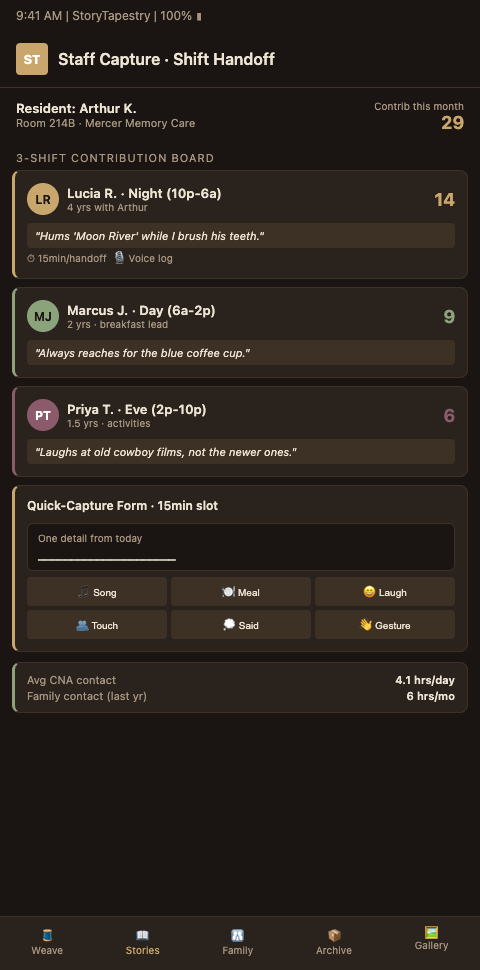
Cognitive-Stage Sensitive Prompts matter more for staff than for family because staff witness residents at stages family members often avoid. An aide assisting with meals sees preferences, reactions, and routines that the adult daughter visiting once a week rarely observes. Staff prompts focus on sensory detail, routine preferences, and small observations rather than biographical arcs. "What did she reach for at breakfast?" "What song did she hum during her bath?" "Who did she light up for when they visited?" These produce threads families could never supply. This approach complements caregiver perspectives and digital story collection workflows in assisted living environments where consistent assignment makes staff contribution especially rich.
Caregiver Fragment Collection operationalizes the philosophy. Staff contribute 90-second voice memos at shift handoff, short text threads during breaks, or photo uploads when residents are engaged in meaningful activity. Contributions are logged by staff member and stored in the resident's tapestry. When the resident dies, the memorial already contains dozens of staff threads. The family meets a tapestry that surprises them with specificity and is spared the burden of asking exhausted staff to reconstruct years of observation on short notice.
Chaplains and spiritual care staff deserve a distinct contributor lane. Advent Christian Village's discussion of spiritual needs in long term care notes chaplains contribute meaningfully to end-of-life and funeral planning. A chaplain who sat with a resident in their final weeks holds observations about comfort, fear, meaning, and response that neither CNAs nor family members see. Their threads deserve attribution as specifically as any other contributor, because institutional observers consistently produce memorial material that individual voices cannot.
Activity staff and life enrichment coordinators form a third distinct lane that facilities often underutilize. The person who runs Tuesday music hour or Thursday garden club observes residents in moments of engagement that neither CNAs nor chaplains witness. Their threads capture the resident as an active participant in community life rather than a patient receiving care, which balances the tapestry and prevents the memorial from collapsing entirely into care-focused observations. StoryTapestry routes prompts to activity staff around engagement moments: which songs triggered singing, which plants the resident tended, which fellow residents they gravitated toward. These threads often become the most family-shared portions of the memorial because they show the person still choosing, engaging, and relating even in late-stage care.
Advanced Tactics for Staff Contribution at Scale
The most common facility mistake is making staff contribution voluntary with no operational support. Staff are already overworked, and adding an uncompensated task in the margins of their shifts fails immediately. Sustainable practice carves out 10-15 minutes of shift time for contribution, treats the work as a professional development activity, and recognizes contributors in staff communications. Facilities that treat contribution as professional development see staff engagement rise and turnover effects soften — an indirect benefit for retention economics.
Edge cases worth scripting. Staff who contributed to a resident's tapestry before leaving employment still deserve acknowledgment when the memorial goes live, because their threads remain attributed. Staff who had difficult relationships with a resident or family need a routing path for their fragments, because not every observation is appropriate for the public tapestry. New staff hired after a resident's death should not be asked to contribute reconstructions; encourage them instead to contribute to current residents' tapestries where their observations are first-person.
Training investment matters. A 30-minute onboarding module covering what story fragments are, how to attribute them, and how privacy routing works dramatically improves thread quality. Refresh quarterly. Recognize staff who produce the most useful threads in shift meetings, which builds the cultural norm that memorial contribution is part of care, not an extra task.
Measure program health with three signals: percentage of residents with at least three staff contributions during active residency, average staff contribution count per memorial, and family ratings of "learned something we didn't know" in memorial feedback. Facilities with rising numbers on all three are operating the model well. StoryTapestry tracks these signals natively and surfaces trend reports for facility administrators.
Staff retention economics provide an underappreciated argument for investing in contribution programs. CNAs who describe their work as meaningful through concrete mechanisms like memorial contribution show higher retention than those whose relationship with residents produces no visible acknowledgment. A facility with 30 CNAs that reduces annual turnover from 100% to 85% through contribution programs and related recognition practices saves substantial recruiting and training cost while simultaneously producing richer memorial material for families. The financial case for the contribution program does not have to rely on memorial outcomes alone; staff retention improvement in a turnover-plagued industry is a business case facility administrators can defend to their own leadership without extended narrative.
Culture change is slower than operational change. A facility can install StoryTapestry and launch the contribution workflow in six weeks, but changing the underlying staff culture so contribution feels like professional identity rather than extra work takes 18 to 24 months. The leading indicator is whether CNAs spontaneously reference their tapestry contributions in shift conversations and team meetings. When that happens, the culture has shifted. Until it happens, directors and facility leadership have to keep modeling the behavior explicitly — acknowledging specific contributions by name in staff meetings, sharing family feedback that mentions specific staff threads, and treating the contribution work as clinically meaningful rather than an HR decoration. The same parallel holds with what post-service organizations contribute in veteran memorial contexts, where VSO post commanders and chapter officers only contribute consistently after the funeral home treats their observations as memorial work rather than administrative courtesy.
Invite Memory Care Staff Into Memorial Tapestries
Memory Care Funeral Homes joining the StoryTapestry waitlist get early access to the staff contributor onboarding workflow, role-specific prompt libraries, and shift-handoff integration designed for assisted living and memory care facilities. If your firm partners with facilities whose CNAs, activity staff, and chaplains hold irreplaceable observations that never reach families, this workflow transforms those relationships into memorial threads with professional dignity. Reserve a pilot slot to help shape the SSO integration, training modules, and staff recognition practices that sustain contribution over time.
Pilot partners work directly with StoryTapestry's product team to integrate the contributor workflow with their partner facilities' existing SSO, to train CNAs and activity staff on the contribution interface, and to establish the recognition practices that sustain staff engagement. Your firm's first three memorials with staff contribution receive concierge assembly support, and your feedback shapes the production release of the training modules, the staff recognition templates, and the retention-focused reporting we publish for facility administrators. Partnerships with memory care facilities increasingly depend on whether the funeral home brings capabilities that help the facility itself, not just the families. StoryTapestry's staff contribution workflow is explicitly designed to produce that dual benefit. Reserve a pilot slot now to build the infrastructure before your local facility partners begin asking every funeral home in the market whether they can support staff contribution programs, because that question is coming faster than most firms expect.