Best Practices for Digital Story Collection in Assisted Living Settings
The Assisted Living Digital Collection Gap
Assisted living communities have added tablets to activity programs for more than a decade, but digital story collection as a structured program remains rare outside specialized dementia research settings. A study of older adults' perceptions of tablet use found consistent barriers: unfamiliar interfaces, inadequate staff training, and anxiety about making mistakes during recording (Frontiers - Tablet Barriers Focus Group). When life enrichment staff try to collect stories without a defined workflow, recordings accumulate on random devices, get lost in shift rotations, and become inaccessible when families actually need them at the end of a resident's life.
The consequence for bereavement is severe. A pilot study of digital life storybooks in care homes found that five of six residents showed improved quality-of-life measures when their stories were systematically captured, yet most facilities still rely on paper life story books that are photocopied, mislabeled, or lost during room transitions (PMC - Digital Life Storybooks Care Homes). Funeral homes partnering with assisted living communities frequently encounter this gap: the facility collected something during the resident's healthy years, but nobody can find it when the family arrives to plan services. The digital infrastructure that should have prevented this failure mode is exactly what was never built.
Weaving Assisted Living Stories Into a Persistent Tapestry
StoryTapestry is designed for the realities of assisted living story collection: short sessions, variable cognitive days, shift-based staff, and the eventual handoff to funeral home partners when a resident passes. The tapestry metaphor works because a resident's life in an assisted living community is never captured in one sitting. Stories come in 8-minute fragments between physical therapy and dinner, often triggered by a song at Tuesday choir or a scent from the kitchen on Thursday. The platform accumulates these fragments across months or years and weaves them into a persistent narrative that the facility owns and families access.
Systematic reviews of digital storytelling interventions show benefits for mood and memory among older adults with cognitive impairment (PMC - Digital Storytelling Scoping Review). Tablets specifically support memory work when the interface is designed for elders with dementia (PMC - Tablet Use Older Adults Systematic Review). StoryTapestry's collection interface removes the failure points that sabotage ad-hoc tablet use. Large-touch recording buttons eliminate menu navigation that frustrates older staff and residents alike. Auto-save every 15 seconds prevents lost recordings when a resident walks away mid-story, as moderate-stage residents often do. Shift-based staff logins mean the day-shift aide who caught a precious story at breakfast does not need to track down the evening activities coordinator to preserve it and can log the thread in under a minute.
The Cognitive-Stage Sensitive Prompts feature adapts to where a resident is on the dementia progression. Early-stage residents receive open-ended questions ("Tell me about your first job"). Moderate-stage residents receive yes-no prompts with photo anchors ("Is this where you grew up?"). Late-stage residents receive sensory prompts that invite non-verbal response (holding a worn baseball glove, playing a hymn from their denomination). JMIR Aging reviewed mobile apps for cognitive impairment and found that cognitive-stage adaptation separates successful digital storytelling tools from generic recording apps that fail in late-stage use (JMIR Aging - Digital Storytelling Cognitive Impairment).
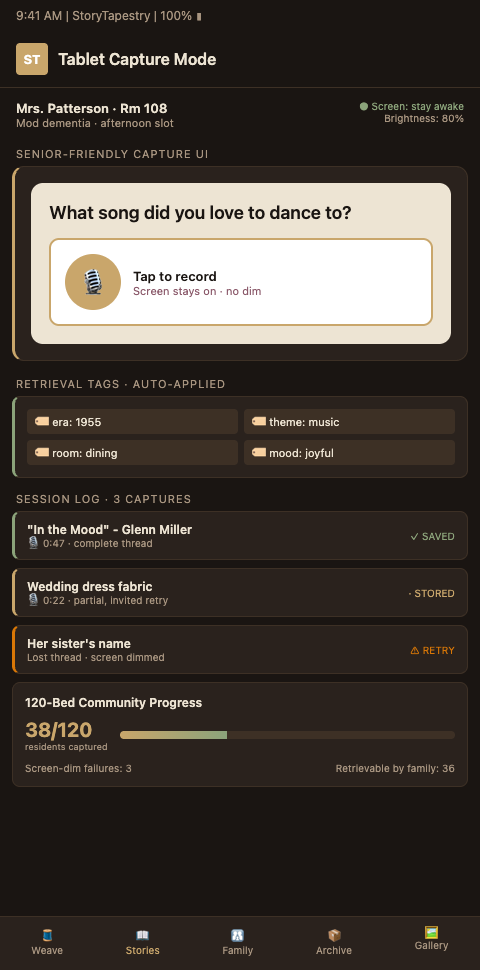
StoryCorps launched a Memory Loss Initiative in 2006 specifically for adults with cognitive impairment, and the methodology they developed informs digital collection protocols today (StoryCorps - Memory Loss Initiative). The key principles are short sessions (under 30 minutes), low-stakes framing ("Tell me whatever comes to mind"), and immediate preservation. StoryTapestry operationalizes these principles across 120-bed communities through narrative assembly platforms that keep fragments findable by resident, contributor, and theme.
Family involvement during collection sessions changes the material produced. A resident recording a story about her 1963 wedding with her daughter present often includes different details than the same resident recording alone. Both versions are valuable. StoryTapestry supports both session modes: solo staff-facilitated and joint family-staff. The joint mode often surfaces corroborating details and anchors memories in the family's shared history. The solo mode often surfaces material the family never heard, because the resident is not performing to family expectations. Facilities that run both session types capture a more complete archive than facilities that default to either alone. The sequencing matters: solo first, joint second, because the solo material can surprise the family in ways that deepen the joint session afterward.
Advanced Tactics for Assisted Living Digital Collection
Five tactics separate facilities that consistently capture story material from those that abandon programs within a quarter. First, assign the tablet to a location rather than a person. When the recording device lives permanently on a charging dock in the garden room, any staff member can initiate a session when a resident spontaneously begins talking. When the device belongs to the life enrichment director, recording only happens during her shifts, and the best stories often surface during dinner conversation with aides who have no recording infrastructure. Location-based assignment also makes orientation simpler for new staff, who can learn one physical context rather than finding a mobile device that moves between offices.
Second, integrate collection into existing activities rather than scheduling separate interview sessions. A reminiscence group already meeting on Wednesday afternoons becomes a three-person recording session with two minutes of setup. A solo resident who sings along to hymns during Tuesday chapel already has music-triggered memories surfacing; pair a staff member with the tablet and capture them in real time rather than trying to reproduce the moment later. The goal is to remove the ceremonial weight of "now we are doing a story interview" that often shuts down participation and to let the storytelling happen inside the context where it would occur anyway.
Third, establish the funeral home handoff protocol in writing before a resident declines. Multi-site story collection requires that the funeral home partner can access the resident's tapestry within four hours of the facility's bereavement notification. StoryTapestry provides role-based access where facility staff can collect indefinitely but funeral home partners gain access only at the point of need, with family consent. This is the same structure that hospital digital memorials use for perinatal bereavement coordination, and it translates directly to assisted living.
Fourth, protect against the abandonment pattern that kills most digital collection programs in the first year. Programs launched with enthusiasm often decay when the champion leaves, the tablet breaks, or the initial training cohort rotates out. Sustainable programs name a program owner with explicit time allocated in their job description, maintain two backup champions in case the primary leaves, replace the tablet on a scheduled three-year cycle, and run a monthly collection review that identifies residents with stalled tapestries for proactive re-engagement. Without these structural commitments, the program will drift within 18 months regardless of how strong the launch was.
Fifth, design collection rhythms that align with the facility's existing cycles rather than creating new ones. Care-plan meetings, family visit days, birthday celebrations, and holiday programming all generate material if a staff member has the tablet and knows to record. Collection that lives inside existing rhythms survives turnover; collection that requires new meetings and new calendar slots is the first thing cut when the facility gets busy. StoryTapestry's tablet interface lets the life enrichment director append collection to a Tuesday choir session without needing a separate workflow, which is why programs anchored to existing rhythms last longer.
Build an Assisted Living Collection Partnership With Your Funeral Home
Assisted living communities that partner with a single funeral home for digital story collection infrastructure report faster arrangement conferences, more complete memorials, and higher family satisfaction scores. The facility builds a collection that serves residents while living and delivers complete tapestries to families at the end. StoryTapestry provides the tablet workflows, cognitive-stage prompts, and handoff protocols that make this partnership operational rather than aspirational. Reach out to StoryTapestry to learn how memory care funeral homes are equipping their assisted living partners with digital story collection infrastructure that produces complete life tapestries when families need them most.
Early pilot partners receive direct product team support to integrate the tablet workflow with their partner assisted living communities, train facility staff on cognitive-stage collection practice, and establish the handoff protocols that bridge the facility's living collection to the funeral home's memorial assembly. Your first three residents transitioned through the pilot workflow receive concierge handoff support, which stress-tests the protocol on real cases. As a pilot partner, your firm contributes to the production release of the tablet interface, the facility champion playbook, and the handoff documentation we publish for the industry. Memory care facilities increasingly evaluate funeral home partners on whether they bring collection infrastructure that serves the facility's living residents, not just memorial services at the end. Reach out to StoryTapestry to position your firm as the funeral home that offers this full-journey collection partnership before your local competitors begin moving in the same direction.