Essential Tools for Assembling Fragmented Life Narratives
The Problem with Generic Life Story Software
Most life story software assumes a coherent primary contributor who can narrate a linear biography. Funeral homes serving dementia families need the opposite: tools that accept short fragments from many contributors, preserve contradictions, and organize material non-linearly. The gap is enormous. According to Dementia Action Alliance's review of dementia apps, only 3% of 297 dementia apps screened met detailed evaluation standards. The ratio for memorial tools specifically is similar — many platforms exist, few are built for fragmented-input workflows.
The tool evaluation problem has real consequences for families. A director who adopts a generic life story tool finds dementia families struggling with the bio field, abandoning contribution forms partway, and later feeling the memorial fell short. PMC's evaluation of digital life storybooks for dementia demonstrates that purpose-built tools produce richer engagement than general memorial platforms, but the market is flooded with general-purpose tools marketing themselves as dementia-friendly without the underlying design work.
Weaving a Toolchain That Handles Fragmentation
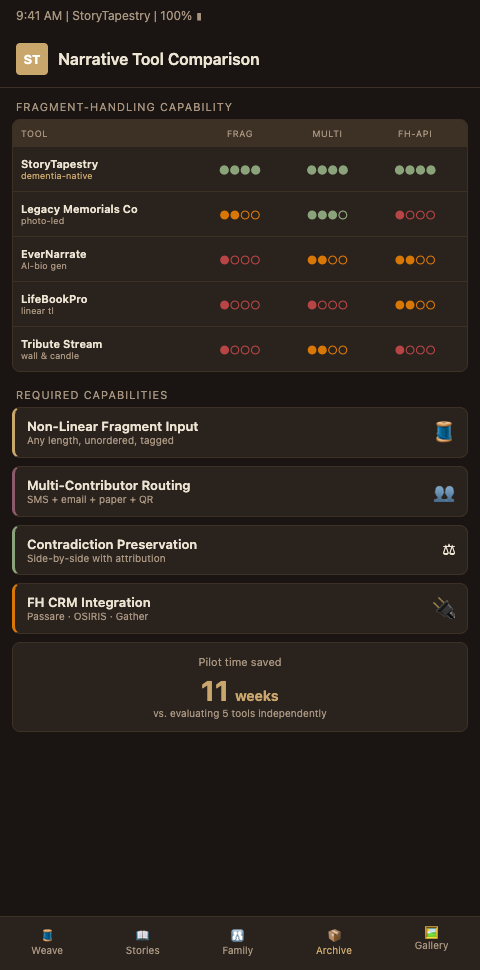
The framework for evaluating tools starts with one question: does the tool privilege fragments or coherent narratives? Fragment-first tools accept short, attributed contributions and weave them into browsable tapestries without forcing synthesis. Narrative-first tools require the family or director to produce a unified story. For dementia memorials, fragment-first tools match how the material actually exists. StoryTapestry sits in this category by design, but funeral homes often use it alongside other specialized tools for specific stages.
Several adjacent tools pair well with fragment-first memorial assembly. Remento's Speech-to-Story technology turns recordings into stories and is useful for capturing voice from contributors who prefer speaking to typing. LifeTales' memoir app accepts video, audio, pictures, and text, making it useful as a family archive feeder for the tapestry. Tell Mel's review of family story collection services surveys the broader landscape for funeral homes evaluating options. Each has strengths, and smart directors use them in combination rather than expecting any one tool to handle the full workflow.
Emerging AI-enhanced tools deserve careful evaluation. JMIR Aging research on AI-enhanced life story structuring shows these systems can generate clinically meaningful timelines from unstructured input, which is powerful for dementia memorials specifically. The risk is AI tools that synthesize confidently across contradictory fragments, producing a false coherence that misrepresents the contributors. Evaluate AI features with a bias toward transparency: does the tool show which contributor supplied which fragment, or does it merge voices into a single generated narrative?
The tapestry metaphor supplies a useful evaluation lens. A tool is tapestry-capable if it preserves individual threads with attribution, shows the weaving pattern to users, and allows non-linear browsing. A tool is narrative-capable but not tapestry-capable if it demands single-voice synthesis before publication. Both have uses, but funeral homes serving dementia families need tapestry-capable tools as their backbone. This framework connects to digital tribute creation guidance and to photo archive integration practices that round out the toolchain.
Caregiver Fragment Collection is where StoryTapestry differentiates most from generic tools. Contributor routing by role, cognitive-stage sensitive prompts, and contradictory memory reconciliation are baked in rather than bolted on. Directors evaluating tools should run a real test: submit three contradictory fragments about the same person and see how the tool handles them. Tools that force reconciliation into one version fail the test. Tools that preserve both with attribution pass it.
For funeral homes serving multilingual or diaspora families, evaluate language capability carefully. Bilingual tapestry design is non-trivial, and tools that claim multilingual support often only translate UI, not contributor prompts and thread metadata. Test with a real bilingual pilot rather than trusting marketing copy.
Security and privacy posture deserves specific scrutiny when evaluating memorial tools for dementia families. The threads a tapestry holds often include medical context, family conflicts, and hospice observations that neither the family nor the contributors want leaking. Evaluate tools for encryption at rest, permission granularity (can a specific thread be limited to immediate family while the rest of the tapestry is public?), audit logs (who viewed what, when), and data portability at contract termination. Tools built for general life-story publishing frequently fail on permission granularity; tools built for bereavement often fail on portability. StoryTapestry was designed around dementia family realities, which means permission granularity and portability are core features rather than add-ons, but directors still need to test each capability against their local regulatory environment and the specific sensitivities of their partner facilities.
Advanced Tactics for Toolchain Integration
The most common mistake is tool consolidation fever. Directors often want one tool that does everything. The practical reality is that dementia memorial assembly benefits from a small stack: one fragment-first memorial platform (like StoryTapestry), one voice-capture tool for contributors who prefer speaking, one photo archive integration for existing family image libraries, and one AI-assisted timeline sketching tool for reviewing fragment coverage. Each handles its stage well and exports to the others. The coordination overhead of three or four specialized tools is lower than the opportunity cost of forcing all work through a single generalist platform that handles each stage adequately but none of them well.
Edge cases worth scripting in tool evaluation. Tools that require email registration shut out elderly contributors who don't check email. Tools that require app downloads shut out contributors in low-bandwidth areas. Tools with complex onboarding shut out contributors in acute grief. Tools that require desktop browsers exclude contributors who only use phones. Evaluate tools for contribution friction, not just feature richness. A tool with fewer features that contributors actually use beats a feature-rich tool they abandon at signup.
Scaling a toolchain across a funeral home network requires documentation. Directors rotate, and a toolchain without documented workflows becomes tribal knowledge that leaves when a senior director retires. Publish a one-page director guide per memorial type that lists the stack, the prompt libraries, and the contributor outreach templates. Update it quarterly as tools evolve. A funeral home with 10 directors across three locations benefits enormously from the 40 minutes per quarter required to keep the guide current.
Measure toolchain health with three signals: mean contributor completion rate per memorial, average time directors spend in tool context-switching, and family ratings of memorial coherence despite fragmentation. Firms with rising completion rates and falling context-switching time have found the right stack.
Total cost of ownership is usually underestimated during evaluation. The license fee is typically the visible 30-40% of true cost; the invisible 60-70% is director training, integration setup, prompt library development, contributor onboarding, and the ongoing maintenance of workflows as tools evolve. Firms that evaluate tools on license fee alone adopt cheap tools that become expensive to operate. Firms that model the full three-year ownership cost, including training and integration, make better decisions and rarely regret paying more for a tool that reduces operational friction. A shared spreadsheet showing license fees, estimated implementation effort, annual training hours, and integration maintenance hours produces the honest comparison that marketing materials cannot.
Vendor stability matters especially for memorial tools. A tapestry assembled today may need to remain accessible for decades as families revisit it on anniversaries. Tools built on fragile financing or acquired by consolidators that pivot their product strategy leave families stranded. Evaluate vendors on their runway, their explicit commitment to long-term data preservation, and their contractual obligations if they shut down. This is not paranoia; the memorial tool category has seen several high-profile shutdowns in the past five years that stranded bereaved families with inaccessible tapestries. Ask every vendor in evaluation for their shutdown plan in writing; the ones that cannot produce a coherent answer are the ones to avoid. Firms serving multilingual households should also scrutinize bilingual tapestry design capabilities during vendor selection, because diaspora families will be among the first to experience the cost of a vendor that cannot sustain language infrastructure beyond the sales pitch.
Start Evaluating Tools for Fragmented Dementia Memorials
Memory Care Funeral Homes joining the StoryTapestry waitlist get early access to the fragment-first memorial platform and the toolchain integration guides covering voice capture, photo archive ingestion, and AI-assisted timeline review. If your firm has piloted generic life story software and watched dementia families struggle with coherent-narrative assumptions, this workflow gives your directors tapestry-capable infrastructure that accepts fragmented input natively. Reserve a pilot slot to help shape the integration spec with adjacent tools and the director documentation standards for your network.
Pilot partners receive direct access to the StoryTapestry product roadmap, concierge integration support for the adjacent tools your firm already uses, and supervised evaluation assistance to help your directors distinguish fragment-first from narrative-first capabilities in the broader market. Your feedback shapes the production release of the integration spec, the TCO evaluation templates we publish for the industry, and the vendor stability documentation that helps funeral homes protect their families from shutdown risk. As an early partner, your firm builds operational fluency with fragment-first memorial assembly before the market matures, which means your directors are ready when the larger industry catches up to the capabilities your partner facilities will begin demanding. Reserve your pilot slot to move your firm from the generic life story software that frustrates dementia families toward the tapestry-capable infrastructure your market will soon expect as baseline.