Integrating Photo Archives from Multiple Caregivers into One Timeline
The Photo Archive Inheritance Problem
When a parent with late-stage Alzheimer's passes, their adult children typically inherit four to six distinct photo sources: childhood albums from the deceased's home, sibling collections from family events, smartphone pictures from the primary caregiver's daily visits, and facility-generated photos from life enrichment staff. Each source carries different metadata standards, different time ranges, and different people who can identify the subjects. A 2024 consumer review of photo management workflows found that families attempting memorial photo assembly typically abandon the effort within 72 hours once they confront the volume (The Photo Managers - 7 Photo Legacy Apps).
The funeral home receiving these archives faces a compounding issue: the person who could explain who is in the 1967 wedding photo is gone, and the caregivers who could identify the 2021 birthday shot were agency staff who have since rotated to different facilities. Families arrive at arrangement conferences with digital folders named "Mom iPhone," "Dad scanned," and "memory care," expecting the funeral director to produce a coherent slideshow by Thursday. Directors working with dementia and Alzheimer's care partners report that photo integration consumes more preparation time than any other memorial element, and the result often disappoints families who remember their loved one as a continuous person rather than four disconnected eras.
Weaving Caregiver Photo Threads Into One Tapestry
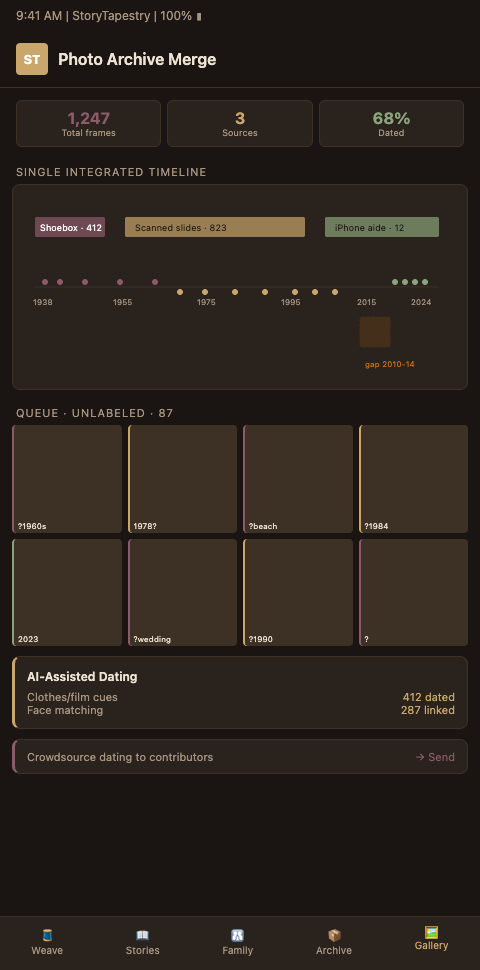
StoryTapestry treats each caregiver's photo collection as a narrative thread rather than a file dump. Instead of asking families to merge everything into a single folder, the platform accepts separate uploads from each contributor and preserves the source attribution through the final memorial display. The daughter's shoeboxes become one thread, the brother's slides another, the memory care aide's phone pictures a third. The tapestry metaphor matters here because no single caregiver saw the whole life, and pretending otherwise produces a flattened, generic tribute.
The foundation is chronomatic sorting, which combines chronological ordering with thematic grouping (OrganizingPhotos.net - Chronomatic Sorting). StoryTapestry applies both dimensions automatically: photos with embedded EXIF dates land on the timeline by year, while AI-assisted scene detection groups photos by context (holidays, grandchildren visits, facility activities) within each time band. For scanned photographs missing metadata, contributors can assign approximate decades through a dropdown rather than exact dates, which keeps the integration moving even when no one remembers whether a picture is from 1978 or 1981.
Metadata tagging is the backbone of multi-source assembly. Research on digital family archives shows that keyword tagging enables timeline assembly across collections that originated on different devices (Ancestry Seeking - Metadata to Organize Photos). When the brother tags "Dad at Cape Cod" on a 1992 slide and the day-shift aide tags "fishing trip memory" on a 2023 photo of the patient smiling at a fish poster, the system surfaces them together as a fishing-life motif for the memorial. This is the kind of pattern recognition that exhausted families cannot perform in a 48-hour arrangement window.
The 3-2-1 preservation rule (three copies, two media types, one off-site) becomes automatic within StoryTapestry (Family Tree Magazine - Organizing Digital Genealogy Files). Families receive their merged archive in addition to the memorial display, so the funeral service also delivers a preservation outcome. For memory care partners, this extends the funeral home's value proposition beyond the service itself. The concept of pre-diagnosis preservation pairs naturally with caregiver photo integration, because the healthy-era photos anchor the timeline that later-stage photos would otherwise orphan. Guides on family photo timeline construction confirm that a well-anchored chronology survives even when some eras are thinly documented (Smooth Photo Scanning - Family Timeline Genealogy).
De-duplication logic prevents the family from drowning in redundant images. When three siblings all upload the same 1989 Christmas photo from their respective collections, StoryTapestry's fingerprinting detects the duplicate, keeps the highest-resolution version, and preserves each sibling's attribution as a "shared memory" tag. A 1,500-photo upload often de-duplicates to 900 unique images, which reduces the family's review burden by 40% while preserving the attribution data that signals which photos were widely shared versus privately held. Facility staff photos rarely duplicate family photos, so the technique disproportionately compresses the family side of the archive without losing the unique material that staff contributors bring.
Advanced Multi-Caregiver Integration Tactics
For funeral homes partnering with dementia and Alzheimer's care facilities at scale, five advanced tactics separate an adequate photo memorial from one that families describe as restorative. First, assign contributor roles explicitly rather than improvising permissions. A professional multi-generational archive service distinguishes primary caregivers (timeline owners), secondary caregivers (fact-checkers), and peripheral contributors (photo suppliers) (EverPresent - Simplify Genealogy Photo Organization). StoryTapestry mirrors this structure: the primary family contact confirms identifications and approves placement, while facility staff simply upload without gatekeeping anyone else's contributions.
Second, run identification sessions with visual memory elicitation techniques for adult children who were not the primary caregiver. A 55-year-old daughter who lived out of state may not recognize the facility friends in her mother's last-year photos. The brother who coordinated medical appointments may not know the names of grandchildren in a 2019 birthday shoot. Surface unidentified photos in short 15-photo batches during arrangement conferences rather than asking families to wade through thousands of images alone. Standard DAM workflows recommend this batched review approach for genealogy research (Family Tree Magazine - Easy Digital Photo Workflows). A 15-photo batch typically takes the family 12-15 minutes to identify, which is the sustainable cadence for a 90-minute arrangement conference that also includes service logistics and other intake work.
Third, add video testimonial integration at timeline anchor points. When the brother uploads a 90-second clip narrating the 1992 Cape Cod slides, every photo in that batch inherits the narration as context. The memory care aide's 30-second video describing the fishing poster moment transforms a pixelated phone picture into the emotional core of the memorial. Contradictory Memory Reconciliation features flag when two contributors' narrations disagree about who, where, or when, which the funeral director resolves before the service. The resolution process often turns into its own narrative thread in the final memorial, with the director capturing the shape of the disagreement ("her son recalls the 1985 trip as Cape Cod; her daughter recalls Martha's Vineyard") as part of the honest record.
Fourth, build a physical scanning station into the funeral home's arrangement conference space. A flatbed scanner with automatic document feed, staffed during arrangement appointments, lets families bring shoeboxes of unscanned photos and leave 90 minutes later with a digital archive. Without the scanning station, families often promise to "send photos later" and never do, which produces tapestries missing the pre-digital eras entirely. The scanner cost is modest compared to the contribution to tapestry completeness, and memory care facility administrators frequently cite the scanning capability as a differentiator when recommending funeral homes to families newly entering arrangement conversations.
Fifth, establish consent protocols for photos containing living people who did not authorize use in a public memorial. A 1972 family reunion photo may include cousins, coworkers, and former neighbors who have no opinion about appearing in a memorial tapestry and whose objection could produce awkwardness if the tribute is widely shared. StoryTapestry's privacy workflow lets families tag photos as "immediate family only" for distribution without removing them from the archive entirely. The director should walk through this decision explicitly with the family at intake rather than leaving it to discover after publication.
Offer Integrated Photo Assembly as a Dementia Care Partner Deliverable
Memory care funeral homes that position integrated caregiver photo assembly as a partnership deliverable shift the conversation with facility administrators from pricing to outcomes. When a skilled nursing director can tell families that their funeral partner will pull together the daily-visit photos alongside the family archives, the facility's bereavement program gains a concrete value proposition. StoryTapestry provides the infrastructure your team needs to deliver that outcome within a 48-hour arrangement window without heroic effort. Schedule a walkthrough with StoryTapestry to see how your funeral home can integrate caregiver photo archives into complete life tapestries for the families your memory care partners serve.
Pilot funeral homes working with StoryTapestry receive direct product team support for the scanning station setup, the chronomatic sorting tuning for their local demographic patterns, and the facility integration protocols that let memory care staff upload directly without family coordination. Your first three memorials with multi-caregiver photo assembly receive concierge support during the 90-day pilot window, which means the technique is validated on real cases before your directors operate it independently. As a pilot partner, your firm's feedback shapes the production release of the de-duplication logic, the consent protocol templates, and the scanning workflow documentation we publish for the broader industry. Partnership conversations with new memory care facilities become substantially easier when you can show a completed tapestry from an earlier pilot rather than describe capabilities in the abstract.
Schedule a walkthrough with StoryTapestry to begin your pilot and establish photo integration as a core memory care partnership deliverable before your competitors in the local market do.