How to Use Visual Prompts to Unlock Caregiver Recollections
The Verbal Interview Limitation With Dementia Caregivers
Dementia caregivers frequently cannot produce coherent verbal narratives about the person they cared for, not because memories are absent but because grief, exhaustion, and the nature of the caregiving relationship leave verbal retrieval blocked. The Alzheimer's Society's dementia experience toolkit specifically recommends photo elicitation interviews to enable meaningful involvement from those with memory difficulties and those who care for them (Alzheimer's Society - Photo Elicitation Interviews). Research on sensory cueing in Alzheimer's disease demonstrates that pictures retrieve more autobiographical memories than most other cueing modalities, including odors (PubMed - Sensory Cueing Autobiographical AD).
Funeral directors partnering with memory care facilities frequently encounter the verbal retrieval block during arrangement conferences. The primary caregiver daughter, asked to "tell me about your mother," produces two minutes of generic statements and then stops. The out-of-state son, asked the same question, reaches for phrases he has heard at other funerals. Neither is failing to care; both are experiencing the well-documented retrieval limitation that pure verbal prompting produces in grieving subjects. Visual methods research confirms that images support communication with cognitively impaired subjects and their caregivers alike, enabling engagement that verbal methods cannot achieve (PMC - Visual Methods Cognitive Impairment).
Weaving Visual Prompts Into the Elicitation Tapestry
StoryTapestry's visual prompt workflow is designed around the research finding that photo-elicitation interviews capture imagery and emotional memory content that verbal interviews miss (SAGE - Photo-Elicitation Clinical Research). The tapestry metaphor is generative here: visual prompts do not just retrieve existing verbal threads, they surface entirely new fibers (emotional texture, embodied memory, relational context) that become narrative threads the funeral director weaves into the final memorial. Nature photography has been specifically documented to anchor lives within relationships for dementia patients and their caregivers (PMC - Nature Photography Memory Loss).
The intake workflow sequences visual prompts purposefully. Early in the session, the funeral director presents three or four photos from different life eras and invites open response. The primary caregiver chooses which photo to start with, signaling which era feels most accessible. Mid-session, after the caregiver has warmed up, the director introduces photos the caregiver has not seen before (images contributed by other family members, facility staff, or extended contacts) to elicit material beyond the caregiver's direct memory. Late-session, the director shows photos that deliberately span multiple life eras at once (a 30-year retrospective collage), which often surfaces integrative narrative about the person's continuity across decades.
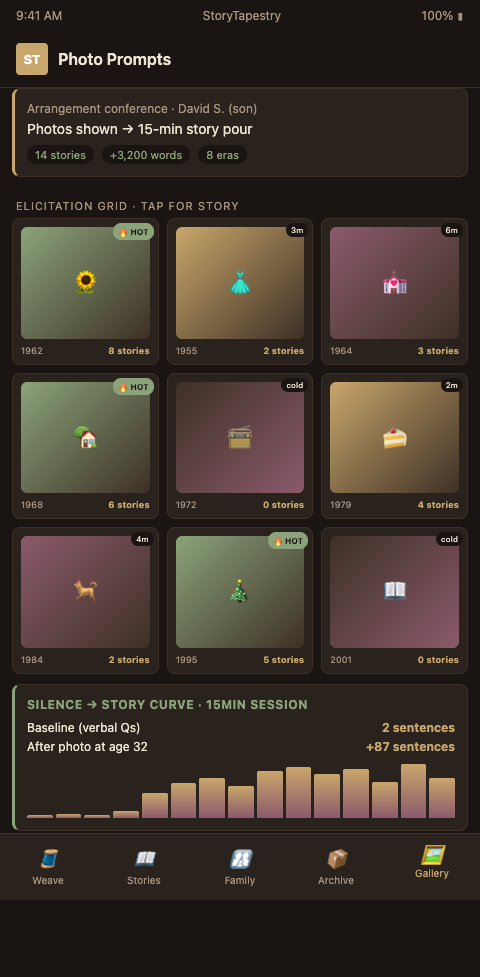
Qualitative research with family caregivers in dementia contexts confirms that photo-elicitation enables dialogue about experiences caregivers cannot articulate in pure verbal interviews (Qualitative Research FQS - Caregivers Dementia). Co-design work on photo-based reminiscence for older adults has established best practices for prompt selection: include familiar faces, recognizable places, era-appropriate material objects, and surprise images that challenge habitual recall patterns (arXiv - Photo-based Reminiscence Older Adults). StoryTapestry implements these best practices in the prompt library that directors can customize per-family using photo archive timelines that contributors have already populated.
The practical intake rhythm matters as much as the prompt selection. A director who flashes through 20 photos in 10 minutes trying to cover ground will produce shallow annotations that help no one. A director who sits with a single photo for six or seven minutes, following the caregiver's trailing responses back through the relational context the image surfaces, will produce narrative depth. StoryTapestry's session timer is designed around slow-elicitation pacing rather than efficient image coverage, which means a 60-minute session typically uses eight to ten photos in total, not thirty. Directors who internalize this pacing report that their arrangement conferences feel less rushed overall and that families leave the session emotionally settled rather than drained, which affects their availability for subsequent conversations about logistics and service planning.
The visual prompts also work bidirectionally: caregivers who see images contributed by others often produce stories they did not know they had. A daughter who saw her mother only during weekend visits during the memory care years is handed an aide-contributed photo of her mother at a facility birthday party she never attended, and she produces narrative about her mother's friendliness with strangers that she had never articulated before. The photo gave her access to a side of her mother she had missed, and the narrative that emerges becomes part of the memorial tapestry. Without the photo exchange infrastructure, this narrative would not exist, because the daughter would not have known to tell it and the aide would not have known which part of her observation to highlight.
Advanced Tactics for Visual Prompt Elicitation
Three tactics separate funeral homes that use visual prompts skillfully from those that produce generic photo slideshows. First, distinguish surface prompts from depth prompts in session planning. Surface prompts are easily recognized photos that invite light commentary ("That's Dad at his retirement party"). Depth prompts are more ambiguous images that require the caregiver to explain context ("Who is the woman standing behind your mother? What was her relationship with her?"). A 60-minute elicitation session that uses only surface prompts produces captions. A session balanced between surface and depth prompts produces narrative. StoryTapestry tags each prompt with its elicitation mode so directors can sequence intentionally.
Second, pair visual prompts with sensory narrative threads for the most productive sessions. A photo of the deceased's kitchen paired with the scent of cardamom triggers narrative density that either cue alone cannot reach. A photo of her gardening paired with a recording of birds from the neighborhood where she lived produces embodied recollection. Cross-modal elicitation consistently outperforms single-modal elicitation in caregiver retrieval research.
Third, extend the visual prompt library with specialized archives for specific caregiver populations. Funeral homes that serve veteran memory care patients benefit from access to military photo archives containing unit insignia, base locations, and deployment imagery that spouse caregivers may not have in personal collections. A WWII veteran with Alzheimer's whose widow does not have deployment photos benefits when the funeral director can access National Archives material that triggers her decades-old stories of his return. StoryTapestry maintains specialized prompt libraries that directors can search by era, service, or life context.
Fourth, capture the caregiver's nonverbal responses to each image alongside their spoken narrative. A caregiver who pauses for 12 seconds before responding to a photo, or whose voice catches partway through a sentence, or who touches the photo before speaking, is producing emotional data that pure transcription loses. StoryTapestry's session capture includes optional video recording of the caregiver's hands and face (with consent) and explicit annotation fields for nonverbal observations that the director notices in real time. The memorial that draws from these notes can include the actual pauses and the actual gestures, not just the words that filled the spaces between them. Families who see the memorial honor the texture of how they told their stories, not just the content, describe the service as having recognized them as whole people rather than narrative extractors.
Fifth, use photos as memory scaffolding for grandchildren and great-grandchildren who did not know the deceased before her decline. A granddaughter who was 4 when her grandmother received the Alzheimer's diagnosis and is now 15 has no pre-decline memories of her own. Photos from the grandmother's own youth, her career years, her early motherhood, become the grandchild's first access to who the grandmother actually was. Intake sessions that include grandchildren looking at grandmother-as-young-woman photos produce intergenerational narrative threads that cross-reference with the primary caregiver's memory in ways neither contributor could produce alone. StoryTapestry's multigenerational intake workflow is built around this combination, and the memorial produced from it gives the grandchild a grandmother she can claim as real rather than only a grandmother who was already disappearing before she could know her.
Make Visual Elicitation Standard Practice in Memory Care Arrangements
Funeral homes that default to pure verbal interviews during memory care arrangement conferences extract thin material from exhausted caregivers and produce memorials that feel generic. Funeral homes that integrate visual prompt elicitation unlock the narrative density caregivers carry but cannot speak spontaneously. StoryTapestry delivers the prompt library, sequencing tools, and cross-modal pairing workflows that make visual elicitation a reliable practice, not a stylistic flourish. Schedule a tour with StoryTapestry to see how memory care funeral homes use visual prompt elicitation to produce memorials that caregivers describe as showing the person they actually knew.
Pilot funeral homes receive product team support to build their custom prompt libraries from existing family-contributed photos, train directors on surface-versus-depth prompt sequencing, and establish the slow-elicitation pacing that produces narrative depth rather than caption lists. Your first ten visual-elicitation arrangement conferences on the platform receive concierge support including session review, where the product team watches the session recording alongside the director afterward to identify which prompts produced narrative density and which produced shallow responses, so directors rapidly calibrate to what works for their local caregiver population. Your feedback shapes the production release of the prompt library taxonomies, the cross-modal pairing workflows, the multigenerational intake structures, and the nonverbal observation capture fields that let memorials honor how caregivers told their stories rather than only what they said.
Schedule a tour to see how memory care funeral homes can move from generic arrangement conferences that extract thin material to visual-elicitation sessions that produce memorials caregivers describe as showing the person they actually knew, not a paragraph summary the funeral home could have written for anyone.