Creating Digital Tributes for Alzheimer's Patients: A Starter Guide
The Problem with Standard Online Memorial Tools
Mainstream online memorial platforms assume the person being memorialized had a linear, retrievable life story. They provide a bio field, a photo grid, a tribute wall, and a candle-lighting interaction. For an Alzheimer's patient whose family has been grieving for eight years, those fields feel wrong. The single bio field forces editorial compression onto gaps that deserve acknowledgment. The tribute wall invites distant connections to post "so sorry for your loss" rather than contributing the small, specific stories that matter.
Market direction is moving. Dignity Memorial's 2025 trends in celebrations of life highlights personalization, QR codes, and AI legacy recordings as defining this year's memorials. The Conversation on AI redefining death and memory describes AI-driven memorial technology reshaping family preservation practices. These shifts benefit Alzheimer's families when tools handle fragmented input natively, but most consumer platforms still default to the coherent-bio model. Everplans' roundup of major online memorial websites shows the gap clearly: feature sets emphasize obituary republishing and donation collection, not structured fragment gathering for dementia patients.
Weaving a Digital Tribute From Fragmented Input
The framework StoryTapestry uses starts by redefining what a digital tribute must do for Alzheimer's families. It must hold fragments without demanding they form a coherent whole. It must accept contributions from many voices across roles. It must grow after the service, not only before. And it must make cognitive decline visible as part of the story rather than hiding it. The tapestry metaphor supplies the architecture: each fragment is a thread, each contributor a spool, and the completed tribute is a weaving that readers can explore non-linearly.
Research supports the format. A PMC evaluation of digital life storybooks for dementia shows these storybooks integrate music, video, and photos to produce richer engagement than single-medium tools. A SAGE systematic review of digital storytelling found digital storytelling triggered memories in dementia patients themselves, which means tributes gathered during the patient's life also serve therapeutic purposes. The BMC Geriatrics Online Life Story Book RCT protocol formalizes the case that digital, shareable memory artifacts improve outcomes across the dementia care continuum.
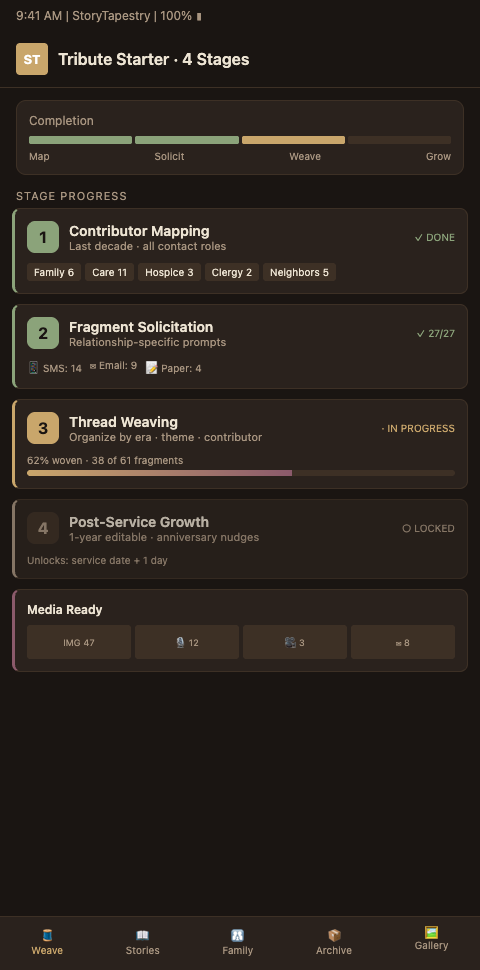
The practical starter sequence runs in four stages. Stage one is contributor mapping. List every person who interacted with the patient during their last decade — family, CNAs, activity staff, hospice team, neighbors, clergy. Stage two is fragment solicitation. Route relationship-specific prompts via text, email, or paper form. Stage three is thread weaving. The platform organizes fragments by era, theme, and contributor, presenting a browsable tapestry rather than a linear bio. Stage four is post-service growth. The tribute stays editable for a year, with nudges to family as anniversary dates approach.
Cognitive-Stage Sensitive Prompts sit at the core of stage two. Directors should never ask families of late-stage Alzheimer's patients to describe "her personality" in open form. Ask instead: "What did she say when she saw her grandchildren?" "What song did she hum?" "What did she reach for at mealtime?" These prompts unlock specific threads and align with life narrative tools that funeral homes increasingly rely on. The choice between digital and paper deliverables is covered in memorial format comparison, though digital typically wins for dementia memorials because the fragment volume exceeds what paper can hold gracefully.
Voice clips from lucid moments deserve their own handling. Many Alzheimer's families have recordings from holidays, care-plan meetings, or spontaneous lucid intervals that capture the patient's voice. StoryTapestry treats these as premium threads, time-stamped and tagged so viewers can hear the person without requiring the family to assemble a coherent audio montage. Digital wins when the source material is inherently multi-modal and when the audience is distributed.
The accessibility layer deserves explicit design attention. Elderly contributors often struggle with modern contribution forms, and a tribute platform that excludes the 82-year-old sister of the deceased is missing the person most likely to hold the earliest biographical threads. StoryTapestry supports three contribution paths: a simple web form with large touch targets, a phone number that accepts voice memos through a free transcription service, and a mailed paper form with a prepaid return envelope for contributors who will not use digital tools at all. Directors should introduce all three paths during family intake, and the paper path typically unlocks contributors who would otherwise produce nothing. For tributes meant to honor a full life, the contribution mechanism has to match the demographic spread of everyone who knew the person.
Advanced Tactics for Digital Tribute Quality
The most common mistake is publishing too early. Directors under service-deadline pressure often push a tribute live with 10-15 threads and freeze it. The better pattern is launch at 30-40 threads for the service and keep intake open for 90 days. Post-service contributions often arrive from distant relatives and old friends who learned of the death through obituary channels, and those threads are often among the tribute's most specific. A tribute that keeps growing for three months produces a richer archive than one that freezes at service time, and families often describe revisiting the tapestry at the one-month mark as an unexpected grief anchor that the traditional obituary could not offer.
Edge cases to script. When the family includes estranged members who contribute damaging fragments, route those to private archive. When contributors submit identical photos, merge at review and preserve attribution. When voice clips include non-consenting third parties (staff, visitors), obtain release or transcribe only. When contributors submit media that triggers copyright concerns (commercial music recordings, published photos), flag for director review before publication. These are unglamorous operational details, but they determine whether families trust the tribute long-term.
Scaling across a funeral home network requires two disciplines. First, prompt library maintenance: the questions that unlock the densest fragments should be logged and shared across directors. Second, contributor acknowledgment: every named thread contributor gets a notification when the tribute goes live. That single touch turns one-time contributors into lifelong advocates for the funeral home and returns measurable referral volume within 12-18 months. The acknowledgment itself is a small piece of craft — a three-sentence note from the director, a thumbnail of the tapestry, and a direct link to the contributor's own thread with their name visible — but firms that automate it without personalization see flat referral data, while firms that invest 90 seconds of director time per acknowledgment see compounding referrals from the same contributor networks.
Integrate mindfully with platforms families already use, not as afterthought but as a design constraint. A StoryTapestry digital tribute should export to Facebook, Google Photos archives, and funeral-home-managed memorial sites without forcing families to migrate material they have already curated. Native import from the most common platforms reduces intake friction dramatically and signals respect for the work families have already done across years of cognitive decline. The parallel with static vs digital memorial decisions in other sensitive niches is instructive: digital wins when source material is multi-modal and the contributor audience is geographically distributed.
Measurement separates tributes that families describe as honoring the life from tributes they describe as adequate. Track four signals per tribute: total thread count, unique contributor count, mean thread length, and 90-day post-service addition rate. The first two signal distribution; the third signals depth; the fourth signals whether the tribute lives beyond the service. A tribute with 45 threads from 18 contributors averaging 60 words with 12 post-service additions is operating well. A tribute with 45 threads from four contributors is operating as a traditional obituary dressed up in tapestry interface. The signals tell the director which families need additional outreach support and which families have built self-sustaining memorial communities.
Begin Building Digital Tributes for Alzheimer's Families
Memory Care Funeral Homes joining the StoryTapestry waitlist get early access to the fragment-first digital tribute workflow designed specifically for Alzheimer's and dementia families. If your directors have assembled tributes on general-purpose memorial platforms and watched families struggle with the coherent-bio template, StoryTapestry offers structured fragment gathering, voice-clip threading, and post-service tapestry growth in one workflow. Reserve a pilot slot to help shape the prompt library, contributor acknowledgment flows, and platform integrations for your local partner facilities.
Pilot partners receive direct product team support during the first 90 days, including supervised setup of the prompt library, training for your directors on fragment-first intake practice, and assembly support for the first three tributes your firm produces on the platform. Your feedback shapes the production release of the voice-clip tagging interface, the multi-channel contribution paths, and the post-service growth nudges that extend tributes across the first year. Firms that join as pilot partners are positioned to be the fragment-first option in their local markets when StoryTapestry moves to general availability, which matters because the demand for purpose-built dementia memorial tools is growing faster than funeral home capacity.
Reserve your pilot slot now to build the operational muscle before general availability, when your directors will already have delivered a dozen or more tapestries and your partner facilities will already recognize your firm as the memory care bereavement specialist in your territory.