Paper-Based vs Digital Memorial Storyboarding for Memory Care
The False Choice Between Paper and Digital
Life story work in dementia care has strong evidence for paper-based life story books improving resident well-being, staff-resident relationships, and family involvement (PMC - Life Story Book Systematic Review). Scrapbooking as a grief intervention has been documented across multiple studies as a tangible connection that bereaved families rank as a preferred ritual (ResearchGate - Scrapbooking Coping Grief). The paper format has real strengths that digital formats cannot replicate: tactile engagement, low technology barriers for elderly caregivers, visible placement in the patient's room, and a tangible object that survives the service.
But paper life story books have documented limitations that dementia care practice knows well. Feasibility research on life story work in dementia care identifies persistent barriers: templates with ambiguous direction, staff time constraints, and the inability to update material as the patient's life changes (NCBI - Life Story Work Feasibility Study). Analysis of life story templates specifically notes that ambiguous direction leaves families uncertain what to fill in (SAGE - Life Story Templates Ambiguous Direction). A funeral home choosing between paper and digital memorial storyboarding is not choosing between traditional and modern; it is choosing between two tools with complementary strengths that most memory care families benefit from combining.
Weaving Paper and Digital Threads Together
StoryTapestry is designed to complement, not replace, paper life story work in memory care settings. The tapestry metaphor is load-bearing here because the final memorial is strongest when it contains both digital threads (searchable, shareable, updatable, enduring through cloud storage) and paper threads (tactile, gift-able, placeable at the service, survivable through the home environments of grieving families). Age UK Sheffield's life story toolkit documents how paper life story work supports the person with dementia during life (Age UK Sheffield - Life Story Work); StoryTapestry extends the same life-story content into digital memorial assembly at the end of life.
The practical model is dual-track capture. Facility staff continue paper life story work with residents as they always have, using the templates, scrapbooks, and binders the program already owns. StoryTapestry ingests digitized pages from the paper book at routine intervals (quarterly scans or annual digitization sessions) so the digital archive always reflects the paper work. When the resident passes, the funeral home has both the physical life story book to reference during arrangement conferences and the digital archive to assemble for the memorial service. Research on scrapbooking bereavement groups demonstrates that bereaved families value the physical object distinctly from the digital version (ResearchGate - Scrapbooking Bereavement Group).
Paper-based scrapbooking has strong evidence for children's grief recovery as well, which matters when memory care patients leave grandchildren who lost a grandparent to dementia (Taylor & Francis - Scrapbooking Children Grief). StoryTapestry produces printable memorial keepsakes (eulogy booklets, photo timelines, annotated lyric sheets) that extend the digital assembly into paper artifacts families can hold during the service and take home afterward. The keepsakes are generated from the digital archive at the funeral home, which means the paper output reflects everything the digital process captured without requiring facility staff to manually re-scrapbook at the end of life.
The audience split is important to recognize explicitly rather than trying to paper over. A memory care family typically has three audiences with different format preferences: the elderly spouse or sibling generation who grew up with scrapbooks and photo albums and expects tangible artifacts, the middle-aged adult children who are comfortable with both formats and may use the digital archive for distributed family coordination, and the grandchildren and great-grandchildren who expect digital access and find paper-only memorials almost inaccessible to share with their own peers. A memorial that serves only one audience alienates the other two.
StoryTapestry's dual-format output is designed so the same underlying archive produces both a printed keepsake booklet for the widow to keep on her coffee table and a digital archive the scattered grandchildren can access from their phones, without the funeral home having to produce two separate memorial projects. The unified pipeline reduces directors' assembly time from a week of parallel work to a single integrated production cycle.
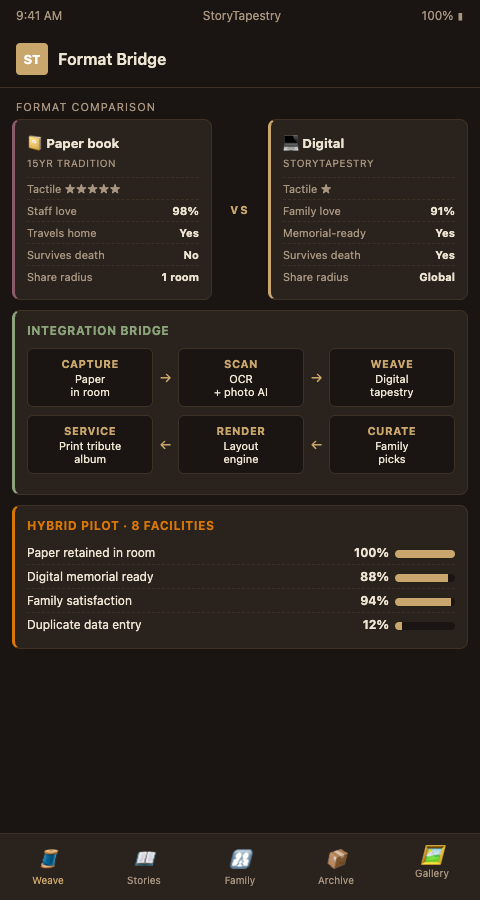
The integration works because each format does what it does best. Paper excels at bedside use during the dementia years, when the patient responds to familiar tactile objects. Digital excels at assisted living collection coordination across staff shifts, family contributors, and funeral home partners. Scrapbooking grief recovery research confirms that bereaved families benefit from hand-assembled artifacts (Taylor & Francis - Scrapbooking Children Grief), which is why StoryTapestry produces print outputs rather than limiting families to screen-only memorials.
Advanced Tactics for Paper-Digital Integration
Three tactics help memory care funeral homes integrate paper and digital formats without losing the strengths of either. First, establish a quarterly digitization cadence with memory care facility partners. Staff-time constraints are the primary barrier to digital-only adoption in dementia care settings, and a scheduled quarterly scan session (facility staff set aside 2 hours per resident's book every quarter, funeral home partner provides the portable scanner) removes the friction. After the first full year, each resident's digital archive reflects the paper work without staff having to learn a new workflow.
Second, design digital Alzheimer's tributes that print beautifully. A memorial planned for screen viewing that also produces a 32-page printed keepsake satisfies both the digital-native adult children and the elderly siblings and spouses who want something they can hold. StoryTapestry's export templates optimize for both, which means the director never has to choose between formats when the family wants both.
Third, understand that some families decisively prefer one format over the other, and the comparison with traditional vs digital in veteran memorial contexts applies directly. A 78-year-old widow whose husband had Alzheimer's may want the paper book on the coffee table and no digital memorial at all. A 45-year-old daughter may want the digital archive for her siblings scattered across three states and view the paper book as secondary. StoryTapestry's configuration allows families to scale either format up or down without the funeral home having to deliver two separate services.
Fourth, build the scanning workflow around the reality that facility life enrichment staff are often stretched thin and cannot absorb new responsibilities. The quarterly digitization session should be run by a funeral home team member visiting the facility, not by asking facility staff to do the work themselves. A portable high-speed scanner, a two-hour block on a pre-scheduled Saturday morning, and one funeral home visitor can digitize 20 to 30 life story books in a single session. The facility hosts the session, the resident families know it is happening and can join if they want, and the scanned material flows into each resident's digital archive automatically. This sidesteps the workflow-adoption problem that doomed earlier digitization partnerships where facility staff were asked to absorb additional documentation burden.
Fifth, design the paper keepsake for longevity in the actual home environments of grieving families. A 32-page softcover booklet that sits on a coffee table is used very differently than a 60-page hardcover that goes on a shelf. Elderly widows often prefer smaller, handleable formats that can be picked up during quiet evenings and revisited without requiring a dedicated reading setup. Middle-aged adult children often prefer hardcover formats that survive being passed between households during the first year of bereavement. Grandchildren often prefer smaller pocket-sized keepsake cards that can be carried rather than displayed. StoryTapestry's print template library includes all three formats, so the same underlying archive produces artifacts appropriate for each audience's actual use patterns rather than forcing one format on audiences with different grief rhythms.
Partner With StoryTapestry for Dual-Format Memorial Assembly
Memory care funeral homes that force families into digital-only or paper-only memorial assembly leave satisfaction outcomes on the table that competitors delivering both formats will capture. StoryTapestry provides the dual-format infrastructure, quarterly digitization workflows, and print-quality export templates that let your memory care families choose paper, digital, or both without tradeoff. Get in touch with StoryTapestry to design a paper-digital integration that fits your memory care funeral home's partner facilities and the dementia families whose memorial preferences deserve real choice rather than false format dichotomies.
Pilot funeral homes receive product team support to establish the quarterly digitization cadence with their partner memory care facilities, train their directors on the dual-format intake conversation that surfaces which audiences the family needs to serve, and set up the print template library customized to their local printing vendors and the keepsake sizes their community actually uses. Your first ten dual-format memorials on the platform receive concierge support including on-site attendance at a quarterly digitization session so your team learns the workflow from the inside, plus post-service review of how each keepsake format landed with each audience segment so the templates calibrate rapidly.
Your feedback shapes the production release of the scanning workflow, the print template library across softcover, hardcover, and pocket formats, the audience-segmented output tools, and the digital-paper integration logic that preserves both formats' distinct strengths without forcing families into false dichotomies. Schedule a consultation to design an integration that fits your memory care funeral home's partner facilities and the dementia families whose grief rhythms deserve memorial artifacts built around their actual use patterns rather than the industry's default.