Building Memorial Narratives When Memories Are Fragmented
The Problem with Linear Obituary Templates
Most funeral home obituary workflows assume a continuous life story: birth, education, career, marriage, children, retirement, death. Dementia breaks that timeline years before death. According to research in PMC on autobiographical memory decline in Alzheimer's, fragmented episodic memories and gaps weaken the patient's sense of selfhood long before family members grieve the medical loss. By the time a funeral director sits with family, the person being memorialized has often lost the ability to confirm, contradict, or elaborate on the family's recollections for a decade.
The scope of the gap is stark. Alzheimer's Society caregiver Tracey's account describes how all-consuming caregiving leaves families with fragmented communication and depleted capacity to document stories in real time. Families arrive at funeral homes with years of caregiving exhaustion, contradictory sibling memories, and a shared conviction that they have forgotten more than they can retrieve. Linear templates force them to paper over gaps with generic platitudes, producing memorials that the deceased's closest people privately admit feel hollow.
Weaving a Tapestry From Incomplete Threads
The shift StoryTapestry proposes is treating fragmentation as the default structure. A tapestry is built from short threads by design. No single thread carries the whole pattern, and gaps are not failures but negative space that defines what is present. The platform applies this to memorial building by letting contributors submit memory fragments of any length, tagged by era, theme, or relationship, and weaving them into an interactive tapestry that readers can explore non-linearly.
This draws on established practice. A PMC systematic review of life story books found they trigger memories, improve relationships between patients and caregivers, and preserve identity even when retrieval is inconsistent. The Springer paper on preserving narrative identity for dementia patients argues distributed memories play a constitutive role in narrative identity, meaning a memorial built from many voices often captures more of the person than any single coherent account could. The PLOS One REMCARE randomized trial of joint reminiscence groups for dementia dyads further supports the polyphonic model as clinically meaningful, not just aesthetically interesting.
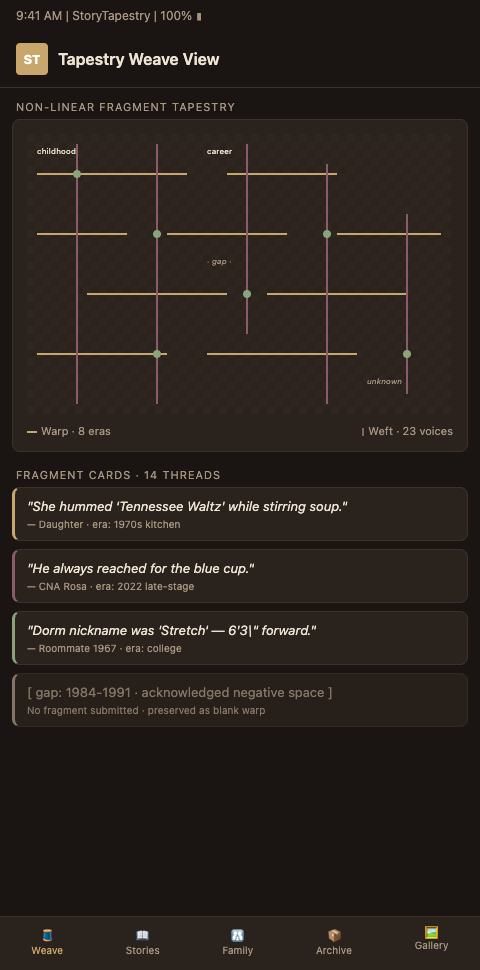
Cognitive-Stage Sensitive Prompts matter here because the contributors often carry secondhand grief. Asking a daughter "what was your mother like?" in open form yields a frozen, anxious response when she is already worried she has forgotten too much. Asking "what song did she hum when she cooked?" unlocks a specific thread. StoryTapestry routes prompts by relationship and era, pulling threads that contributors did not know they still held. This connects to work on scattered story value and the case for letting marginal voices contribute core material.
Contradictory Memory Reconciliation is woven into the same fabric. When two siblings describe their father's first job differently, the tapestry shows both versions with contributor attribution. Readers see the disagreement as part of the portrait, which mirrors how families actually remember. TimeSlips creative storytelling evaluation demonstrates that polyphonic storytelling benefits people across all dementia severity levels, supporting the idea that multiple voices produce stronger memorials than forced consensus.
The platform also draws on narrative assembly tools that give directors and families a shared workspace. Funeral homes piloting the system can assemble a memorial tapestry with 40 to 80 contributed fragments in a week, far denser than a traditional two-paragraph obituary but organized so the family does not feel overwhelmed during grief.
Fragment layering is the design principle that makes this work in practice. Rather than presenting 60 fragments as a flat list, the tapestry layers them by era (childhood, early career, family years, late-stage caregiving) and by theme (work, relationships, rituals, sensory markers). Readers can browse by era to see the life chronologically or by theme to see how the person's relationship with their garden or their Saturday coffee ritual evolved across decades. The family reviewer experience is equally important: a single-screen approval workflow lets the widow accept, edit, or privately archive each fragment in about 10 seconds per thread, so a 60-fragment tapestry takes 10-12 minutes of focused review rather than several hours of dread.
Advanced Tactics for Fragment-First Narratives
The most common mistake is quality gating too early. Directors trained on coherent obituary writing reflexively discard short, unconfirmed, or emotionally charged fragments. Hold those back for a second-pass review rather than deleting them at intake. A three-word fragment — "she wore red" — from a grandson can become a memorial's most-shared detail when paired with a photograph surfaced from another contributor's archive. The right heuristic during intake is simple: if the fragment is in the contributor's own voice and attaches to the specific person, capture it. Editing comes later with the family as partner, not at intake as solo gatekeeper.
Edge cases worth scripting: contributors who know only the final decline years, contributors who know only the pre-diagnosis decades, and contributors whose fragments contradict the family's preferred narrative. All three need different routing. Final-decline contributors (usually memory care staff and hospice workers) produce sensory detail that families often cannot. Pre-diagnosis contributors produce the biographical arc. Contradictory contributors need family reviewer routing before publication. The same principles apply in adjacent niches like brief life fragments, where the entire narrative exists in short fragments by definition.
A fourth edge case deserves its own protocol: the anonymous or pseudonymous contributor. Sometimes a neighbor who had a quiet friendship with the deceased wants to contribute a story but does not want their name attached, usually because they are worried about family dynamics or their own relationship with the deceased's history. StoryTapestry allows initial-only attribution ("R.K., neighbor since 1994") or anonymous attribution with director verification behind the scenes. This preserves the integrity of the attribution while respecting contributor privacy, and it captures threads that would otherwise stay unspoken. Directors report that 5-8% of contributions in a typical tapestry come from contributors who needed this option and would not have contributed under their full name.
Scaling across a funeral home network requires a prompt library that updates as directors learn which questions unlock the most material. StoryTapestry logs which prompts produce the longest fragments and surfaces those to new directors. Privacy design matters too: some fragments carry family conflict and should remain in the private archive rather than the public-facing tapestry. Role-based visibility handles this without requiring directors to make delicate judgment calls under time pressure.
Director training deserves specific investment when moving from linear to fragment-first intake. The habits that make directors efficient in traditional arrangement conferences — summarizing, compressing, moving toward a unified obituary draft — actively sabotage fragment-first work. A half-day workshop that drills the inverse habits (capture verbatim, resist synthesis, let contradictions stand) reshapes practice within a month. Supervised pilots on three or four memorials after the workshop reinforce the pattern. Firms that skip the training and expect directors to intuit the new approach produce tapestries that look coherent on the surface but flatten the contributors' actual voices, defeating the point.
Measurement discipline prevents the platform from drifting back toward linear habits in the months after launch. Track fragment count per memorial, unique contributor count, fragment length distribution, and family-reported satisfaction on completeness versus coherence. A memorial with 60 fragments from 20 contributors and a 4.6 satisfaction score signals the model working correctly. A memorial with 60 fragments from three contributors and a 3.9 satisfaction score signals that the director is still running a traditional intake in fragment clothing, collecting high-volume material from the same small circle rather than genuinely widening contribution. Review these metrics at the monthly partnership meeting with each memory care facility, so the numbers drive protocol changes before bad habits calcify across a full quarter of memorials.
Begin Building Fragmented Memorial Narratives
Memory Care Funeral Homes joining the StoryTapestry waitlist get early access to the fragment-first intake workflow and the prompt library tuned for dementia families. If your directors regularly sit with families who feel their loved one deserved more than a three-sentence obituary but cannot piece together a linear account, StoryTapestry gives them a structured way to gather, attribute, and weave short threads into a memorial that honors the full life. Reserve a pilot slot to help shape how the platform handles reconciliation workflows and archive-first contributor contributions before general release.
Pilot partners also shape the training curriculum, the contributor acknowledgment flows, and the integration patterns with the facility systems your firm already uses. Your directors will run supervised fragment-first intakes with concierge product support during the first 60 days, which means the transition from linear obituary habits to tapestry-weaving practice happens under guidance rather than by guesswork. Each pilot funeral home we onboard contributes prompt library entries, edge-case protocols, and family feedback patterns that we weave into the platform for later adopters, so the firms that join the waitlist now help define what fragment-first memorial assembly looks like for the memory care niche as a whole. Reserve your pilot slot to move your arrangement conferences from hollow three-sentence obituaries toward memorials your families actually recognize as their loved one.