Understanding Perinatal Grief and the Need for Tangible Memory Artifacts
The Problem: Perinatal Grief Persists Without Shared Mourning Infrastructure
A mother whose son was stillborn at 34 weeks described the first year after her loss as "grief without furniture." She had a cedar box of footprints and a lock of hair. Her mother-in-law had a framed ultrasound. Her husband had a phone full of photos he could not bring himself to open. Her four-year-old daughter had a drawing the hospital social worker had taped to her hospital bracelet. Each family member held a fragment of tangible memory, but no one had a structure that held them together.
The research on perinatal grief is unambiguous about duration and severity. A meta-analysis of mental health impact documented 25-39% PTSD prevalence at one month after perinatal loss. A complementary study on depression and PTSD at nine months post-loss confirmed that bereaved women continue to show persistent distress well beyond the initial acute phase. Research on complicated grief across family systems identified persistent perinatal grief affecting grandparents and siblings in addition to primary parents.
Tangible artifacts are clinically significant. Research on transitional objects after perinatal loss established that transitional objects support healthy grieving — with a separate study finding that 98.6% of bereaved mothers had transitional objects in the months following loss. Continuing bonds research documented how memories, sensory perceptions, and objects serve as primary pathways through which bereaved families maintain connection. A mixed-methods study of bereavement photography found that sharing photos correlated positively with continuing bonds. Artifacts matter; families need infrastructure to hold them.
The Solution: Tangible Artifacts Woven Into Interactive Tapestries
StoryTapestry treats physical artifacts not as substitutes for digital memorials but as co-threads — each physical object accompanied by digital narrative that preserves the artifact's specific meaning and context. The tapestry metaphor resolves the "grief without furniture" problem: no single artifact has to carry the whole weight of remembrance because every artifact is held in relation to every other artifact within the larger weaving.
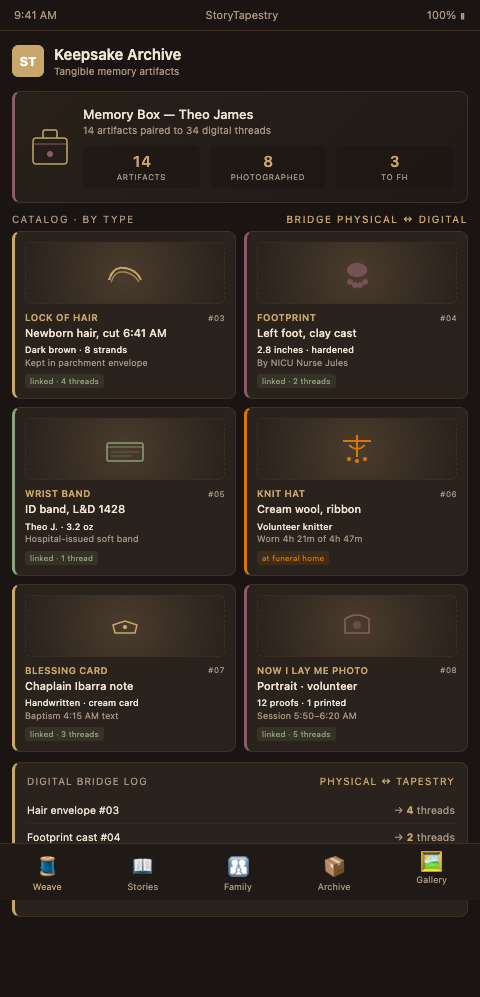
Artifact-centered contribution pathways. When a family brings home a memory box, each item inside can become its own tapestry node. The footprint card links to a prompt asking about the nurse who made it. The lock of hair links to a prompt asking about the afternoon it was cut. The knitted hat links to a prompt asking about the volunteer who knitted it and the first moment the parent saw it on their baby's head. Each artifact accumulates narrative threads that otherwise would disperse across family members' memories.
Trauma-informed prompting calibrated to artifact sensitivity. Not every family is ready to engage with every artifact at the same moment. StoryTapestry lets families mark specific artifacts as "not yet" — the artifact is preserved in the tapestry but prompts about it are suspended until the family chooses to re-engage. This pacing autonomy draws on trauma-informed principles also used in loss story sensitivity practice across our work.
Grandparent and sibling artifact contribution. The grandmother who knitted a blanket. The aunt who made a playlist. The grandfather who wrote a letter to the grandchild he never met. StoryTapestry provides consent-controlled pathways where extended family members can contribute their own tangible artifacts and the narrative context around them. Grief spreads across generations, and the tapestry accommodates it. This approach parallels what families describe in bereaved parent communities where multi-generational artifact contribution is the norm.
Physical-to-digital artifact preservation. A physical footprint card will fade. A lock of hair will become fragile. A knitted hat may be lost in a house move. StoryTapestry helps families photograph, scan, or digitize their physical artifacts with structured metadata — so the digital memorial persists even if the physical object is damaged, and the preserved record can later be shared inside bereaved parent community spaces at the family's pace. Hospital-affiliated funeral programs increasingly bundle this digitization service with their memorial offerings.
Anticipatory grief bridge for known lethal diagnoses. Families facing a fatal prenatal diagnosis often have weeks or months of anticipatory grief understanding before loss. StoryTapestry allows artifact contribution during pregnancy — letters to the baby, recordings of the mother singing, ultrasound annotations — creating a memorial that exists before and after the loss event rather than beginning at discharge.
Advanced Tactics for Tangible Memory Artifact Integration
Artifact condition tracking over time. Physical keepsakes change. StoryTapestry includes optional periodic re-photography reminders so families can document their artifacts' condition across years — not because anything is wrong with change, but because the changes themselves become part of the memorial narrative. A footprint card that yellows with age, a blanket that softens from being held, a photograph that fades — each change carries meaning.
Artifact-linked memorial keepsake fulfillment. Affiliated funeral homes increasingly offer services that transform tangible artifacts into new keepsake forms — pressed flowers into resin pendants, ultrasound images onto memorial stones, heartbeat waveforms into printed art. StoryTapestry integrates with these fulfillment workflows, preserving the original artifact's narrative context through the transformation so the new keepsake carries forward meaning rather than losing it.
Redistributed memory box contents. Some bereavement programs encourage families to take home a full memory box, while others suggest leaving some artifacts with the hospital for a later retrieval moment, guided by loss story sensitivity principles that respect each family's pacing. StoryTapestry supports this distributed architecture: a hospital-held artifact can be digitally present in the family's tapestry while the physical object remains with the program until the family is ready to receive it.
Religious and cultural artifact accommodations. A rosary blessed at the baptism, a Quran passage handwritten by a grandfather, a Buddhist sand mandala created at the memorial — StoryTapestry preserves religious and cultural artifacts with terminology and presentation appropriate to each tradition. Bereavement coordinators can customize prompt language per family's cultural and religious context.
Sibling play-artifact integration. Older siblings often create artifacts through play — drawings, dollhouse scenes, imagined dialogues with the baby. StoryTapestry includes an age-appropriate sibling contribution mode that preserves these play-artifacts in forms children can recognize and return to across developmental stages. A six-year-old's drawing becomes part of the tapestry she can re-engage at sixteen.
Clinical artifact integration with family consent. Hospital records sometimes include artifacts families never see — the handwritten note the charge nurse added to the baby's chart, the footprint record kept in the patient file. With explicit consent processes, StoryTapestry can help hospitals share these artifacts with families who want them, preserving institutional memory as part of the family's memorial rather than burying it in archived records and resonating with anticipatory grief dynamics we see across extended loss trajectories.
For Hospital Bereavement Programs Ready to Extend Artifact Work Beyond the Memory Box
Your bereavement program already assembles memory boxes with care. StoryTapestry extends that work into the months and years a bereavement nurse cannot staff in person. Physical artifacts hold meaning; digital narrative wraps that meaning in preservation infrastructure that survives house moves, storage damage, and the slow fade of memory. We partner with hospital bereavement coordinators and affiliated funeral directors to pilot the platform in your existing artifact workflow, integrating with your memory box assembly process rather than adding new steps. Reach out to discuss a pilot that begins with your next quarter's bereavement cases and includes your affiliated funeral home's keepsake fulfillment workflow. The pilot consultation runs 60 minutes and covers your current memory box assembly checklist, the four-image capture protocol for each physical artifact, the voice-note material memory workflow, and the sibling play-artifact mode for families with older children.
Pilot engagements include platform access for your bereavement coordinator and one NICU social worker, a training block for the hospital photographer and memory-box assembly team, and a named implementation lead who shadows the first 10 family handoffs. Most programs onboard their first family inside three weeks of contract signing, reach steady-state case flow by week eight, and complete integration with the affiliated funeral home's keepsake fulfillment workflow by month three. Bring your bereavement coordinator, your hospital photographer or volunteer photographer lead, one NICU social worker, and your affiliated funeral home's keepsake manager — the consultation produces a four-role integration plan with clear handoff points.