How to Create Anniversary Memorial Updates for Infant Loss Families
The Problem: Anniversaries That Arrive Without Infrastructure
A PubMed systematic review on bereavement anniversary reactions synthesizes evidence that anniversaries produce measurable physical and psychological responses in bereaved parents — sleep disturbance, intrusive memories, somatic symptoms — that recur for decades after the loss. The VA clinical resource on anniversary reactions describes the typical pattern: intrusive memories peaking in the days before the date, avoidance and numbing on or near the date, and gradual return to baseline after. A PMC paper on special occasions triggering distress finds the effect strongest in the first six months post-loss but present at detectable levels for years.
Hospital bereavement programs often acknowledge the first anniversary — a card, a call — and then the program's formal involvement tapers off. Research supports a longer engagement horizon. The Wikipedia synthesis on continuing bonds summarizes a body of work establishing that long-term ritualized connection to the deceased is the healthy pattern, and that anniversary updates are structurally important to that connection. Community observances like Wave of Light and PLIDA's October Awareness Month formalize annual collective observance, and the UK Baby Loss Awareness Week treats breaking silence as a public goal. But individual families need individualized update infrastructure in addition to public observances.
Without infrastructure, anniversaries turn into private moments of grief that leave no trace. A mother who adds a photograph to a memorial on the fifth anniversary wants the addition to persist — to be there next year, and twenty years from now — not to scroll past on a social feed.
Solution Framework: A Tapestry That Prompts Without Pressuring
StoryTapestry's anniversary update model does three things: it recognizes the date without announcing it, it invites a contribution without requiring one, and it preserves anything added with the same durability as the original weave. The system supports ongoing memorial rituals as an extension of the continuing-bonds framework, not a replacement for formal grief services.
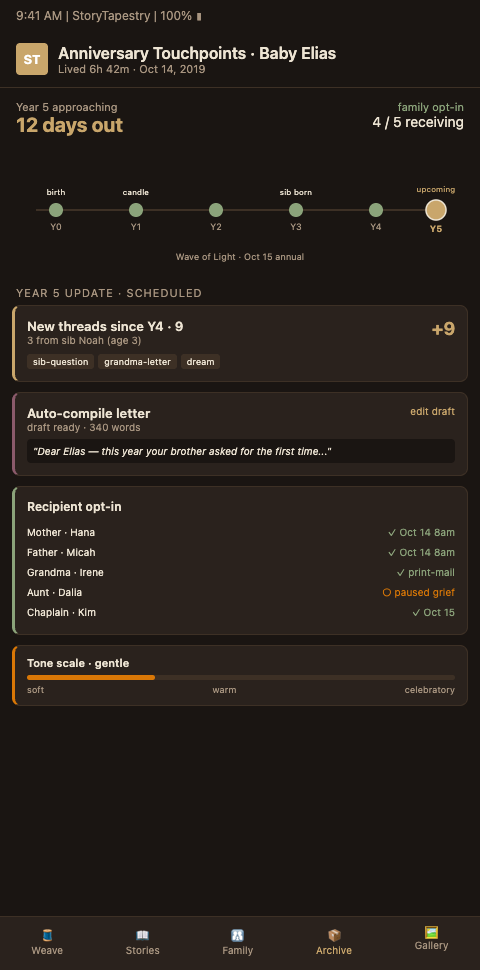
Date awareness without ambush. StoryTapestry knows the anniversary date, the due date, and any other family-designated observance dates. Seven days before each date, the tapestry's landing page shows a subtle "anniversary approaching" indicator to the family member who opens it — not a push notification. The difference is intentional: a push notification arrives uninvited and can destabilize a grieving parent who was not ready. A landing indicator shows up only when the parent has chosen to open the tapestry. Opt-in push notifications exist for parents who want them but default off.
Contribution invitations with low friction. On the day of the anniversary, the tapestry offers a one-tap "add a thread this year" prompt. The parent can decline, defer, or use a short-form template. Short forms include: a single photograph (with optional caption), a one-sentence letter, a voice memo up to two minutes, a candle-lighting moment, a selected quote. These take seconds. A parent who wants to write a longform letter can do so; a parent who only has the capacity for a photograph of the tree in the yard this year contributes a photograph. Both are full-weight contributions.
Sequence visibility. Each year's anniversary thread stacks into a visible sequence. Year one's photograph, year two's voice memo, year five's short poem, year eight's letter, year fifteen's photograph of the sibling born after who is now a teenager — the sequence becomes its own narrative. Parents report that the sequence view becomes meaningful around year three or four, when the accumulation starts to show. Programs that treat anniversary updates as one-off additions miss this compounding effect.
Sibling and extended-family anniversary participation. The tapestry extends anniversary prompts to siblings (age-appropriately, through parent-supervised invitations for young children), grandparents, and any designated family members. Each contributor sees their own prompt without seeing whether others have contributed yet; contributions become visible after the anniversary passes. This prevents social pressure dynamics where one contributor sees another's thread and feels compelled to match it.
Public-layer options. Some families want anniversary participation in community observances — the Wave of Light wall, Baby Loss Awareness Week shared threads — and StoryTapestry provides opt-in pathways. A parent adding a candle photograph on October 15 can toggle the thread into the public wall for 24 hours, keeping it private afterward, or publish permanently. The default is private with a visible but unticked public option, not the other way around. Tracking engagement rate tracking patterns developed for veteran comrade memorials helps the program understand which community features are serving families and which are sitting unused.
Format variety. Parents at year one tend toward longer letters and photographs. Parents at year ten tend toward short voice memos and objects. The available digital memorial formats should not constrain what parents can contribute at any stage. A format that works at year ten should be available at year one, and vice versa.
Advanced Tactics for Anniversary Program Durability
Four tactics sustain anniversary engagement over decades.
First, build anniversary prompts grounded in developmental phase. Year one prompts emphasize presence and acknowledgment. Year two-five prompts emphasize change and continuity. Year six-ten emphasize what the family has built. Year eleven-plus emphasize legacy and what the baby's life has meant over time. The continuing-bonds literature supports this progression: the meaning of the loss shifts across decades, and the prompts should track that shift. Generic "how are you today" prompts across all years produce disengagement by year four.
Second, coordinate program-level anniversary outreach. A hospital bereavement program that sends a handwritten card on year one, year five, and year ten — in addition to the system's in-tapestry prompts — produces stronger long-term engagement than programs relying on automated prompts alone. The human touch at multi-year intervals signals that the program remembers the family, not just the system.
Third, offer facilitated anniversary groups. Families who want to observe alongside other bereaved parents benefit from structured anniversary groups — small cohorts of families whose loss dates fall in the same month, meeting virtually once a year for an hour around their anniversaries. StoryTapestry can facilitate cohort formation from the family's opt-in preferences. Programs like PLIDA and October15 demonstrate demand for this kind of structured collective observance.
Fourth, prepare for the empty anniversary. Some years, parents cannot face the date. Some years, the date passes and nothing is contributed. A program that gently acknowledges the skipped year ("thinking of you — the tapestry is here when you're ready") without generating guilt supports the family more than a program that silently notes the non-contribution. Prompts in the year after a skipped year should not start with "we noticed you didn't contribute last year" — they should start fresh.
Fifth, provide a tapestry mail-forward for anniversary access. Some parents do not want the tapestry open on their phone on anniversary day, but do want a printed keepsake mailed to them. StoryTapestry generates printable spreads of the anniversary sequence that can be mailed annually or on specific years. This bridges the digital-physical gap for families who experience grief more through objects than screens.
CTA: For Hospital Bereavement Programs Extending Through Anniversaries
The families you cared for last year will experience their first anniversary next year, and your formal program involvement probably ends before it starts. StoryTapestry gives you an anniversary infrastructure — scheduled prompts, format variety, sequence visibility, public-layer options — that lets your care extend for decades without continuous staff outreach. Schedule a 45-minute session with your bereavement coordinator and a social worker. We'll walk through year-one, year-five, and year-fifteen views for a sample tapestry and design an outreach cadence that matches your program's capacity. The session covers the anniversary prompt library, the multi-format delivery options — email, SMS, printed mail-forward spread — the sequence visibility architecture that shows families how their tapestry has changed over time, and the opt-in public layer that lets families connect with other bereaved families on shared anniversary dates.
Pilot engagements include platform access for your bereavement coordinator, one social worker, and one alumni parent liaison, plus a named implementation lead who configures the anniversary cadence for your first 25 active family cases. Most programs onboard their first family cohort inside four weeks of contract signing and reach anniversary-prompt coverage across all active cases by month six. Bring your bereavement coordinator, social work lead, and one alumni parent willing to serve as advisory voice — the session produces a capacity-matched outreach cadence document the three of them can present to hospital leadership before the pilot launches.