Case Study: A 36-Hour Life Story Told Through 15 Contributor Threads
The Problem of Time Scarcity in Perinatal Memorial Creation
When Baby Levi's parents first sat with their assigned grief counselor three weeks after his funeral, the mother said she felt her son had not had time to be anyone. She had held him. Her partner had held him. A few family members had briefly been present. The rest of their relatives had sent flowers and condolences. Her fear was that Levi's life would become an absence around which the family circled rather than a presence they could return to.
The fear is not irrational. Maternal narratives documented in a scoping review of mother's voice and identity formation show that perinatal loss mothers express persistent yearning to honor who their infant was, not just that their infant was lost. Parent stories from NICU settings confirm that meaningful time memories, however brief, form the scaffolding of healthy mourning. When those memories remain siloed inside individual witnesses, most of the story disappears.
The traditional memorial response collects a photograph, a handprint, and perhaps a professional portrait if time permits. These artifacts are precious. They are also thin. They capture the baby's physical presence without capturing the 14 or 15 adults who loved him, the charge nurse who stroked his cheek at 2am, the grandmother who drove 400 miles and sang to him for 40 minutes, the sibling who wrote a letter she could not yet read aloud. Without infrastructure to gather those distinct threads, the story collapses into silence.
The StoryTapestry Framework for Multi-Contributor Brief-Life Narratives
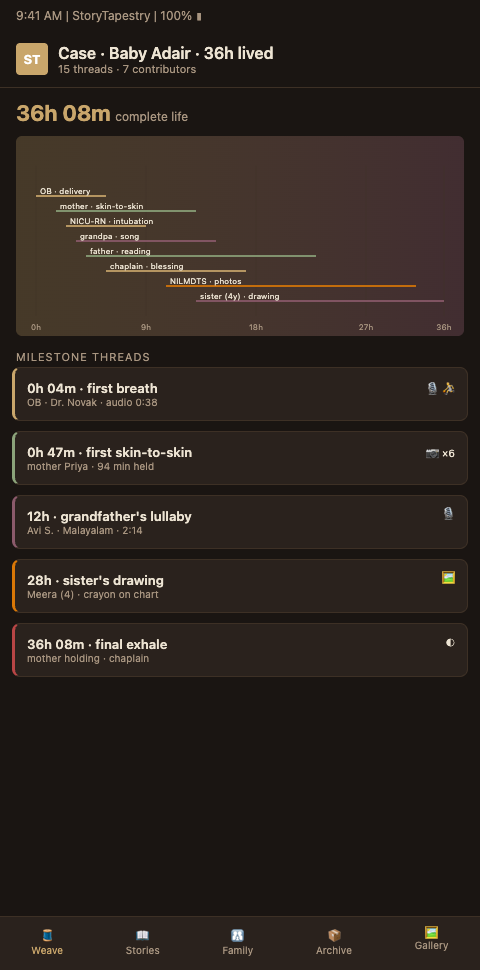
The case of Baby Levi shows how a 36-hour life can produce a layered tapestry when the right threading infrastructure is in place. The family activated a StoryTapestry within four hours of his birth, not as an act of anticipatory grief but as a practical tool to coordinate a geographically dispersed family. Because contributor threads can carry moments, reflections, photos, and voice notes asynchronously, the tapestry grew while Levi lived and continued growing for weeks after.
The contributor list tells you how the weaving happened. The birth mother contributed 9 entries including the moment of first eye contact at 4am. The father contributed 7 entries including a 90-second voice memo from the car outside the NICU at hour 20. The maternal grandmother contributed 5 entries across two continents because she was in Manila during the birth and flew in at hour 28. Four NICU nurses contributed across three shifts. The hospital chaplain contributed a reflection from the baptism at hour 12. The palliative care physician contributed a clinical note that parents had requested in the discharge bundle. Two aunts, one uncle, two family friends, and Levi's 3-year-old sister contributed through dedicated sibling voice inclusion workflows that translated her crayon drawings into tapestry threads.
The tapestry metaphor matters here. Each contributor saw only the thread they were weaving. They did not see the full pattern. That meant the overnight charge nurse, who had cared for Levi for 8 hours while the parents slept, contributed a detailed description of his breathing patterns and how he stilled when she hummed. The day nurse who followed her added a different thread: how Levi responded to his mother's voice differently than his father's. No single observer could have produced either thread. The tapestry made both visible.
Time-zone asynchrony was solved by the platform rather than by the family. The aunt flying from Singapore contributed her 34-hour reflection while boarding her flight. That entry became the emotional bridge the parents returned to most often during the first anniversary. StoryTapestry's audio waveform preservation captured the hospital chaplain's baptism prayer as a permanent visual artifact, something the family had not requested but found weeks later when the chaplain contributed it to the tapestry.
Trauma-informed prompting guided contributors who had never been asked to honor a brief life. The platform offered graduated prompts: observational entries for those who struggled with emotional articulation, reflective prompts for those comfortable with feeling language, and sensory prompts (What did Levi smell like? What did his small sounds remind you of?) for contributors who needed concreteness. The collaborative storytelling documented as supportive for bereaved families shows that structured prompts produce more and richer contributions than open-ended requests.
The completed tapestry for Baby Levi contains 47 distinct moments across 15 contributors, spanning the 36 hours of his life and the six weeks that followed. His mother returns most often to the charge nurse's 3am entry. His father returns most often to the uncle's video contribution. His sister will grow into her own relationship with the tapestry through multinational memorial weaving threads that came from family members in Manila, Sydney, and Los Angeles. The recurrent perinatal loss case study literature confirms that healthcare provider contributions, like those from Levi's nurses, shape parental grief trajectory for years.
Advanced Tactics for Activating Multi-Contributor Memorial Threads
The Levi case reveals tactical choices any bereavement program can replicate. Four patterns consistently distinguish multi-contributor memorials that thrive from those that stall at three or four entries.
Activate the tapestry early, not after death. Parents often feel guilty creating memorial infrastructure while their baby is alive. Reframe this. The tapestry during life captures moments that would otherwise vanish. Levi's contributors were invited at hour 6, which gave the Singaporean aunt 28 hours to contemplate her contribution rather than scrambling two weeks after the funeral. The legacy intervention feasibility documented for NICU parents supports digital storytelling activation during life rather than after.
Seed the tapestry with a clinical anchor entry. The palliative care physician's first note, contributed with parent consent, gave subsequent family contributors something to weave against. Nurses who see a physician's thread understand that clinical entries are invited. Family members who see a nurse thread understand that observational entries matter. This seeding eliminates the common failure mode where contributors wait for someone else to start.
Build trauma-informed prompts that recognize gestational age. A parent of a 22-week loss does not want the same prompt as a parent of a 38-week stillbirth or a 14-day NICU death, and modalities such as audio waveform preservation must adapt to what each circumstance actually produced. StoryTapestry's embodied grief narrative infrastructure adapts prompts to gestational circumstance while preserving the invitation to every contributor.
Preserve the thread provenance forever. Each entry records who contributed, when, and from where. Years later, when Levi's sister asks her mother who the overnight nurse was, the tapestry answers with name, shift, and the specific thread she wove. Provenance turns a memorial from a collage into a document of community.
Invite Families to Weave Brief Lives Into Lasting Tapestries
Hospital bereavement programs that want to move from thin artifacts to layered narratives can replicate the Levi framework in any Level II, III, or IV nursery. StoryTapestry provides the threading infrastructure, trauma-informed prompts, clinical integration, and multi-contributor coordination that transforms 36 hours into 47 remembered moments. If your program currently produces a photograph and a keepsake box, consider what another 44 entries across 14 contributors would mean for the families you serve. Schedule a case study walkthrough with our clinical team to see the Levi tapestry in full and discuss how your program could weave its first multi-contributor narrative next month. The walkthrough runs 60 minutes and covers the 14-contributor role map, the provenance-preserving thread architecture, the family-controlled ingest permissions, and the clinical integration checkpoints your bereavement coordinator uses to moderate staff contributions before family review.
Pilot engagements include platform access for your bereavement coordinator, one NICU charge nurse, and one L&D charge nurse, plus a named clinical implementation lead who shadows the first three multi-contributor cases and facilitates the first post-pilot debriefing session. Most programs complete the initial configuration within four weeks of contract signing and ship their first multi-contributor tapestry to a family inside eight weeks. Bring your bereavement coordinator, NICU nurse manager, and L&D nurse manager — the walkthrough produces a nursery-specific contributor map the three of them can present to hospital leadership before the pilot begins.