Case Study: Weaving a Memorial from 8 Countries and 4 Languages
The Stretched Family That Broke the Standard Workflow
Amal — we will use this pseudonym — died at 87 on a Wednesday morning. Her immediate family lived in Brazil. Her siblings lived in Beirut. Her children had emigrated to Canada, Australia, Germany, and the United States. Her grandchildren added Sweden, the United Arab Emirates, and Argentina to the map. Eight countries. Four active languages: Arabic, Portuguese, English, and French. The funeral home that took the case in Porto Alegre had never run a project this distributed.
The global pressure behind this case is not exotic. UN DESA estimates 304 million international migrants in 2024, and a peer-reviewed study of transnational bereavement in Family Process documents how common stretched-family grief has become. Research on British Sylhetis and on African diasporic bereavement in the UK shows that families routinely coordinate rituals across continents. The financial and organizational costs of these coordinated funerals are chronicled in Taylor and Francis research on rituals of migration, and a 2024 study on virtual funeral participation found 48% of participants attended virtual services from multiple countries. Amal's case was ordinary by these statistics. What was unusual was that her family asked for more than a livestream.
Weaving the 47-Day Tapestry
The funeral home deployed StoryTapestry on day one and treated the platform as the memorial's structural loom. Here is the sequence.
Days 1-3: Warp threads. The daughter in Toronto acted as coordinator. She populated the tapestry skeleton: eight biographical periods spanning Amal's life from 1937 Beirut through 1970s Lebanon, 1980s civil-war displacement, 1990s settlement in Porto Alegre, and the grandchildren era. Each period became a tapestry section that contributors could thread into later. The platform's time-zone aware intake meant relatives in Sydney could add stories at 3 AM Porto Alegre time without blocking coordinators.
Days 4-14: Cross-continent story collection. Forty-one family members received contribution invitations in their preferred language. Arabic-speaking cousins in Beirut submitted voice notes; a grandson in Munich recorded a 12-minute video of Amal's knödel recipe, adapted for Middle Eastern stuffed vegetables. Technical requirements rivaled any global video integration project — raw files totaling 14 GB, formats spanning WhatsApp voice messages to 4K video. StoryTapestry ingested everything, normalized playback, and tagged each contribution with contributor metadata and origin country.
Days 15-25: Translation and weaving. Four human translators — Arabic-Portuguese, Arabic-English, French-English, and a Portuguese-English editor — worked in parallel inside the platform's translation memory. When a cousin referenced a Beiruti neighborhood bakery, the Arabic-Portuguese translator left an annotation; the Portuguese-English editor pulled that annotation through to preserve the reference for North American grandchildren. This workflow compounded: by day 20, the translation memory was auto-suggesting phrases for recurring Lebanese family idioms, cutting translation time on later contributions by 34%.
Days 26-35: Geolocation enrichment. The coordinator worked with the funeral home to add geolocation memorial metadata to each story — where it happened, not just who told it. Amal's 1975 displacement story was pinned to the Beiruti neighborhood. Her 1985 arrival in Porto Alegre was pinned to the apartment. The resulting map view became one of the most viewed sections of the final tapestry.
Days 36-42: Ritual stitching. Amal's family blended Maronite Christian funeral rites performed in Beirut, a Porto Alegre wake, and a memorial livestream for family who could not travel. The tapestry captured photos and video clips from all three, stitched in sequence, with language-appropriate captions.
Days 43-47: Final weave and delivery. The coordinator reviewed every story for consent, translation accuracy, and cultural fit. The platform produced a single shareable tapestry with 217 contributions from 41 contributors in 8 countries. Every contributor could view the whole tapestry in their preferred language.
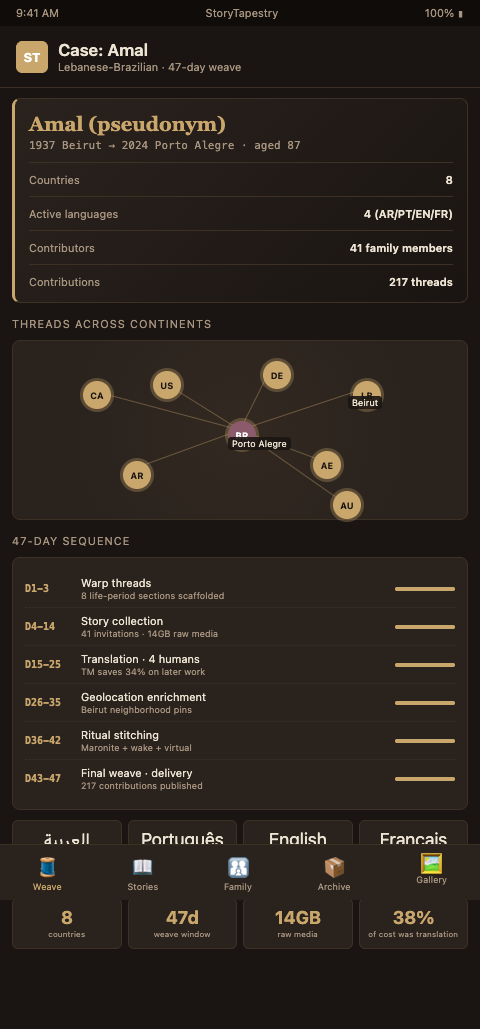
The final tapestry functions exactly as the metaphor suggests: you can see the whole, and you can trace each thread back to its source. This was closer in spirit to collaborative genealogy projects like Geni's World Family Tree than to conventional funeral programs. Another useful parallel is the fragmented source case study from the memory care niche — different trigger, same fragmentation problem.
A few specific choices during this case illustrate how the platform handled complexity that would have broken conventional tools. When Amal's brother in Beirut, age 84, attempted to record his tribute, his first three attempts were cut short by phone battery failure, wind noise from an open window, and an interruption when his caregiver arrived. The platform's segmented recording mode let him restart from the last saved segment rather than beginning over each time, and his grandson in Stockholm remotely guided him through the setup by video call. His final 37-minute recording, stitched from six sessions over four days, became one of the most viewed sections of the tapestry. Conversely, when a niece in Sydney submitted three separate tribute videos over two weeks, the platform grouped them automatically on the timeline rather than displaying them as redundant duplicates, preserving each one's distinct angle.
Advanced Tactics From This Case
Three lessons from Amal's tapestry transfer directly to your next transnational case:
Assign exactly one family coordinator. Having two coordinators in different countries sounds balanced but creates scheduling conflicts the platform cannot resolve. Amal's daughter in Toronto took ownership; everyone else contributed. When a family wants co-coordinators, split by life period or language, not by equal authority.
Set translation cutoffs, not translation deadlines. Instead of "all translations done by day 14," set "any contribution arriving after day 25 gets basic machine translation only." This enforces quality for the bulk of material while keeping the door open for late arrivals.
Use voice notes as the default intake format for elders. Amal's elderly siblings in Beirut could not use video upload flows. Voice notes over WhatsApp, forwarded to a dedicated platform address, auto-ingested and transcribed, captured four hours of stories that would not have otherwise existed.
Invoice translation separately from platform fees. Families understand paying translators. Bundling translation into a platform subscription obscures value. Present human translation as a per-minute-of-content line item. For Amal's case the translation line was 38% of the total project cost — families saw the work and paid without friction.
Document ritual choices in the tapestry itself. Amal's family blended three rituals across three countries. A brief text panel in the tapestry explains why — "we held a Maronite service in Beirut because her parents are buried there; a Porto Alegre wake because this was her home for 35 years; a virtual memorial because grandchildren could not travel" — so future generations viewing the tapestry understand the reasoning.
Plan for contributor wellness across a long intake window. A 47-day collection window is long enough that contributors' own lives continue during it. Amal's niece in Munich gave birth during the window; her nephew in Auckland had minor surgery; her sister's husband in Beirut had a cardiac event. StoryTapestry's coordinator dashboard flags when a contributor has gone silent for more than a week and prompts gentle follow-up rather than pressure. Several contributors later expressed gratitude that the follow-up came as a check-in rather than a deadline reminder, which reflects the respect diaspora families need throughout a prolonged memorial process.
Account for repatriation contingencies in the timeline. Amal's family initially planned a 28-day window and expanded to 47 days when documentation delays pushed the Beirut memorial later. The platform accommodates these shifts gracefully, but the coordinator should communicate clearly with contributors when windows extend so that late submissions do not feel awkward. A one-line update email to all contributors at each major timeline change preserves the collective experience even as dates shift.
Preserve the case as a teaching artifact for future coordinators. Amal's case, redacted of personal details, became a training reference inside the funeral home. Future cases with comparable complexity could draw on the specific sequences, prompt variants, and translation-memory patterns that worked in her case. This institutional memory compounds value across subsequent cases, so documenting the case as a reference resource is worth the modest effort.
Take the Next Step
StoryTapestry handled Amal's eight-country memorial because we built the platform for exactly this kind of stretched-family case. If you are a diaspora funeral service bracing for similar complexity, we will walk you through a redacted version of this case and show you the coordinator dashboard that made it possible. Request a case-study demo at the link below. We can be in a call within three business days with our head of customer success on the line. The demo includes the actual dashboard views from Amal's case, the translation memory corpus that accelerated later contributions, the geolocation-enriched map view that became one of the most viewed sections, and the ritual-stitching workflow that unified the Beirut, Porto Alegre, and virtual services into one memorial.
We also cover the pricing model for comparable cases, typical timelines for cases spanning six or more countries, and the staffing implications for funeral homes considering whether to build internal capability or partner with our case management team. Funeral homes that encounter eight-country cases once or twice a year benefit from our white-glove coordination service; homes with multiple such cases per month benefit more from direct platform licensing and internal capability development. We help you determine which model fits your caseload, and we do not push the licensing option when partnership would serve your families better. Your next stretched-family case does not have to become a logistical crisis; it can become your funeral home's strongest reference case for the next decade of diaspora memorial work.