Case Study: Rebuilding a 40-Year Life Story from 12 Fragmented Sources
When the Storyteller Is the One Who Forgot
Margaret, 82, entered memory care in 2018 after eight years of progressive Alzheimer's. By the time she died in 2024, she could no longer name her husband or recognize her daughter Sarah in photographs. Sarah is not unusual. A review of 83 studies on autobiographical memory in Alzheimer's disease documents that episodic memory degrades earliest and most severely, leaving families with decedents who cannot narrate their own lives.
The clinical literature is blunt about the consequence: fragmented pieces require emotional cues to reconstruct because the person who lived them can no longer sequence them. Sarah arrived at Thompson Family Funeral Home with a shoebox of Post-it notes her mother had written during lucid windows in 2019-2021, a 23-second voicemail from 2013, five photographs, and a printed spreadsheet of 14 family members, hospice workers, memory-care staff, and old friends who might remember something.
The stakes are bigger than one memorial service. Informant history is integral to confirming cognitive deficits during life, and in death it becomes the only mechanism for reconstructing a 40-year identity. Without it, Margaret's great-grandchildren would grow up knowing the woman in the nursing home, not the woman who ran a dry-cleaner shop in Queens for 27 years. This case study documents how Thompson Family Funeral Home rebuilt her story in six weeks using StoryTapestry.
The reconstruction had structural constraints from the start. Sarah's brother in Florida was 79 and hospitalized intermittently during the interview window. Two of Margaret's closest friends from the 1980s had pre-deceased her. The priest who knew her in 1992 had retired to Ireland and was reachable only by email. These constraints are typical, not exceptional — families arriving for memory-care memorial work almost always face partial, time-pressured, geographically dispersed informant sets. Thompson's team had to design the reconstruction around what was actually available rather than an idealized source list.
The 12-Source Reconstruction: A Tapestry in Practice
Thompson's intake director mapped Margaret's fragmented sources before any interviews. The 12 sources broke into four clusters: family (Sarah, two grandchildren, one brother in Florida), professional caregivers (two hospice aides, three memory-care staff from two facilities), community (the priest who knew her from 1992, a former dry-cleaner employee), and artifacts (the 1987 letter to her sister, the 2013 voicemail, a wedding video, the shop's receipt book).
The tapestry metaphor is structural here, not decorative. Each source provides threads that alone are unreadable. The dry-cleaner employee, Luis, remembered that Margaret gave him $50 every December from 1998 to 2011 "for his kids' Christmas." He had no context for why she stopped. The 2019 Post-it, in shaky handwriting, said "Luis's boy finished college — send card." The 2013 voicemail was Margaret telling Sarah, "I'm so proud of Luis's Daniel, first in family to finish." Three threads. One continuous story about a woman who tracked her employee's son for 13 years.
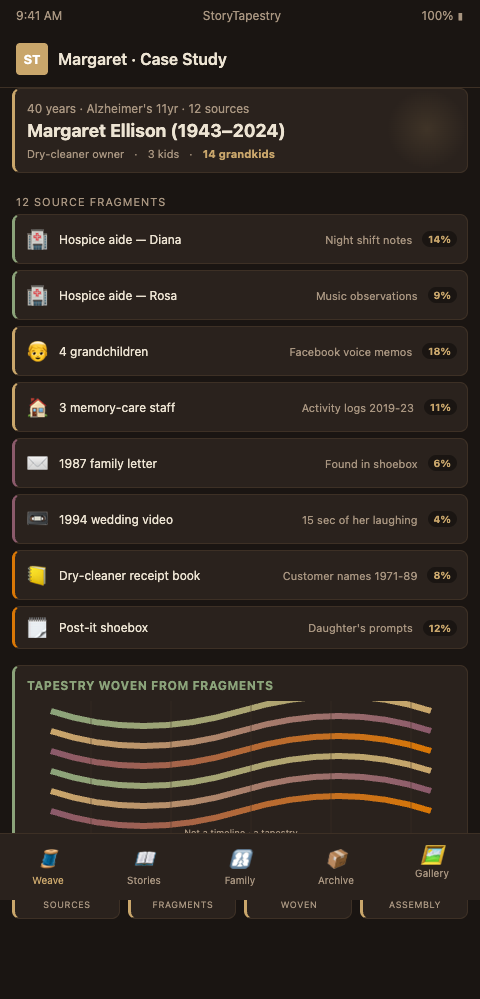
StoryTapestry ingested each source's fragments through cognitive-stage-sensitive prompts tailored to the informant's relationship. Family members got autobiographical prompts ("what did she teach you about money"). Professional caregivers got behavioral prompts ("what did she repeat in late-stage conversations"). Community sources got episodic prompts ("tell me about one specific day"). The prompt library draws from literature on how dementia care residents manage chaos through life storytelling, where multi-informant input raises whose-story tensions that the system must surface rather than silently average.
Contradictions appeared immediately. Sarah remembered her mother as strict about money. Luis remembered her as generous. The brother in Florida remembered her as anxious about finances after the shop closed. StoryTapestry flagged the conflict and presented it to Sarah through the reconciliation workflow, where she discovered — through the 1987 letter — that her mother had been both: strict internally, generous externally, anxious in private. The contradiction was the truth. Collapsing it would have falsified the tapestry.
The artifacts threaded through as anchor points. Objects distribute autobiographical memory across physical holders — the receipt book held 27 years of Margaret's handwriting evolution, the wedding video held her 1968 voice saying phrases her granddaughter never heard her say. Thompson's director wove these artifacts into the tapestry as fixed points around which the interview-sourced fragments arranged themselves chronologically.
The reconstruction echoes findings in advanced-dementia narrative identity research: people with late-stage cognitive loss construct narrative identity through family mediation. StoryTapestry formalized this mediation into a workflow. Over six weeks, Sarah reviewed 127 discrete fragments, reconciled 19 contradictions, and approved a woven tapestry that became the centerpiece of a 90-minute memorial where 40 attendees left knowing Margaret as dry-cleaner, neighbor, mother-in-law, and employer — not only as memory-care resident.
This case study also illustrates why pre-diagnosis memory preservation matters: three of Margaret's 12 sources only existed because Sarah had recorded voicemails and saved Post-its during lucid windows. Families who wait for funeral planning to begin story collection have fewer threads to weave.
The memorial itself was structured as a tapestry walk rather than a linear service. Attendees entered the chapel to find a projected tapestry display with threads color-coded by source cluster — family in deep blue, caregivers in warm amber, community in forest green, artifacts in copper. Sarah gave an opening that acknowledged all 12 contributors by name. The priest's remote message (delivered by video) followed. Luis spoke briefly about the dry-cleaner years. The hospice aides shared two late-stage moments each. The final 30 minutes of the service had no speaker — attendees circulated the room, interacting with the tapestry, reading the fragments, adding their own memories to a supplementary thread opened specifically for the service. This format is structurally different from a eulogy-plus-condolences service, and it produced what Sarah later described as "the first time in six years I felt I understood my mother whole."
Advanced Reconstruction Tactics for Complex Cases
Identify artifact anchors before interviews. The receipt book and wedding video let Thompson's director ground every interview in shared material. When Luis could not remember the decade of a story, the receipt book's handwriting samples helped place it within a five-year window. When the brother in Florida gave vague dates, the wedding video footage of his 12-year-old self placed family dynamics in 1968 specifically. Artifacts do the dating work that failing memory cannot.
Sequence interviews from outermost to innermost. Thompson interviewed Luis (the employee) and the priest before the brother, and the brother before Sarah. Peripheral sources surface uncontested facts — names, dates, small anecdotes — that form a scaffold. Core family members then react to this scaffold and either confirm or refine it. Interviewing Sarah first would have centered her version as truth and made contradictions feel like attacks rather than data.
Use AI narrative threading cautiously, not generatively. StoryTapestry's AI module stitched Margaret's fragments into chronological sequences and surfaced patterns (the 13-year Christmas gift to Luis's family) but did not invent connective tissue. Directors who let AI fill gaps produce smoother tapestries that families later reject as untrue. Margaret's tapestry has gaps — the 1995-1998 period is thin because two potential informants died before she did — and the gaps stay visible.
Treat contradictions as features. Sarah's "strict" and Luis's "generous" were both true at different scales. StoryTapestry's contradiction workflow preserves both and annotates the context, rather than averaging them into "Margaret handled money in a complicated way." Late-stage dementia memorial work often surfaces contradictions that families would prefer to flatten — hold the line against flattening.
Build a local "artifact rescue" partnership with memory-care facilities. Three of Thompson's 12 sources were staff at two facilities where Margaret lived. Staff keep fragments — anecdotes, drawings residents made, phrases repeated — that families never learn about because no one asks. A standing agreement with facility social-work teams to flag decedents for bereavement outreach turns staff into a reliable 12th, 13th, 14th source. For veteran families, parallel techniques apply when building comrade account assembly from 22 former colleagues spread across 30 years of service.
Sequence fragment verification ahead of family review. Before presenting reconciled threads to Sarah, Thompson's director cross-checked factual claims — names, dates, places — against artifact evidence and independent source confirmation where possible. Luis's recollection that the dry-cleaner's original location was on Northern Boulevard was verified against the 1987 letter's return address. The brother's claim that Margaret's wedding dress was sewn by their aunt was cross-referenced with the wedding video's visible tag reading "handmade by E.R." (the aunt's initials). Fragments that cannot be verified are not discarded — they are threaded with an "unverified" flag so families can decide whether to retain them. This preserves the polyphony while distinguishing factual claims from remembered impressions.
Budget for the real reconstruction timeline. Six weeks, not six days. Funeral directors under pressure to produce a memorial within the traditional 7-10 day window should either negotiate a delayed service date with the family or produce a "first-pass" tapestry for the service with the understanding that reconstruction continues for 30-60 days afterward. Families who know the tapestry is extensible accept the first-pass artifact readily; families who are told the first-pass version is final can resent the gaps they later discover. Be explicit about the timeline.
Ready to Rebuild a Life?
Every family that walks into a funeral home with a shoebox deserves the Margaret treatment — not a compressed obituary but a tapestry that honors the complete person. StoryTapestry is the infrastructure Thompson's director used, and it is available to any funeral home that wants to offer this caliber of memorial work. Schedule a 45-minute case-study walkthrough where we take you through Margaret's reconstruction step by step and show you how your home can run the same process within 90 days. The walkthrough covers source-mapping templates, interview scripts calibrated for care-facility staff and long-estranged relatives, the contradiction reconciliation protocol that kept Sarah's and Luis's accounts intact, and a review of the artifact-verification steps that upgraded unverified fragments to threaded evidence.
Firms that move forward receive a 30-day pilot engagement with one dedicated case, platform access for two funeral directors, and a named reconstruction advisor who shadows the first intake conversation. We return a gap analysis identifying where your current intake process drops fragments, plus a staffing recommendation matched to your expected dementia-loss case volume. Pilot onboarding begins within two weeks of the walkthrough, and most firms run their first complete reconstruction case inside 60 days. Bring one funeral director, one aftercare coordinator, and any memory-care facility partner willing to join — the call produces a shared action list across the three roles.