Case Study: Assembling a 30-Year Career from 22 Comrade Accounts
The 30-Year Career Reconstruction Problem
CSM Robert Keller retired from the Army in 2002 after 30 years of service. He died in January 2026, leaving behind his wife, three adult children, and an attic full of awards, unit photos, and a reunion mailing list two decades out of date. His widow Linda approached the funeral home coordinator with a simple request: "His family knew the dad. His men knew the soldier. Can we build something that shows both?"
The reconstruction problem for 30-year careers is harder than most memorial workflows acknowledge. Per Federation of American Scientists analysis, military retirement eligibility cliff-vests at 20 years, which means the cohort of veterans with 20+ year careers is substantial and growing—yet their service narratives span units, deployments, and duty stations that no single contributor witnessed. Peer-reviewed longevity research on 20+ year military retirees documents that these veterans develop overlapping but non-identical relationships with comrades across their careers. Basic training buddies lost touch by the time of first permanent duty station. First-tour squad members dispersed after 36 months. Mid-career staff peers knew the professional soldier but not the young trooper.
PMC research on unit cohesion confirms the bond pattern: deep connections form within units during deployments and high-intensity training, then fade geographically once duty stations change. A 30-year career spans 10-15 such unit cycles. No single comrade saw more than 10-20% of the career. The memorial must be assembled from fragments.
Funeral home coordinators without a structured reconstruction workflow default to letting the family write the obituary from their own limited knowledge. The resulting tribute skips entire decades of service, misattributes assignments, and fails to activate the comrade network who most wanted to contribute.
The StoryTapestry Reconstruction Workflow
The Keller memorial used a four-phase reconstruction approach designed for long-career reconstructions. Each phase weaves additional threads into the tapestry, respecting the civilian military chapters distinction while ensuring neither life domain overshadows the other.
Phase One: Career Skeleton. The coordinator worked with Linda to pull Robert's DD-214 and construct a chronological skeleton of assignments: Basic and AIT at Fort Dix (1972-1973), first assignment with 1st Battalion, 7th Cavalry at Fort Hood (1973-1976), Ranger School (1977), 2nd Ranger Battalion at Fort Lewis (1977-1981), drill sergeant duty at Fort Jackson (1981-1984), and onward through First Gulf War, peacekeeping deployments, and a final SOCOM staff tour. Each assignment became a chapter placeholder on the tapestry canvas. The Taylor & Francis analysis of oral history as autobiographical practice validates this skeleton-then-flesh approach for reconstructing lives from multiple-source testimony.
Phase Two: Comrade Discovery. With 12 identifiable units across the career, the coordinator needed to find surviving comrades from each. Together We Served provided the initial directory hit—2.5 million member profiles searchable by unit and date range. Linda's shoebox contained a unit reunion flyer from 2015 with 40 names, half with email addresses, half needing lookup. Facebook veterans groups for 2nd Ranger Battalion (1970s-80s era) surfaced three additional contacts. The VFW post Robert had attended provided two more. By end of discovery, the coordinator had 68 candidate contributors across 12 unit chapters.
Phase Three: Structured Contribution. Rather than sending a generic "share a memory" link, StoryTapestry generated unit-specific contribution prompts. A 1st Cav soldier from 1974 received prompts about Fort Hood life, specific training exercises during that window, and any photos from the barracks era. A Ranger School classmate received prompts about the 1977 class experience. A Gulf War peer received deployment-specific prompts. Structured prompting, as recommended in the Columbia Oral History bibliography, produces richer, less-repetitive testimony than open-ended solicitations. Twenty-two of the 68 candidates contributed substantive accounts within the first three weeks—a 32% response rate, which outperforms typical memorial contribution benchmarks.
Phase Four: Tapestry Integration. Each contributor's account was tagged to its relevant chapter on the career tapestry. A single story from a 1977 Ranger School classmate about Robert's response to a helicopter extraction gone wrong was tagged to the 1977 chapter. A 1991 Gulf War story about his handling of enemy prisoners went to the Desert Storm chapter. When multiple contributors touched the same episode, StoryTapestry's conflict-flagging surfaced inconsistencies—two contributors remembered the callsign of Robert's Kuwait convoy differently—which the coordinator resolved by routing back to the senior contributor with direct knowledge.
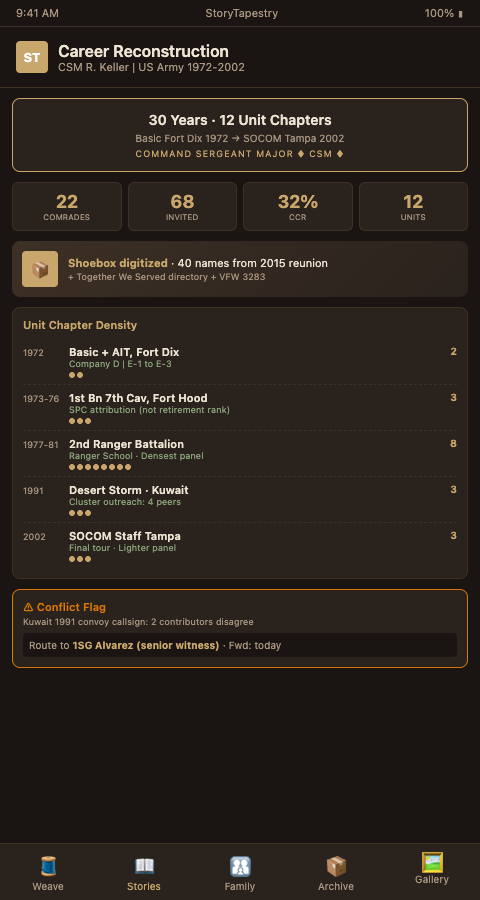
The final memorial tapestry represented 30 years, 12 unit chapters, and 22 distinct comrade voices. Linda said the Ranger School episode—which she had never heard before in 44 years of marriage—was the moment she felt she understood who her husband had been at 25. Long-career reconstructions succeed when the workflow treats the memorial as a distributed knowledge-assembly project, not a solo-author obituary. PMC research on unit cohesion and post-deployment mental health confirms these bonds persist for decades, making late-career comrade outreach viable.
Attribution discipline mattered throughout the Keller reconstruction. Each of the 22 contributions appeared on the tapestry with the contributor's rank and unit at the time of the shared experience, not the contributor's final rank or current status. A former specialist who served under Robert in 1978 appeared as "SPC, 2nd Ranger Battalion, 1978" rather than his later retirement rank, because that is how the shared memory was formed. A Gulf War peer who served alongside Robert as a fellow Staff Sergeant appeared at that rank even though he retired as a First Sergeant fifteen years later. Veterans notice this kind of attribution discipline immediately because it mirrors the way their own memories are organized around the rank structure of each specific tour.
Advanced Tactics for Multi-Decade Careers
Geographic deployment mapping deepens the tapestry's temporal dimension. Overlay Robert's assignment chronology on a world map and the career arc becomes immediately legible: Fort Hood, Fort Lewis, Fort Jackson, Saudi Arabia, Bosnia, Fort Bragg, Tampa. Pair this with the geospatial deployment mapping approach for full visual coherence. Viewers can tap each location to see who contributed from that chapter, which photos were taken there, and how long Robert stayed.
Rank progression visualization adds career-arc context. A 30-year career moves from PFC through CSM—a 12-grade climb that most civilian audiences don't intuitively understand. StoryTapestry's rank ribbon visualizes the progression chronologically alongside each assignment chapter, so the memorial shows not just where he served but how he grew through the ranks. Comrade contributions can be timestamped by the rank he held when the contributor knew him, creating temporal accuracy that mono-rank memorials miss.
Photo dating through AI-assisted uniform analysis helps place undated photos into the correct chapter. A photo of Robert in woodland BDUs with no date markings can be analyzed for uniform era (BDUs in circulation 1981-2005), insignia details (Ranger tab, 2nd Battalion flash, specific rank insignia), and background cues to narrow placement to a 3-5 year window.
Era-specific contributor outreach language matters. The email you send to a 2002 SOCOM peer (age 50s, digitally fluent) differs from the phone call you make to a 1974 Fort Hood buddy (age 70s, possibly not on social media). StoryTapestry's contributor workflow supports era-coded outreach templates. Multi-decade memorials that cross three distinct communication generations need this variability to hit the full cohort.
For broader reference on cross-border long-career assembly, the multinational memorial case study demonstrates parallel multi-source reconstruction at geographic scale, validating the same structural patterns.
Deployment-cluster outreach produced higher yield than generic memorial requests in the Keller build. When the coordinator reached out to four Gulf War peers simultaneously, three contributed within ten days because each saw that others from the same unit were also being invited. One of the three mentioned that the platoon sergeant Robert reported to during that tour was still alive and living in Florida; the coordinator added him to the outreach list and received a rich contribution two weeks later. The cluster approach leverages unit cohesion principles directly: comrades respond more fully when they see their unit being honored collectively rather than being treated as scattered individual informants.
Chapter weighting mattered for Linda's experience of the finished tapestry. The 2nd Ranger Battalion chapter held eight contributions and became the densest panel on the tapestry, which matched Robert's own sense of his career because he spoke of the Ranger years more than any other period. The SOCOM staff tour chapter held three contributions and was correspondingly lighter. Families recognize when a memorial's visual weight matches the veteran's own sense of his career arc; this calibration is the difference between a tapestry that feels right and one that feels like a generic service record.
Late-arriving contributions continue to enrich the tapestry months past publication. Six months after the initial memorial build, a former Ranger School classmate found the published tapestry through a unit reunion Facebook post and contributed a fifteen-minute audio recording about the specific patrolling exercise in 1977 that shaped Robert's early career. The tapestry absorbed the contribution as an additional thread in the Ranger School chapter, and Linda received a notification that the memorial had thickened. Long-career memorials continue to grow across the first year and beyond, and the platform supports that ongoing expansion rather than locking the memorial at the funeral service.
Build Your Next Long-Career Memorial
Veteran Memorial Programs handling 20+ year career reconstructions need a workflow that treats contributor assembly as a managed project, not a serendipitous event. StoryTapestry's four-phase workflow—skeleton, discovery, structured contribution, integration—has now been validated across retirements spanning 20 to 40 years of service. Book a workflow consultation with StoryTapestry to pilot the reconstruction methodology on your next career retiree memorial. A retired sergeant major's 30 years deserve better than a ten-line obituary.
The consultation walks through a pending long-career reconstruction from your own intake queue, mapping the DD-214 fields into chapter placeholders, identifying candidate contributor directories for each unit, and drafting the outreach sequence your staff will execute over the memorial's first three weeks. We cover the specific trauma-informed practices that apply to combat-era contributors, the pacing of outreach waves across the contributor pool, and the contributor reconciliation workflow for resolving memory conflicts. Funeral homes in regions with retiree concentrations—communities near Fort Bragg, Fort Hood, Joint Base San Antonio, Hampton Roads, San Diego, and Colorado Springs all host large retiree populations—typically handle multiple 20-to-40-year career memorials per year, and the standardized workflow dramatically reduces the per-memorial staff time while raising the contribution depth across every memorial.
Firms serving smaller retiree populations benefit because the handful of long-career reconstructions they handle annually receive the same structured treatment rather than becoming ad hoc projects that the staff builds from scratch each time. Schedule the consultation with Linda Keller's 30-year reconstruction as your baseline reference, and pilot the workflow on the next retired Command Sergeant Major, First Sergeant, Senior Chief, or Master Chief who comes through your intake door.