Scaling Flow Data Across a 40-Exhibit Floor
The Compression Problem on Large Floors
At 10:15 AM, P.S. 142 unloads 32 third-graders into your atrium. A smaller museum might funnel all of them into a single gallery. On a 40-exhibit floor, those kids branch into four corridors within the first ninety seconds—and your Water Cycle puzzle, your Earthquake Simulator, your Forces of Flight stations, and your Fossil Dig are all competing for attention at the same moment. Your docents can't be everywhere. Your chaperones are already trailing the fastest third of the group toward the far end of the floor.
The challenge isn't that you lack data. Modern sensor deployments can cover roughly 120 square meters per sensor unit, meaning a 40-exhibit floor may be pulling from 15 to 25 independent data streams simultaneously. The challenge is that raw throughput data from those streams doesn't tell you whether bypass at the Water Cycle puzzle happened because the wave was too fast, too large, or because the group came in from the wrong entrance and never saw the station's approach corridor.
Consider the specific failure mode: your sensor at the Water Cycle cluster shows low dwell time on Tuesday mornings. Is that because the wave is bypassing the station? Or because the wave is hitting the station but not engaging—children touching the first lever and moving on in under 20 seconds? Or because the sensor is in the adjacent corridor and the students are engaging at the station but outside its detection radius? Without a floor-wide model that connects those 15 to 25 streams into a coherent picture, you're diagnosing individual zones and missing the system-level pressure dynamics driving what you're seeing.
Spatial Layout and Visitor Paths (MDPI) documents how spatial configuration shapes path choice across multi-gallery museums: the layout topology itself—not just signage or docent positioning—predicts which stations absorb traffic and which get bypassed structurally. On a 40-exhibit floor, you have multiple layout typologies coexisting in one building. Scaling flow data means accounting for that structural variation, not just stacking up sensor feeds.
Analyzing Visitor Behavior (MDPI) reports that AI/ML adoption for real-time crowd alerts now sits at 63.6% among institutions actively monitoring visitor flow. That figure suggests the field has crossed the early-adopter threshold—but the majority of those deployments are single-zone or single-floor implementations. Multi-zone, floor-wide scaling requires different modeling assumptions than a single-room pilot. The specific difference is coordination latency: a single-zone system can respond to what's happening in that zone; a floor-wide system needs to predict where pressure will be in 8 to 12 minutes based on what's happening now, so your docents and partition configurations can be adjusted before the wave arrives rather than after it has already bypassed three stations.
From Zone Data to Floor-Wide Wave Pressure
PressurePath treats a school wave entering your building the same way a fluid dynamics model treats a high-pressure burst moving through a pipe network. When 32 third-graders enter your atrium, they're a pressure event. The floor's corridors and exhibit clusters are the pipe branches. Each interactive station is a valve: if it's open (engaging, physically accessible, developmentally appropriate), it captures flow and drops local pressure. If it's closed (bypassed, crowded, poorly positioned), pressure continues downstream and the next station absorbs a larger, faster burst.
Scaling this metaphor to 40 exhibits requires solving a specific modeling problem: how do you connect the pressure readings from individual zone sensors into a coherent floor-wide pressure map in real time?
Managing Crowded Museums (ScienceDirect) describes IoT-based Lagrangian tracking that creates stochastic digital twins to optimize flow at scale. The key insight is that Lagrangian tracking follows individual trajectories through the space rather than aggregating zone counts—so when a wave splits at your atrium's T-intersection, the model distinguishes between the sub-wave that turned left toward the Water Cycle puzzle and the sub-wave that turned right toward the Fossil Dig. Each sub-wave carries its own pressure signature.
Interactive Visitor Flow Analytics (Jönköping) demonstrates that sliding-window analysis with MLP networks can reconstruct visitor trajectories at room scale across multi-zone venues. The sliding window is critical for floor-wide scaling: it lets the model update pressure estimates as new sensor data arrives without requiring a complete recalculation of the entire floor's state. That's the difference between a system that can respond to a wave in real time and one that's always a few minutes behind the actual movement.
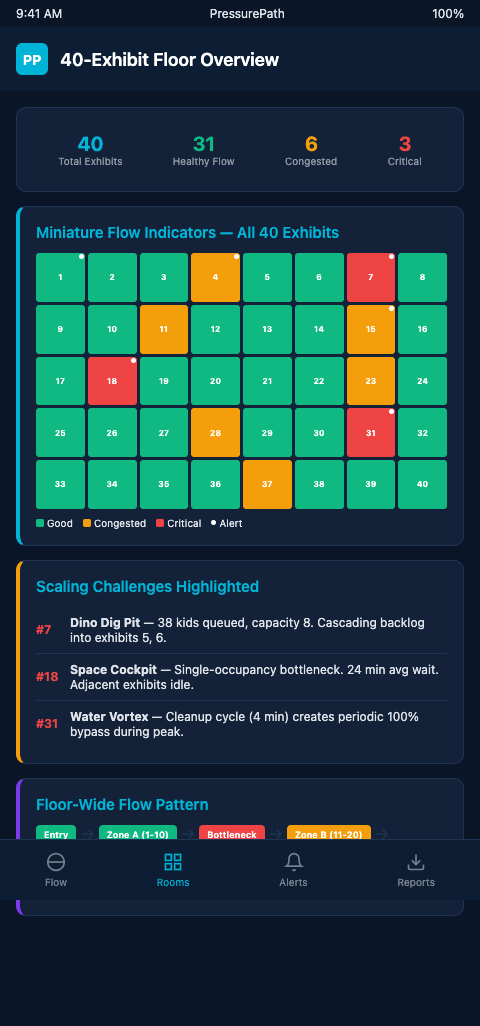
The practical architecture for a 40-exhibit floor looks like this: individual zone sensors feed into cluster-level aggregators for each wing or gallery area. Those cluster aggregators feed into a floor-wide pressure model that tracks wave position, wave density, and the bypass-rate at each station in the cluster. PressurePath's simulation layer runs on top of that model, predicting where pressure will accumulate over the next 10 to 15 minutes given the current wave's speed and density.
Museums Use Visitor Analytics for Funding (V-Count) confirms that enterprise sensor systems can cover 120 square meters per unit delivering zone-level dwell time data scalable across multiple exhibit areas. At that density, a 2,000-square-meter floor with 40 exhibits requires roughly 17 sensor units—a deployment cost that's justifiable once you're protecting $180K NSF-funded centerpiece stations from structural bypass.
Pedestrian Simulation Museum Circulation (MDPI) adds the behavioral layer: pedestrian simulation models that account for step length and movement speed let you differentiate a third-grade wave (shorter steps, higher density, faster directional changes) from an adult group (longer strides, more deliberate path choices). For educator dashboards, that differentiation matters because the corrective action for a fast-moving third-grade wave is different from the action for an adult group that's simply slow-walking past a station.
The visibility graph layer—documented in Natural Movement: Pathway Configuration (ScienceDirect)—maps which stations are visually accessible from each approach corridor and agent simulation path. On a 40-exhibit floor, this layer reveals the structural bypass candidates: stations that sit in low-visibility positions regardless of how engaging their content is. Those stations will show chronic bypass rates in your flow data until the approach sight line is addressed.
A museum that has implemented a floor-wide pressure model gains a specific operational advantage on field-trip mornings: when the 10:15 AM bus from P.S. 142 unloads, the model immediately classifies the arriving wave based on its estimated entry velocity and group size. It predicts which clusters will see pressure peaks in the next 10 minutes and which stations along the secondary corridors are at bypass risk. That prediction is available to the floor ops team before the leading edge has moved past the atrium—which is the only window where a docent positioning adjustment or a partition configuration change can actually intercept the wave before it generates a bypass event.
Calibrating Floor-Wide Data Without Sensor Overload
The risk of a 17-sensor deployment isn't data scarcity—it's noise. Every sensor on your floor is generating continuous readings, and when a school wave arrives, most of those readings spike simultaneously. Without a filtering layer, your ops team gets a dashboard full of red alerts with no clear priority order.
Three calibration practices make floor-wide data actionable. First, establish bypass baselines per station type before deploying full-scale flow monitoring. Your hands-on interactive stations should have different baseline engagement rates than your passive display panels—a station that gets 85% pass-through on normal days isn't in crisis; a station that drops from 40% engagement to 8% on school wave days is flagging a real problem. That distinction—normal-day pass-through versus school-wave-day bypass—is what your calibration baseline needs to capture per station. Without it, a floor-wide alert system will fire on your busiest stations (which have high absolute throughput and look alarming) rather than on the stations with meaningful engagement drops.
Second, weight pressure alerts by capital exposure. A bypass event at a $180K NSF-funded exhibit deserves a different alert threshold than bypass at a lower-cost interpretive panel. PressurePath lets you set grant-weighted bypass thresholds so your floor-wide pressure map surfaces the most consequential issues first—a direct input for building grant-worthy evidence when your next funding cycle arrives.
Third, build school-wave profiles into your calibration baseline. A 30-kid third-grade group from a Title I school moving through a 40-exhibit floor will generate a different pressure signature than a 15-kid homeschool co-op. Segment your calibration data by group type, entry time, and field-trip booking context so your floor-wide model isn't trying to average across fundamentally different wave shapes. The average school-group profile is a useful starting point but a misleading operating assumption: the groups at the tails of your group-size and grade-level distribution are the ones generating your highest bypass events, and those tails require their own calibrated thresholds.
A fourth practice becomes relevant once you have two or more semesters of floor-wide data: cross-station correlation analysis. On a 40-exhibit floor, bypass at station A is often correlated with overcrowding at station B—the wave that bypassed A didn't stop; it flowed to the next accessible station and created a density spike. Identifying those co-movement patterns lets you use a single early-indicator station (one that receives wave pressure before the pressure reaches the grant-funded exhibit) as a leading signal for impending bypass at a downstream station.
For museums beginning to scale from a single-wing pilot to a full 40-exhibit deployment, the lessons from scaling 4 to 12 rooms in other high-pressure crowd environments apply directly: the architecture decisions you make at five zones will constrain your options at twenty, so starting with a layered cluster model rather than a flat sensor array saves significant rework.
Scale Your Floor Monitoring Before the Next School Wave Season
The practical timing question for floor-wide monitoring is when to begin. The honest answer is that the data asset compounds, so the earliest start produces the largest long-term benefit. A museum that deploys sensors in September generates a full season of baseline data by June, which means the summer planning cycle can work from empirical patterns rather than staff intuition. A museum that delays deployment until the following fall loses a full year of accumulation, and its pattern-detection confidence intervals remain too wide to support capital decisions until late in the second year.
For a 40-exhibit floor specifically, the sensor infrastructure decision is also a capital planning decision. Sensor deployments at that scale typically cost less than a single mid-range interactive exhibit installation, but they generate the diagnostic data that protects every other exhibit investment from structural bypass. The ROI argument is straightforward: the sensor network is the diagnostic layer that makes every other piece of installed capital perform closer to its theoretical maximum. Floor-wide monitoring is not competing with exhibit investment — it's protecting it.
PressurePath is built specifically for children's museum exhibit designers managing multi-exhibit floors where one school wave can bypass your most important stations before a docent can redirect them. If you're planning a sensor expansion or a capital campaign that includes interactive stations, join the waitlist now to see how floor-wide pressure modeling protects your grant-funded exhibits from structural bypass.