Scaling Pacing Models From 4 Rooms to 12: What Breaks
The 4-Room Illusion and Where It Breaks
At four rooms, a pacing model feels manageable. Your Game Master covers the floor, resets happen in a sensible sequence, and the briefing room rarely sees two groups at once. The system has slack built in by accident — not by design.
Add rooms progressively and that slack disappears faster than the room count suggests. At four rooms running near 70% occupancy, average wait time for shared assets stays short. Push to eight rooms at the same utilization rate and wait time grows non-linearly, not proportionally. At twelve rooms, even a modest late arrival or extended session can trigger a cascade through the briefing room, reset stations, and photo op simultaneously. M/M/1 Queue — Wait Time Degradation (erikbern.com) documents the math: above 80% utilization, wait time increases explosively — and multi-room franchises hit that threshold on every busy Saturday without noticing because the individual room metrics still look fine.
The compounding problem is that chains and franchises are the growth driver right now — US Escape Room Industry Report – December 2025 reports Escapology reached 100 locations, and operators everywhere are expanding faster than their pacing frameworks can absorb. Most operators inherit a 4-room model and stretch it to 12 without rebuilding the underlying logic.
Bottleneck Analysis in Lean Manufacturing (ATS) identifies the parallel risk: in mixed-product environments, the constraint moves depending on the product path. A franchise with four beginner rooms and eight mid-to-hard rooms doesn't have a single pacing bottleneck — it has a different one every hour.
Why Queueing Math Breaks at Scale
The pressurized-water-in-pipes model makes the failure mode visible. At four rooms, pressure builds slowly and the main junction — the briefing room — has enough pipe diameter to absorb surges. At twelve rooms, four groups can exit parallel rooms within minutes of each other, all funneling toward the same junction at once. Pressure at the briefing room doesn't double when you double the rooms; it multiplies because simultaneous exits arrive in clusters, not evenly spread across the hour.
Economies-of-Scale in Many-Server Queueing Systems (SIAM) describes this precisely: the QED regime shows systems near full utilization require exponentially more coordination as server count scales. Each additional room you open requires more than proportionally more coordination infrastructure — not just one more Game Master, but faster signaling between reset stations, more buffered briefing capacity, and cleaner handoff protocols.
Queueing Theory and Economies of Scale (johndcook.com) makes the trade-off explicit: adding servers shows diminishing returns, and each additional room helps throughput less than the one before. That's the paradox — you build more rooms to serve more groups, but the pacing model required to run them efficiently becomes harder to maintain, not easier.
Three specific failure modes appear reliably between rooms 6 and 12:
Reset station contention. At four rooms, a single reset station can serve two rooms in the gap between session endings. At twelve rooms with parallel endings, two reset stations may need to service four rooms at once. The station that was a throughput asset becomes the new bottleneck.
Briefing room collision. With four rooms, a 12-minute briefing cycle rarely overlaps with more than one outbound group. At twelve rooms on a Saturday grid, back-to-back 60-minute sessions across six parallel rooms mean the briefing room receives groups almost continuously. A 3-minute late start anywhere compounds across the full pipeline.
Mixed-difficulty pacing divergence. Beginner rooms turn over faster than advanced rooms. A franchise mixing both types has two different flow rates running through the same shared infrastructure. The photo op queue, the briefing room schedule, and the Game Master rotation all need to accommodate both cadences. A pacing model calibrated to a uniform session length fails whenever the difficulty mix shifts — which happens every day as booking patterns vary.
Theory of Constraints — Lean Production explains the systemic effect: removing one bottleneck reshuffles the entire system, creating new constraints elsewhere. Fixing the briefing room collision by adding buffer time at sessions 1-4 just shifts the problem downstream to the photo op or the exit lane.
PressurePath models these three failure modes simultaneously, running your actual Saturday booking grid through a pipe network that accounts for session length distributions, shared asset capacity, and difficulty-adjusted turnover rates. Rather than discovering the reset station contention at 2:47 PM, you see it in the simulation at 9 AM on Friday.
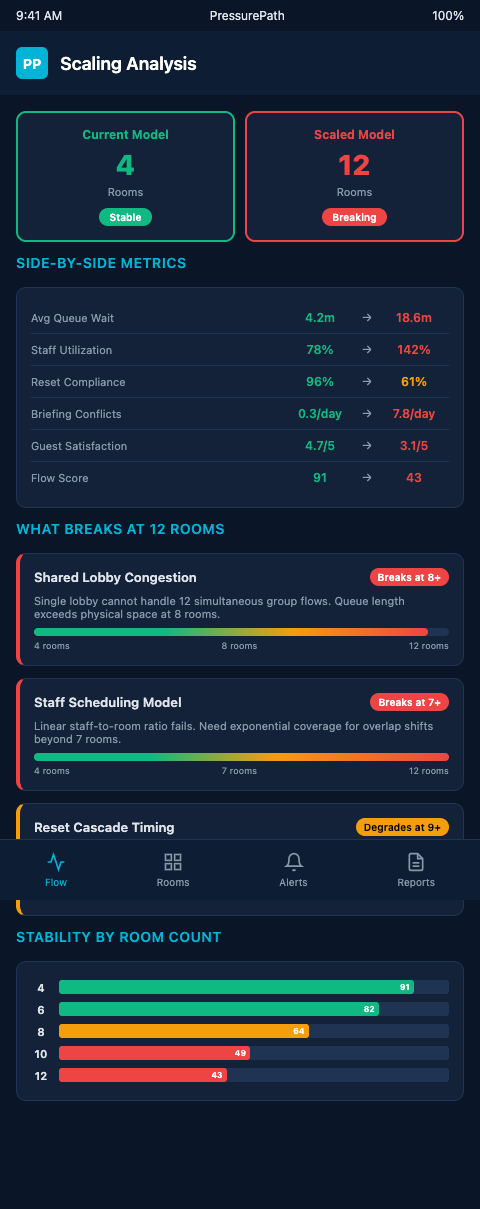
Rebuilding the Model for Scale
The fix isn't adding more buffer time everywhere — that costs revenue. It's identifying which specific transitions break at each room count threshold and designing only those transitions for resilience.
At six rooms, the first intervention is usually briefing room throughput. A staggered start protocol — where no two rooms begin sessions within 8 minutes of each other — eliminates most briefing room collisions without requiring additional space. That protocol is easy to maintain at six rooms and still manageable at eight.
At ten rooms, reset station sequencing becomes the priority. The model needs to assign reset order before groups even finish their sessions, based on projected completion times. A Game Master dashboard that shows the next three expected exits in order lets staff pre-position rather than react.
At twelve rooms, the photo op becomes the hidden constraint. Groups lingering after sessions block outbound flow from adjacent rooms. A timed photo op protocol — with a GM cue at seven minutes — keeps the pipeline moving without reducing guest experience. This matters especially as utilization rises toward the threshold where forecasting when to add a new room becomes the next capital planning question.
PressurePath surfaces these thresholds per location based on your actual booking data. You input your room mix, session lengths, and typical Saturday grid; the simulator shows you the exact room count where each failure mode first appears.
For franchises planning beyond twelve rooms, the franchise-wide flow standard determines whether new locations can inherit a proven protocol or require fresh calibration. Getting the standard right at ten rooms is far cheaper than rebuilding it at twenty.
The Theory of Constraints — Lean Production framework predicts the sequencing clearly: fix the current bottleneck, confirm the system improves, identify the next constraint, repeat. For a franchise at eight rooms, the current bottleneck is typically the briefing room. Fix that. At ten rooms, the next constraint is usually reset station sequencing. Fix that. At twelve rooms, the photo op becomes the binding constraint. Having this sequence mapped in simulation means you're not discovering each bottleneck under Saturday pressure — you're deploying the fix before the bottleneck activates.
Operators in adjacent entertainment categories face the same scaling pressure. The pattern of scaling immersive productions from 80 to 400 guests mirrors the multi-room breakpoints almost exactly — parallel pathways, shared assets, and the same non-linear behavior at utilization ceilings.
What to Do Before You Open Room 9
The most costly time to discover multi-room scaling failures is after opening. The second most costly time is during a Saturday peak. The right time is in simulation, with your real booking grid and your actual room mix, before you commit the staffing schedule.
PressurePath gives you a concrete checklist: run your current room count at projected Saturday utilization, identify the first shared asset that hits contention, and build the stagger protocol before training staff. Repeat the simulation when you add the next two rooms.
The operator who runs this simulation before opening Room 9 avoids the 2 PM emergency that no refund policy fully resolves. The operator who skips it discovers at peak-hour why their 4-room model stopped working — and tries to fix it with extra staff rather than with better sequencing.
The simulation's most important output isn't a list of problems — it's a sequenced action list. "Add stagger protocol between rooms 3 and 5 before operating above 70% utilization" is something your GM can implement before the next Saturday. "Assign reset station priority by projected completion time rather than floor proximity when more than six rooms are running simultaneously" requires a policy change, not a capital investment. These interventions cost nothing but preparation time, and preparation time is what the simulation buys you.
For franchises at eight rooms planning their ninth or tenth, run the simulation first. The output will tell you whether your current shared asset configuration can absorb the additional flow, or whether the ninth room requires a briefing room expansion before it generates positive throughput economics. That answer, delivered by simulation rather than by a bad Saturday, is worth considerably more than the cost of the simulation run.
If your franchise is at six or eight rooms now and planning to expand, the time to rebuild the pacing model is before the next location opens, not after. PressurePath is built to answer the scaling question before the construction decision is made — so your growth plan is founded on flow logic rather than optimism about how the existing model will stretch. Join the waitlist and we'll run the scaling simulation against your current room count as part of onboarding.