Flow Forecasting at Scale: When to Add a New Room
The Cost of Timing Errors in Both Directions
A franchise that adds Room 11 when Room 9 is running at 60% average utilization has made a capital commitment against insufficient evidence. That room needs to carry its construction and setup costs across a booking base that hasn't yet demonstrated demand for it. The margin impact of an underutilized room persists for 12-24 months while bookings grow into the capacity.
A franchise that delays adding Room 11 until every existing room is sold out on Saturdays has left revenue on the floor for the prior 8-12 months and likely sustained guest experience damage from briefing room overcrowding that will show up in repeat-visit rates before it shows up in booking cancellations.
Capacity Decisions Require Multi-Year Commitment (D. Brown Management) frames the cost structure clearly: capacity decisions require multi-year commitment, and timing errors are costly and long-lasting in both directions. The operational reality for escape room franchises matches this precisely — building and theming a new room typically requires a 6-12 month lead time, meaning the timing signal must come well before the capacity need materializes.
How to Manage & Scale a Multi-Unit Franchise (Operandio) confirms that beyond 10 units, expansion timing becomes a systematic decision rather than a heuristic — single-location intuitions about when the operation feels full don't scale to multi-site franchise management where different locations hit capacity at different times. The related challenge of scaling from 4 to 12 rooms within a single location operates on the same structural logic: each room addition reshapes the pressure profile of the entire network, and timing the addition requires pressure data rather than revenue intuition.
The Flow Thresholds That Precede Revenue Saturation
Revenue saturation — the point where available time slots consistently sell out — is a lagging indicator. The flow indicators that precede it by 3-6 months are measurable today.
Briefing room utilization rate. When the briefing room operates above 85% of theoretical maximum throughput on more than 40% of Saturday sessions, the facility is approaching the utilization threshold where a new room would create additional revenue rather than additional pressure. Below that threshold, adding a room may only make the briefing room problem worse.
Saturday booking density slope. The rate at which Saturday bookings per available room-hour are increasing tells you when the demand curve will cross the supply ceiling. If density is growing at 3% per month, you have 8-10 months before Saturday sellout — which aligns precisely with the lead time required to build and staff a new room.
Reset cycle variance. When reset cycle time variance increases across Saturdays — not the average, but the standard deviation — the system is absorbing increasing demand volatility through staff improvisation. That improvisation conceals the capacity problem from the revenue numbers but surfaces clearly in the timing data. Capacity Constraints as Growth Trigger (Springer) identifies firms at critically high utilization hitting a trigger point requiring broad investment or retreat — the escape room equivalent is the briefing room hitting that threshold, not the room count.
Briefing room second-queue frequency. When groups queue outside the briefing room before the preceding briefing completes on more than 35% of Saturday sessions, the facility has exhausted the throughput buffer at its primary constraint. Adding a room without addressing this adds demand before the constraint is resolved.
The pressurized-water-in-pipes model makes the threshold logic intuitive. The pipe network has reached capacity when multiple junctions simultaneously show near-maximum pressure during peak hours — not just one junction, and not just occasionally, but consistently and in combination. A single undersized pipe can be widened (briefing room protocol adjusted); a fully pressurized network requires a new branch (a new room routed through its own briefing and reset pipeline).
PressurePath runs your current booking data through the pipe network and calculates the pressure headroom at each junction. "Briefing room: 78% of maximum — 4 Saturdays before threshold at current growth rate" is a precise statement about timing, not a judgment call.
Multiserver Queues Scaling with Congestion (INFORMS) provides the formal model: when congestion-dependent demand signals adding a server becomes the only viable relief, the queueing model identifies that threshold mathematically. Applied to escape rooms, it's the point where briefing room wait time can no longer be reduced through scheduling alone and requires additional throughput capacity.
Capacity Planning for Service Organizations (Wolters Kluwer) frames three strategy types — lead capacity (build before demand arrives), lag capacity (build after demand is confirmed), and match capacity (build incrementally with demand). Escape room franchises with high construction lead times benefit most from a lead strategy calibrated against the flow threshold signals rather than revenue saturation.
What to Do With the Forecast
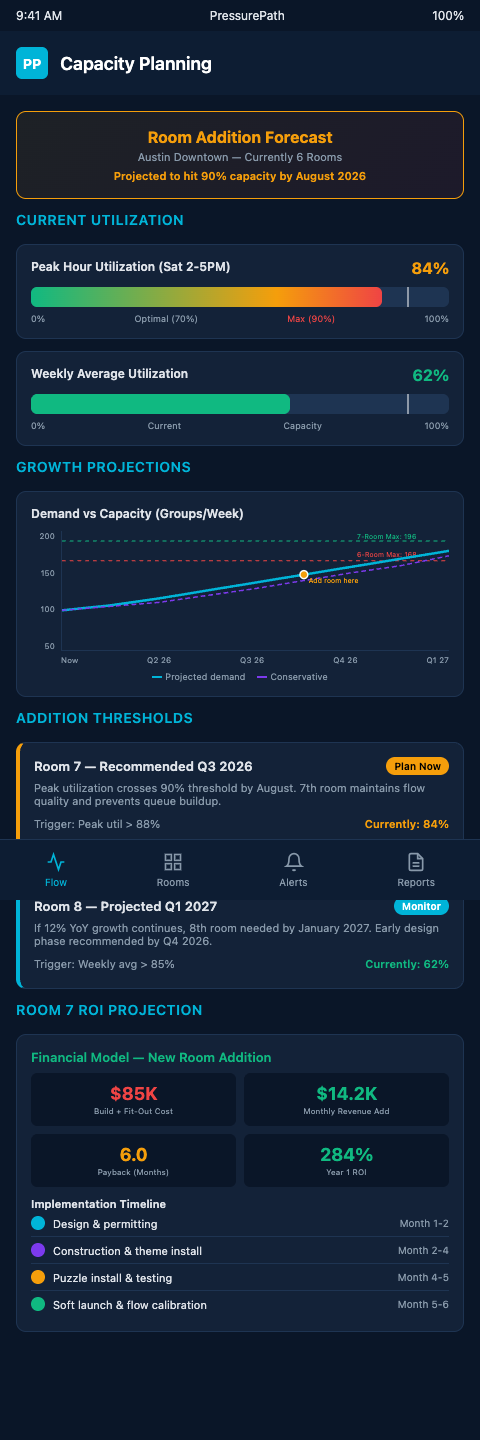
A franchise whose PressurePath analysis shows 6 months to briefing room threshold has three concurrent decisions to make, each with a different time horizon.
Immediate (this Saturday): If the briefing room is already operating above 80% throughput, implement the second-queue protocol now — designate a secondary briefing zone and assign a second GM to peak hours. This buys 3-4 months of additional runway before the structural constraint becomes unmanageable.
Near-term (this quarter): Begin the capital planning process for the new room — architectural assessment, theme concept, permit timeline. The flow forecast gives you the demand justification for the capital commitment. Escape Room Market Size and Forecast to 2032 (Allied) projects 14.8% CAGR, meaning the demand growth assumption behind your capital decision has macro support — but the specific timing signal comes from your facility's flow data, not the industry average.
Strategic (next 12 months): Plan the new room's position in the pipe network before designing it. Which shared assets will it share? Does it route through an existing briefing zone or require a dedicated one? Does it add pressure to the reset station that's already the most constrained? The room concept should follow the flow analysis, not the reverse.
The connection to scaling concerns is direct: each room addition changes the pressure profile of the entire network. The expansion signal tells you when to add; the scaling analysis tells you how to configure the new room's integration into the existing pipe network.
Understanding buffer capacity economics before adding a room ensures you don't build the wrong buffer into the new room's scheduling. A room that's been added at the right time but given a 20-minute uniform buffer regardless of difficulty will underperform its revenue potential for its entire operating life.
For haunted attraction operators facing the same expansion timing question, when to add a second path uses the same pressure-threshold logic — the first path reaches congestion saturation, and the flow data specifies when a second path becomes the correct investment rather than a speculative one.
Your franchise's expansion timing is in your data right now. PressurePath reads six months of your booking and session history and outputs the specific Saturday where your first shared asset crosses its throughput threshold — and how many months you have before the guest experience impact becomes measurable. That number is worth knowing before your next capital conversation.
Getting the New Room's Configuration Right Before Breaking Ground
The timing decision is only half the problem. The configuration decision — where the new room sits in the pipe network and how it connects to shared infrastructure — determines whether the new room generates additive revenue or creates the next bottleneck.
3 Types of Capacity Planning Strategies (Xola) outlines lead, lag, and match strategies for experience-based businesses. The configuration question is separate from the timing question: a franchise following a lead strategy may add the room before demand saturation, but if the new room routes through the same briefing junction that's already the binding constraint, early opening accelerates the briefing room problem rather than solving it.
PressurePath's expansion simulation adds the proposed room to the current pipe network model and shows the system-level effect: does the new room relieve pressure elsewhere, maintain current pressure at shared junctions, or intensify pressure at the briefing room or photo op? The answer depends on the new room's difficulty tier, its physical position relative to the briefing room, and its projected session length distribution at your typical booking density.
An expert room added adjacent to three other expert rooms creates an exit cluster that will hit the briefing room at a specific time every Saturday. A beginner room added in a wing with its own briefing capacity adds throughput without increasing shared junction pressure at all. These aren't equivalent additions even if both rooms carry the same ticket price.
Operators who run the expansion configuration simulation before finalizing the new room's design brief can build shared asset capacity into the construction plan — a second briefing zone, an extended photo op corridor, a third reset station positioned to serve the new wing. Those changes cost a fraction of their post-construction retrofit equivalent. The simulation that identifies them is the capital planning document that justifies the additional investment and proves its operational return before a single wall is built. Join the waitlist and apply for early access to run your first expansion simulation against your current booking grid.