When to Add a Second Path: Flow Thresholds for Doubling Capacity
The Wrong Reason to Add a Second Path
The most common prompt for second-path construction is peak-night turnaway — groups who are queuing but leave before entering because the wait is too long. It is a real problem, and a second path does address it. But turnaway is a demand signal, not a flow signal, and building capacity in response to demand signals without first modeling flow thresholds is how haunts end up with two under-performing paths instead of one.
America Haunts — Facts and Industry Quick Reference notes that fewer than 3% of haunts exceed 35,000 annual guests — roughly the attendance level that makes multi-path construction economically viable in a single revenue month. Most haunts experiencing peak-night turnaway are at 60–70% of their single-path capacity on average nights and saturating only on their top four to six peak nights. Adding a second full path to solve a four-night problem while the other 24 peak nights run at comfortable single-path density is an expensive solution to a narrow problem.
The flow threshold framework answers a more precise question: at what density does your current single path produce scare delivery degradation that a second path would resolve — and at what density do you simply need to optimize the path you have?
The distinction matters because the economics are asymmetric. Pacing optimization for a single path costs $400–$2,000 and can absorb 100–150 additional tickets per peak night. A second path costs $40,000–$150,000 and absorbs 200–400 additional tickets. If you are 100 tickets away from your breaking point rather than 300, optimization returns its cost inside a single season; construction takes three to five seasons.
The Four Flow Thresholds That Signal Second-Path Readiness
Think of the single-path haunt as a pressurized pipe running at increasing inlet pressure. The pipe has four threshold states, each observable from flow data and each carrying a different recommendation.
Threshold 1: Normal operation (below 85% of modeled capacity). Groups traverse the path at consistent intervals, actors complete full scare arcs, and the spawn interval at gate runs above the chamber floor for every scare room. No intervention required.
Threshold 2: Optimization zone (85–95% of modeled capacity). Specific chambers — typically transition corridors like Clown Alley or multi-trigger rooms like the Butcher Room — begin receiving groups at intervals 5–8 seconds below their floor. Scare delivery is degrading in isolated locations. Flow optimization (buffer corridors, corridor width adjustments, geometry changes) restores full performance without adding path infrastructure. Calculating Your Haunted House Capacity (HauntPay) provides the capacity calculation baseline for identifying when you are in this zone.
Threshold 3: Sustained saturation (95–100%+ of modeled capacity on more than 6 peak nights per season). The path is consistently running above its scare-quality ceiling. Optimization has been applied and the breaking point threshold has been pushed as far as single-path geometry allows. Demand is turning away guests on those six-plus nights. This is the signal that a second path's construction cost will return within two to three seasons at current demand growth rates.
Sequential Capacity Expansion Options (INFORMS) models this as a sequential compound option: the decision to add capacity should be triggered by the combination of observed saturation frequency and projected demand growth — not by a single peak-night observation. Time-to-Build and Capacity Expansion (Springer) adds that uncertainty in construction timeline affects optimal investment timing: if your second path takes two seasons to build and permit, the demand signal for triggering that investment should arrive 18–24 months before your saturation threshold becomes routine.
Threshold 4: Structural demand excess (saturation on 10+ peak nights with consistent turnaway). A second path is the correct answer. The flow model for this decision should simulate the second path's contribution to the haunt's overall density distribution — not just the additional throughput, but the redistribution effect on the first path's density and whether both paths can maintain scare-quality spawn intervals simultaneously.
Modeling Crowd Flow During Stadium Ingress (ScienceDirect) shows that branching path simulations reduce density at the primary path by 20% under bifurcated access protocols — a useful benchmark for estimating how much relief the second path provides to your existing scare chambers on nights when both paths run simultaneously.
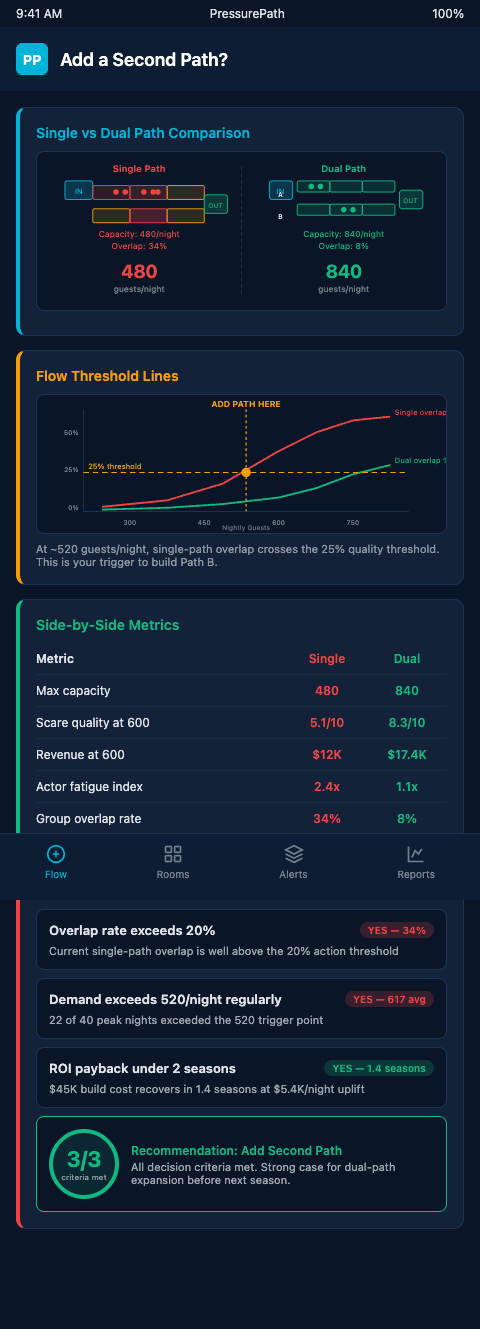
Dense Crowd Simulation Literature (ScienceDirect) confirms the theoretical basis: bifurcating paths at high-density nodes reduces clogging and restores throughput to near free-flow — but only when both paths have sufficient scare-quality capacity to absorb the redistributed guests. A second path that is 60% of the first path's chamber quality will not produce 60% additional scare delivery; it will produce inconsistent experiences that damage both paths' reputations.
For the pre-second-path optimization analysis — the flow modeling that confirms you have pushed single-path capacity to its limit before committing to construction — scaling beyond 600 tickets per night maps the specific interventions available at each capacity tier on a single path.
Frankfurt Airport Simulation (AnyLogic) provides a large-scale precedent: simulation optimized flow paths for 5.5 million passengers per month before committing to physical expansion — confirming that simulation-first capacity planning produces better construction decisions than demand-signal-only reasoning.
Advanced Analysis: Second-Path ROI by Saturation Frequency
The return-on-investment calculation for a second path is a function of three variables: construction cost, revenue per additional ticket, and the number of peak nights per season at Threshold 3 or above. PressurePath's simulation models this as a break-even analysis: how many additional peak-night tickets does the second path need to sell per season to return its construction cost in three seasons?
For haunts at typical ticket prices ($20–$28) with typical construction costs ($60,000–$100,000 for a complete second path), the break-even requires roughly 1,000–1,800 additional tickets per season above the current single-path ceiling. That is 100–180 additional tickets on each of 10 peak nights. If your simulation shows that saturation on 10 peak nights is leaving 150+ guests per night unserved, the second path pays for itself. If it is leaving 60 guests per night unserved, optimization of the current path is the better investment.
The ROI calculation also depends on the quality distribution between paths. A second path that replicates the first path's full actor roster and scare chamber design generates full revenue per head. A second path built as a lighter-weight overflow route — fewer actors, reduced scene investment — generates lower revenue per head and a longer payback period. PressurePath's second-path simulation models both scenarios: it shows the revenue projection for a full-quality second path versus a reduced-investment overflow route, and calculates the payback period for each based on your specific peak-night saturation frequency.
That calculation changes the construction decision in a non-obvious way. If your saturation frequency is concentrated in four peak nights rather than ten, a reduced-investment overflow route — callable only on those four nights — may return its cost faster than a full second path that runs all season. The simulation reveals that option because it models saturation per night rather than averaging across the season.
For context on how multi-room franchises model the equivalent capacity expansion decision — adding a room rather than a path — forecasting when to add a new room covers the same threshold framework in a year-round operational context that illuminates where haunt economics diverge from daily operations.
The multi-path crowd behavior implications of running two paths simultaneously — how crowd distribution between paths affects each path's scare quality independently — are covered in predictive crowd behavior in multi-path hauntings, which documents the distribution modeling required to staff and pace both paths correctly once construction is complete.
Timing the Construction Decision Against Demand Growth
The flow threshold framework gives you the current-state answer: are you in Threshold 2, 3, or 4 today? The investment timing question requires a forward-looking layer: at your current rate of demand growth, when will you reach Threshold 3 — and how long will it take to build and open a second path from that moment?
Time-to-Build and Capacity Expansion (Springer) establishes that construction timeline uncertainty affects optimal investment timing. For haunts, second-path construction typically takes 8 to 18 months from design commitment to opening night, depending on permitting, contractor availability, and scope. If your demand growth rate suggests you will reach Threshold 3 sustained saturation in 24 months, you need to start the construction process in the next 6 to 10 months — not when you observe the sustained saturation, but 18 months earlier.
PressurePath's demand projection layer takes your last three seasons of peak-night saturation frequency and fits a growth curve. If that curve reaches Threshold 3 conditions in 18 months, the system flags the construction trigger now — so your capital planning can begin the design process while demand is still in Threshold 2 and you retain the lead time that a well-planned second path requires.
Know Your Flow Threshold Before You Call the Contractor
The second-path construction decision is one of the largest capital allocations a haunted attraction makes, and the decision frame most operators use — peak-night turnaway visible in the queue — is a lagging, imprecise signal. The flow threshold framework gives you a leading, quantitative signal: specific density patterns that reveal whether you have saturated your current single-path capacity or whether targeted optimization would unlock 100-150 more tickets per peak night without touching the concrete.
For most haunts in the growth zone — attendance rising 8-12% year over year, saturation on 4-8 peak nights — the answer is optimization first, construction second. The simulation confirms which specific modifications push the single path's ceiling from 580 tickets to 640 at a cost under $2,000. That additional 60-ticket headroom buys 18-24 months of runway before the second-path decision genuinely matures. Operators who skip this optimization step and jump directly to second-path construction typically discover that the first path was not actually saturated — it was just under-optimized — and the $80,000 construction cost returned on a problem that a $500 fog corridor would have addressed. Run the threshold simulation before you call the contractor.
PressurePath's second-path decision framework runs your current floor plan against your peak-night ticket data and identifies exactly which threshold you are in — so you know whether you need a $600 pacing fix or a $60,000 construction project before you commit to either. Join the waitlist for haunted attraction designers and access the capacity expansion simulation module before your next season's planning cycle.