Predictive Models for Crowd Behavior in Multi-Path Hauntings
Why the 50/50 Assumption Breaks on Peak Nights
Most multi-path haunt designs include a route-choice point with two or more equally valid paths. The design intent is to reduce congestion by splitting the crowd. The operational assumption — often unstated — is that guests will divide roughly evenly. That assumption is reliable on average nights and wrong on peak nights, when group composition, age mix, and peer behavior create systematic preference cascades that push 70% of guests toward the same path.
The consequence is that the path your model assumed would absorb half the crowd is absorbing two-thirds. The actors on the minority path are underutilized. The actors on the majority path are receiving groups at intervals their scare design cannot sustain. The scare delivery on the over-selected path degrades, and if that path contains your highest-investment scenes, the damage is disproportionate.
2025 Haunt Industry Report (HauntPay) shows average haunt total sales rose more than 8% in 2025, intensifying multi-path capacity planning pressure. As ticket counts increase, the variance in path selection compounds — a 10% distribution swing at 400 tickets misroutes 40 guests; the same swing at 650 tickets misroutes 65 guests, enough to collapse scare timing across an entire path for the duration of the surge.
Corridor Geometry Effects on Pedestrian Walking (ScienceDirect) confirms what haunt operators experience intuitively: altering corridor geometry at a branching point generates distinct collective patterns. Wider entry corridors on one path attract proportionally more guests even when both paths are equally accessible. The predictive challenge is quantifying those attractors for your specific layout and guest profile.
How Predictive Models Work for Branching Path Flow
The physics frame for multi-path flow is a branched pipe system under pressure. At the junction point, flow distributes according to the relative resistance of each branch — narrower paths, higher friction, dimmer lighting all increase resistance and redirect flow. A predictive model for your haunt is a calibrated resistance map: it specifies how your specific branching geometry distributes crowd flow under different density conditions.
Large-Scale Agent-Based Pedestrian Traffic (ScienceDirect) shows how agent-based models simulate pedestrian route choice, speed, and density across branching paths. Each simulated guest agent makes route decisions based on visible crowd density ahead, path width, and directional cues — the same factors real guests use. Run across 10,000 simulated groups with your specific floor plan geometry, the model produces a distribution curve that shows not just the average split but the full range of plausible distributions on any given night.
Predicting Citywide Crowd Dynamics (ACM TIST) demonstrates that deep learning systems predict inflow and outflow per zone at event scale with enough precision for operational scheduling. At haunt scale, the same spatial-temporal prediction framework can project path selection forward by 20 to 30 minutes based on the crowd composition currently in the queue — allowing route-guidance adjustments before the misallocation reaches your scare chambers.
PressurePath's multi-path simulation runs the agent-based distribution model against your floor plan and outputs three operational numbers: the expected path split under normal conditions, the expected split under peak-night crowd composition, and the maximum deviation your actor roster can absorb before scare delivery degrades on either path. Those three numbers define the guardrails for your route-management strategy.
For the spawn-in timing layer that feeds path-specific release signals — how the algorithm knows which path to release a group into based on real-time path density — machine-driven spawn-in timing covers the feed between path density data and gate release logic.
Agent-Based Multi-Room Building Emergency Evacuation (ResearchGate) provides relevant multi-room branching physics: congestion propagates across branching layouts in non-obvious ways, and models that do not account for inter-path density feedback systematically underpredict peak-night bottlenecks. PressurePath incorporates that inter-path feedback in its branching simulation so you can see secondary congestion effects, not just first-order path splits.
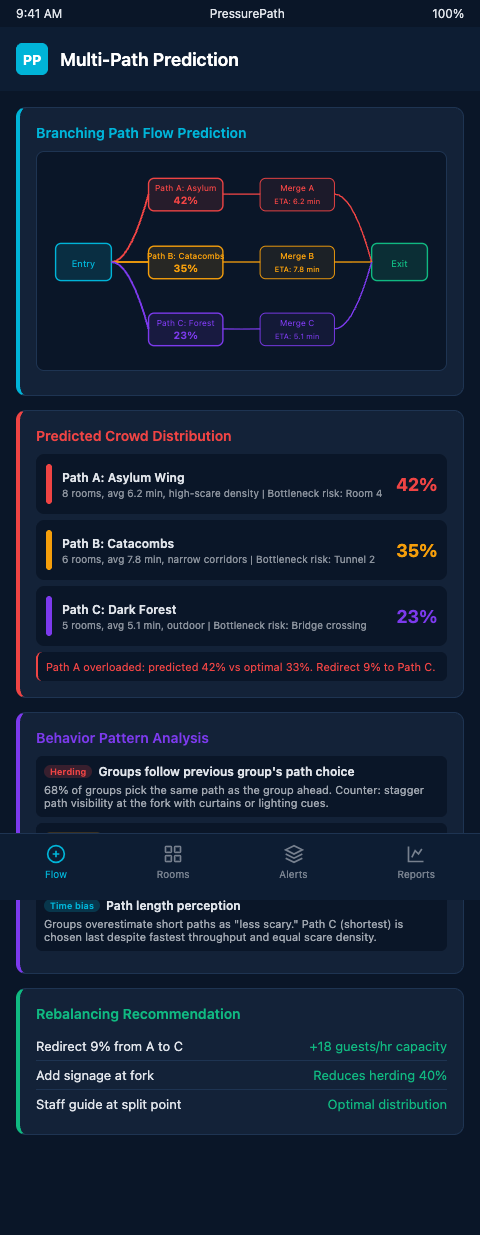
Commercial simulation tools like Pathfinder — Crowd Movement Simulation and AnyLogic Pedestrian Simulation Software provide the general-purpose pedestrian physics. PressurePath extends this physics with haunt-specific parameters: actor reset windows, fear-state density thresholds, and fire marshal density limits — variables that general pedestrian simulation tools do not model natively.
Advanced Tactics: Dynamic Path Guidance and Redistribution
The most sophisticated multi-path operations do not use static route assignments. They use dynamic path guidance: real-time instructions to guests at the branching point that redistribute flow based on current path density. The implementation can be as simple as a staff member positioned at the junction with a simple directional cue — "take the right corridor tonight" — or as sophisticated as a light-based routing display that changes based on sensor data.
Dynamic guidance works because guests at a branching point have no strong preference — the choice is novel and they have no prior information. Modest guidance produces large redistribution effects: a staff direction converts a 70/30 split back toward 55/45 within a 15-minute window. The operational question is how to know when to apply guidance, which requires real-time path density monitoring.
The path distribution model also changes the actor roster calculation. Haunts that staff multi-path designs symmetrically — the same number of actors on each path regardless of predicted distribution — overspend on the minority path and underprovide on the majority path. If your predictive model shows that Path A will receive 62% of the crowd on peak nights, Path A needs proportionally more high-impact scare positions and more actors. Symmetric staffing on an asymmetric flow distribution produces poor value on Path A and wasted labor cost on Path B.
The practical output of a PressurePath multi-path simulation is an actor allocation recommendation: how many performers per path, and in which scene positions, given your predicted flow distribution. That recommendation changes by night-type. On a standard night where the 50/50 assumption holds approximately, symmetric staffing is fine. On peak nights where the predictive model shows a 65/35 split, the actor roster adjusts accordingly. Building the predictive model in simulation before the season opens gives your scheduling system those night-type-specific roster recommendations before the first actor is hired.
Next decade immersive horror pacing covers how predictive routing models will evolve over the next 10 years as sensor density and AI prediction precision increase — the longer horizon for what multi-path management looks like when path density data is continuous rather than inferred.
For multi-grade field trip contexts that share the same branching distribution problem across different demographic groups, predictive models for multi-grade field trips shows how exhibit designers use the same agent-based distribution physics for a very different visitor population.
Calibrating the Predictive Model to Your Specific Haunt
A predictive multi-path model built on general pedestrian physics will produce a useful first estimate but will drift from your haunt's actual behavior because haunted attraction crowd movement differs from pedestrian movement in a mall or airport. Guests in haunts exhibit distinctly non-standard movement patterns: they slow at scare-state transitions, they cluster at decision points because the person at the front of a group is more reluctant to choose, and they accelerate through low-stimulation corridors. Each of those behaviors affects path selection at branching points.
Calibrating the model to your specific haunt requires at least one season of observed path data — even rough data, like a floor manager counting groups entering each path hourly. Three sessions of hourly counts on peak nights provide enough data to fit a calibration multiplier to the general pedestrian physics model. After calibration, the prediction accuracy for your specific branching point improves substantially, and the actor allocation recommendations the model generates reflect your haunt's actual crowd behavior rather than theoretical pedestrian averages.
PressurePath's simulation mode supports this calibration workflow: you input your observed path counts from prior seasons, and the system adjusts the agent-based model parameters to match your observed distribution. The calibrated model then projects forward to your next season's peak-night distributions — accounting for anticipated ticket count increases and any floor plan changes — so your actor roster planning for the new season starts from empirically grounded distribution estimates rather than theoretical geometry.
Fire Marshal Density and Multi-Path Compliance
Multi-path haunts introduce a compliance dimension that single-path designs do not face: the fire marshal density limit applies to aggregate occupancy across all paths simultaneously, but the scare-quality density threshold varies by path geometry. A wide, high-ceiling primary path may tolerate 2.0 persons per square meter safely. A narrow secondary corridor with lower ceilings hits the fire marshal threshold at 1.5. Running both paths simultaneously means managing two different density limits against a single aggregate ticket count.
PressurePath's multi-path compliance layer models fire marshal density separately for each path and calculates the maximum aggregate ticket count at which both paths remain within their respective compliance thresholds simultaneously. For most multi-path designs, that aggregate limit is lower than the sum of each path's individual limit — because queue dynamics create uneven density distribution that periodically pushes the narrower path above its threshold even when the aggregate is within bounds.
Knowing that compliance ceiling before opening night — and building spawn interval protocols that keep both paths within their individual density limits — is the operational protection that prevents a fire marshal visit during a peak Saturday from becoming a capacity shutdown.
Run Your Multi-Path Distribution Model Before You Assign Actor Rosters
PressurePath's branching path simulation gives you the full distribution curve for your multi-path haunt under peak-night conditions — before you staff the actor roster or set the spawn interval. Join the waitlist for haunted attraction designers and access the multi-path predictive model alongside your spawn-interval and density mapping modules.