Machine-Driven Spawn-In Timing: The Future of Fear-Room Flow
The 14-Second Variance Problem
On a peak October night, your front gate operator is managing a 400-person queue, answering questions, and watching a small monitor to time group releases. Their average release variance — the gap between when they should release a group and when they actually do — is roughly 8 to 14 seconds under sustained load. That sounds trivial. At the Clown Alley actor's 6-foot strike radius, 14 seconds is the difference between a clean fear-state build and two groups overlapping in the same scare chamber.
Playing With Fear: Field Study in Recreational Horror (PMC) measured EEG data across haunt participants and confirmed that peak fear response depends specifically on timing and surprise — and that over-density collapses that response. The problem is not whether your actor can perform. The problem is whether the guest population entering the scare chamber is in the right psychological state when they arrive. Fourteen seconds of early release is enough to destroy that state.
Manual gate operations have been the industry standard because the alternative — automated spawn timing — requires real-time density data from inside the attraction. Most haunts have not had that data. That is changing, and the change is happening faster than seasonal operators expect. Top 8 Technology Trends in Attractions 2026 (Blooloop) identifies sensor and AI flow tools as the fastest-growing investment category in the attractions industry — not because large parks are experimenting with them, but because the cost of sensor hardware has dropped enough for seasonal operations to consider deployment.
The spawn-in timing problem is solvable at the hardware level. The harder question is what the algorithm needs to read in order to issue a correct release signal.
How Machine-Driven Spawn Timing Reads Your Haunt
The pressurized-pipe model for crowd flow gives the clearest frame for what machine-driven spawn timing is actually doing. In a well-pressured pipe system, flow regulators at each junction measure upstream pressure and downstream capacity, then open valves at the rate the system can absorb. A machine-driven spawn-in system is a flow regulator at your front gate: it reads density at every downstream scare chamber and issues a release signal only when the pipe has capacity.
The inputs the algorithm needs are specific: current occupancy per scare chamber, estimated travel time from gate to each chamber based on observed queue velocity, and the reset-window requirement for each actor's performance. The algorithm computes the earliest release time that guarantees every actor finishes their current scare arc before the new group arrives in their sightline.
Predicting Citywide Crowd Dynamics (ACM TIST) shows that deep learning systems predict crowd flow at large events with spatial-temporal accuracy sufficient for operational scheduling. The same architecture — observing density at known sensor points, modeling travel-time distributions, projecting forward — applies at haunt scale. The difference is that a city-scale crowd prediction system needs to be right about where 10,000 people will be in 20 minutes; a spawn-in timing system needs to be right about where 6 people will be in 90 seconds.
Large-Scale Agent-Based Pedestrian Simulation (ScienceDirect) provides the underlying physics: agent-based models simulate disaggregated pedestrian flow and provide the backbone for calculating group travel time distributions through specific corridor geometries. PressurePath's simulation layer uses this same pedestrian physics to generate the travel-time estimates that feed the spawn interval calculation — so when you model your haunt at 550 tickets, the system computes actual traversal distributions for every corridor segment, not fixed averages.
For the actor cue delivery side of the problem — how scare signals reach individual performers in real time — real-time actor cues and group spacing covers the interface between spawn timing systems and in-room actor communication.
CuePilot — Automated Cue System represents the production-automation precedent: a tool that synchronizes triggers to crowd state in live performance environments. The haunt application is more dynamic — crowd state changes continuously rather than at scripted moments — but the principle of machine-issued cues replacing human judgment is already proven in high-stakes performance contexts.
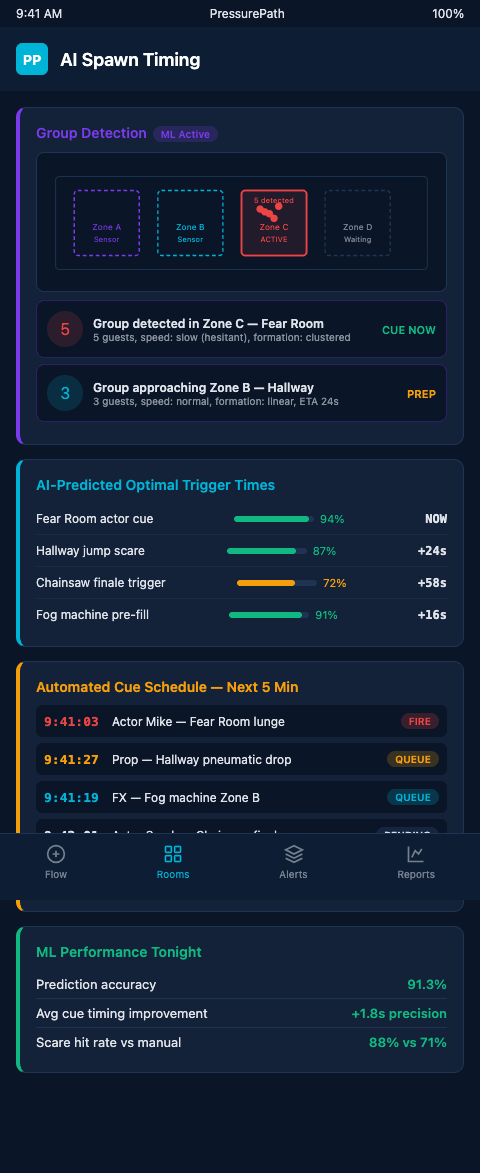
AI-Powered Venue Operations in 2026 (Ticket Fairy) documents how AI venue tools analyze historical and real-time data to anticipate peak congestion — the operational workflow that machine-driven spawn timing plugs into. How AI Is Changing Venue Management 2025 (Prism.fm) adds that ML models already forecast staffing needs from ticket velocity and historical patterns; spawn-in timing is the next operational layer that consumes the same data feeds.
For the predictive multi-path variant of this problem — how machine-driven timing works across branching route choices — predictive multi-path crowd behavior models covers the added complexity of algorithms that need to route groups, not just release them.
Advanced Implementation: What Seasonal Haunts Actually Need
Full sensor deployment is not a prerequisite for machine-driven spawn timing. The minimal viable implementation for a seasonal haunt uses three components: infrared beam sensors at each scare chamber entry and exit, a lightweight timing algorithm that computes release signals from chamber occupancy changes, and a simple interface — typically a colored light or haptic device — that signals the gate operator when to release.
This configuration costs significantly less than a full camera-and-AI deployment and delivers 90% of the variance reduction. The gate operator is still in the loop — they retain override authority — but they are responding to a machine recommendation rather than estimating from a monitor. The 14-second variance drops to under 4 seconds.
The next implementation tier adds corridor sensors at the three to five highest-friction points identified in a PressurePath simulation. With mid-corridor density data, the algorithm can detect group bunching before it reaches the next scare chamber and issue an early release-hold signal, buying the actor an extra 10 to 15 seconds of recovery time. The practical test for whether your haunt is ready for this tier: if you have run three or more peak nights where manual timing variance produced at least one scare chamber double-occupancy event per night, corridor sensors will return their cost in guest satisfaction within a single season.
The calibration process for a machine-driven system requires a simulation baseline to run against. Before the first sensor is installed, PressurePath generates the theoretical spawn interval distribution for your floor plan at your target ticket count. That distribution becomes the reference curve — when the live sensor data produces interval distributions that deviate from the simulation baseline by more than 8 seconds on average, the algorithm flags a calibration issue: either the sensor placement is wrong or the floor plan geometry has changed in ways the model did not anticipate.
This calibration-first approach prevents the most common machine spawn timing failure, which is not hardware failure but model drift: the algorithm issuing release signals based on a flow model that no longer reflects the actual physical haunt because a set piece was moved or a corridor was narrowed. A simulation layer that regenerates the baseline each season — updated with any layout changes — keeps the machine timing system calibrated to the current physical environment.
For the broader sensor tracking infrastructure that underpins machine spawn timing in multi-zone operations, sensor-driven group tracking documents the hardware and data architecture that escape room franchises use across high-traffic walk-through formats.
Operator Training for Machine-Assisted Spawn Timing
The final barrier to machine-driven spawn timing at seasonal haunts is not technology or cost — it is operator trust. Gate staff who have managed releases manually for three or more seasons have deeply ingrained timing intuitions. When a machine recommendation conflicts with that intuition, operators override it. On nights when the machine is wrong, the override is correct. On the majority of nights when the machine is right and the operator's intuition has drifted from the actual floor state, the override degrades scare delivery.
Building trust in a spawn timing system requires a calibration-visible interface: the gate operator can see not just the release signal, but the chamber occupancy data driving it. When operators understand that the hold signal is active because the Butcher Room currently shows two guests still in the exit corridor — not because a computer decided arbitrarily to slow the queue — the override rate drops significantly. Transparency about the reasoning behind each signal converts the system from an authority to a tool, which is the mental model under which seasonal staff are most likely to use it correctly.
Training on a machine spawn timing system should run during the pre-season simulation period, not on opening night. PressurePath's simulation mode lets gate staff practice responding to simulated chamber occupancy data at full peak-night volume — a dry run where override decisions produce visible downstream consequences in the simulation rather than in a live scare chamber. After four to six hours of simulation-mode training, most staff have developed the judgment to distinguish machine recommendations that should be followed from genuine edge cases where manual override is appropriate.
Let PressurePath Model Your Spawn Intervals Before You Install Hardware
Sensor hardware is a recurring cost. Running a pre-season simulation against your haunt's specific floor plan and target ticket count is a one-time cost per season — and the output tells you exactly which chambers justify the sensor investment and which do not. For most 14-chamber haunts running 400-500 tickets on peak Saturday, three to five sensors positioned at the highest-variance choke points deliver the same operational benefit as a full 14-chamber deployment at one-third the hardware cost. The simulation is how you identify which three to five.
The second reason to simulate first is calibration integrity. A machine-driven spawn timing system that runs against an uncalibrated baseline makes release decisions against an incorrect reference — which is worse than manual timing because operators trust the machine and override less frequently. Building the simulation baseline from the specific geometry of your haunt, then deploying sensors only at the points the baseline flags as high-variance, produces a machine timing system that is calibrated to your haunt from day one rather than drifting into correctness across three seasons of deployment.
Before committing to sensor hardware, PressurePath simulates your haunt's spawn-in timing requirements at your target ticket count — identifying which chambers need the tightest release precision and where a manual override is sufficient. Join the waitlist for haunted attraction designers and access the machine spawn interval simulation module ahead of your next season's build-out planning.