The Future of Sensor-Driven Group Tracking in Escape Rooms
What Sensors Actually Change About Pacing
Right now, most multi-room franchises track group progress through one channel: the Game Master watching monitors and communicating via radio. That channel is slow, intermittent, and degrades under peak-hour load exactly when accuracy matters most.
The core problem is that the pacing model — whether it lives in PressurePath or in a GM's mental model of the day — runs on assumptions established before the shift. When actual group behavior diverges from those assumptions, the model falls out of sync with reality. A group that finishes 12 minutes early, a group that takes 7 minutes longer than expected, a reset that ran long because one prop malfunction needed resolution — each of these events changes the pressure state of the pipe network, and without sensor feedback, the model doesn't know until a GM calls it in. By then, the downstream junctions have already started adjusting, often in ways that compound rather than resolve the deviation.
A Saturday at 2:45 PM with seven rooms active means one GM is trying to track seven simultaneous sessions, anticipate exits, coordinate with reset staff, manage the briefing room queue, and handle any guest issues — all using visual observation and radio calls. The information lag between a group finishing their final puzzle and the reset staff receiving the call averages 2-4 minutes at most franchises. Over a full Saturday, that lag costs 20-40 minutes of cumulative reset delay.
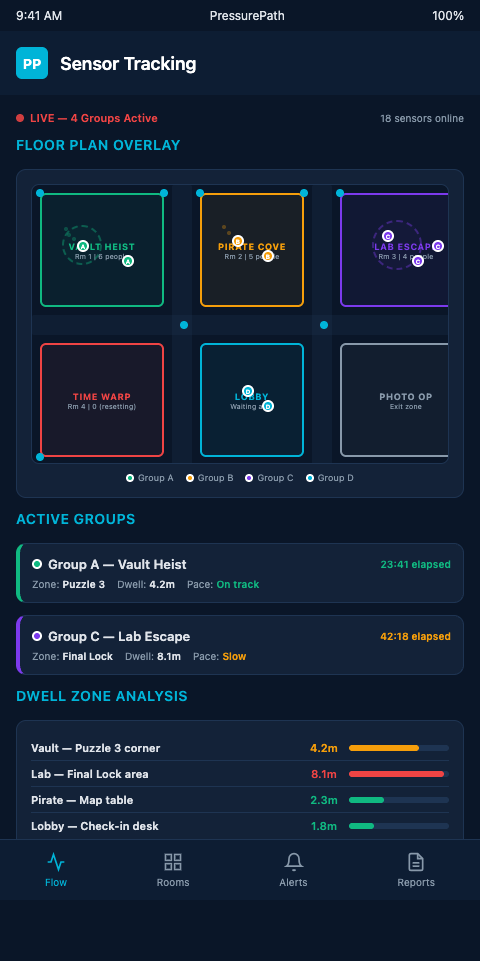
Sensor-driven group tracking eliminates that lag. When an entry door sensor registers a group entering the exit corridor, the system knows immediately — not when a GM notices and calls it in. That real-time signal feeds directly into the pacing model, which updates the pipe network's current state and projects the next 15 minutes of junction pressure.
IoT-Based Wristband for People Tracking (MDPI Sensors) demonstrates that wristband IoT devices enable automatic location tracking and geofencing in enclosed spaces — at escape room scale, this means knowing where each group is in their journey from briefing room through active play to exit corridor, without any manual observation.
Sensor Technologies for Escape Room Environments
The practical sensor stack for a multi-room franchise doesn't require expensive custom hardware. Three categories of off-the-shelf technology cover the core tracking needs.
Door and zone sensors. Simple magnetic contact sensors on exit doors register when a group transitions from the active room to the exit corridor. Combined with a timer started at session initiation, these sensors provide completion time data for every session without any GM action. Occupancy Detection for Smart Buildings Using IoT (MDPI) reviews PIR, Bluetooth, and UWB occupancy sensing achieving up to 98% accuracy — the same sensor types applicable to escape room zone detection.
RFID wristbands. Groups wearing RFID wristbands can be tracked through designated checkpoints — briefing room entry, room entry, photo op, and exit. The wristband data creates a timestamped record of every group's journey through the facility. RFID for Live Events: Crowd Management (HID Global) reports RFID wristbands calculating number of people per zone in real time — directly applicable to the briefing room occupancy monitoring that prevents double-scheduling.
Room-completion triggers. Many escape rooms already have a mechanism for groups to signal completion — a final puzzle solved, a door unlocked, a button pressed. Connecting that signal to the pacing system rather than just to the in-room audio/lighting cue creates an automatic session completion timestamp with zero latency.
PIR-based session monitoring. Passive infrared sensors tracking motion within a room can distinguish between a group actively moving through puzzles and a group gathered at the exit — a behavioral signal that predicts completion 4-6 minutes before the exit door opens. PIR Sensor-Based Occupancy Monitoring (PMC) demonstrates that PIR-based systems with ML can track group movement patterns, providing the early-exit signal that lets the pacing model adjust before the group actually exits.
The pressurized-water-in-pipes metaphor becomes a live system with sensor data. Rather than running the simulation as a static model before the shift, PressurePath can ingest real-time sensor feeds and update the pipe pressure map continuously. When Room 6 triggers completion at 2:48 PM — 7 minutes early — the model immediately adjusts the briefing room queue projection, flags that reset station 2 needs to redirect from its current room to Room 6, and updates the photo op queue estimate for the next 20 minutes.
Intelligent Crowd Monitoring with IoT Cloud (MDPI) describes middleware integrating cloud and IoT for scalable real-time visitor monitoring — the same architecture that a franchise-wide sensor deployment would use to feed live data to a centralized PressurePath instance.
The integration with ML flow forecasting creates a compounding accuracy advantage. The predictive model generates expected flow patterns; the sensor feed shows actual flow; the discrepancy between them becomes the signal that updates the forecast in real time. A holiday Saturday where groups are running 8 minutes longer than the model predicted gets that adjustment incorporated into the afternoon's projections by noon — not discovered at 4 PM.
The connection to flow control tools is direct: sensor-driven tracking is the data source that makes flow control tools predictive rather than reactive. Without sensors, the tools respond to what the GM reports. With sensors, they respond to what the facility is actually doing.
The Franchise Case for Sensor Investment
A single-location operator with four rooms might manage tracking manually without significant operational cost. A 10-room franchise running parallel sessions on weekends absorbs enough tracking delay to justify sensor infrastructure within a few months.
Restaurant Management for Multi-Location Consistency (MBB) reports that standardized operational metrics add 10-20% revenue across multi-location businesses. Sensor-driven tracking extends this principle to pacing: when every location's real-time group positions feed into the same pacing system, the franchise can identify which locations are running systematically late on resets and intervene with protocol adjustments before guest satisfaction data confirms the problem.
The upfront cost of sensor hardware per room varies by technology: door sensors run $15-60 per point; RFID wristband systems require a reader infrastructure investment of $500-2,000 per zone plus $1-3 per wristband per use. A 10-room franchise deploying door sensors and one RFID checkpoint at the briefing room entry can instrument the most critical tracking points for under $3,000 in hardware — less than one Saturday's revenue.
IoT Sensor Technology at Live Event Venues (Verizon) documents 5G-enabled sensor networks predicting congestion and delivering crowd flow analytics at venue scale. The same technology stack, scaled down to a multi-room escape room, provides the real-time input that turns a pre-shift simulation into a continuous pacing system.
For haunted attraction operators exploring the same sensor infrastructure, machine-driven spawn-in timing demonstrates how live group position data controls actor release cadence — a direct analog to how sensor-driven escape room tracking controls reset and briefing sequencing.
PressurePath's sensor integration layer is built to accept standard webhook inputs from commercial IoT middleware, meaning the connection between your sensor hardware and the pacing model doesn't require custom software development. The path from door sensor to live pipe pressure map is a configuration step, not a development project. If your franchise is considering a sensor deployment for the next season, the pacing integration is ready to receive the data the day the sensors go live.
The long-term franchise argument for sensor investment goes beyond individual shift efficiency. A franchise that accumulates timestamped group-position data across thousands of sessions builds the most accurate training dataset available for its own pacing models — data that captures the specific behavioral patterns of its customer base, its room configurations, and its booking density. That dataset improves every simulation, every forecast, and every pre-shift briefing over time. The sensor infrastructure is both an operational tool and a data asset, and the two compound together as the dataset grows.
Operators who deploy sensors today and connect them to PressurePath are building a two-year head start on the pacing accuracy that competitors who skip sensor infrastructure will need to reconstruct from manual observation records. The operational payoff starts in the first week; the competitive advantage compounds from there.
The sensor deployment decision is most straightforward when framed as a comparison against its alternative. Without sensors, improving pacing accuracy requires manual timing studies — a GM with a stopwatch recording session completion times across multiple Saturdays, then feeding that data into a spreadsheet, then updating the simulation parameters manually. That process takes weeks and captures only a fraction of the behavioral variance that sensors capture continuously. With sensors, the same data arrives automatically after every session, with no GM time invested and no risk of observation bias distorting the timing records.
For a franchise evaluating sensor deployment across multiple locations, the right starting point is a single location pilot: instrument the briefing room entry and exit corridor of one location for one quarter, connect the data to PressurePath, and measure the accuracy improvement in the pacing simulation's predictions versus the pre-sensor baseline. That pilot generates the business case for the franchise-wide deployment — in the language that capital allocation decisions require: measured accuracy improvement, operational cost reduction, and a concrete per-location payback period.