Workflow Tools Every Franchise Operator Needs for Flow Control
Why Booking Software Alone Leaves Flow Problems Invisible
The most common failure mode across multi-unit escape room franchises isn't inconsistent service — it's consistency applied to the wrong system. A franchise can enforce identical briefing scripts, identical room reset checklists, and identical GM training at every location, and still generate Saturday traffic jams because the booking software creates schedules without modeling what those schedules do to shared assets.
American Franchise Academy's research on multi-unit consistency identifies inconsistency as the top franchise failure mode, but notes that without workflow tools, compliance becomes personality-dependent. For escape room franchises, the equivalent failure is flow management becoming GM-dependent — the experienced Saturday GM at location 1 intuitively spaces her room starts to avoid briefing room collisions, while the newer GM at location 3 runs the standard booking grid and gets hit with a 12-minute photo wall queue at 2:47 PM every week.
Flow control tools close that gap. They're not replacements for skilled GMs — they're systems that make the intelligent behavior observable, transferable, and consistent across locations.
The Core Tool Stack for Multi-Room Flow Control
The tool stack for flow control at a multi-room escape room franchise has four layers:
Layer 1: Pacing Simulation (Pre-shift). Before the week's booking grid is finalized, a pacing simulator runs the proposed schedule through a pressure model of your rooms, briefing room, reset stations, and photo wall. PressurePath occupies this layer — it accepts your Saturday booking grid as input, treats the 10-room franchise as a pressurized pipe network, and flags every junction node where simultaneous pressure from parallel rooms will exceed shared asset capacity. The output is a modified booking grid with specific start-time adjustments, not a generic "add 15-minute buffers" recommendation.
The pipe network metaphor is precise here: each room is a pressure source feeding into a shared distribution system. When rooms 3, 6, and 9 all discharge simultaneously, the pressure wave hits the briefing room junction simultaneously. The simulation tells you this on Tuesday. Without it, your GM discovers it Saturday afternoon.
Layer 2: Operations Dashboard (During shift). Once the shift begins, a real-time operations dashboard surfaces the signals that precede a traffic jam. Briefing room pressure index, reset station lag, photo wall queue depth. FranConnect's franchise operations platform provides AI-driven operational insights and cross-location KPI dashboards — the type of infrastructure that makes a multi-location operator's dashboard possible. For smaller franchises, a shared spreadsheet with timestamped GM inputs achieves the same visibility at lower cost.
A 10-room franchise running 70-80% Saturday utilization typically generates 4-8 dashboard-worthy pressure events per 8-hour shift, each lasting 10-15 minutes from first amber warning to full resolution. The dashboard collapses the detection window from about 6 minutes after the event starts — the point at which a GM notices physical congestion — to roughly 90 seconds before it reaches red state. That 7-minute advance warning is enough to redirect one staff member from a quiet zone to the pressured one, or to delay a room start by 4 minutes upstream. Across 4 peak Saturdays monthly, those advance interventions prevent an estimated 60-100 minutes of guest queue exposure that would otherwise show up in shift debriefs as "the 3 PM wave got away from us" — the narrative that reliably precedes a review score dip in the following week.
Layer 3: Workflow Automation (Task routing). Kanban-style task boards for reset teams prevent priority confusion during peak hours. The Lean Enterprise Institute's Kanban lexicon entry defines how WIP limits and visual signals surface bottlenecks instantly — a reset team with a Kanban board sees which rooms are in active reset, which are queued, and which are clear, without radio calls to the GM. The WIP limit (no more than 2 rooms in simultaneous active reset for a 2-person team) enforces the throughput constraint automatically.
Layer 4: Staffing Optimization (Resource allocation). McKinsey's research on AI-driven staff scheduling documents how smart scheduling reduces idle labor while maintaining service quality during peak demand. For escape room franchises, the practical application is pre-shift staff assignment based on the pacing simulation output: if Saturday's pressure model shows the 2:00–3:30 PM window as high-stress, that's when the third reset team member is scheduled — not for the full 8-hour shift.
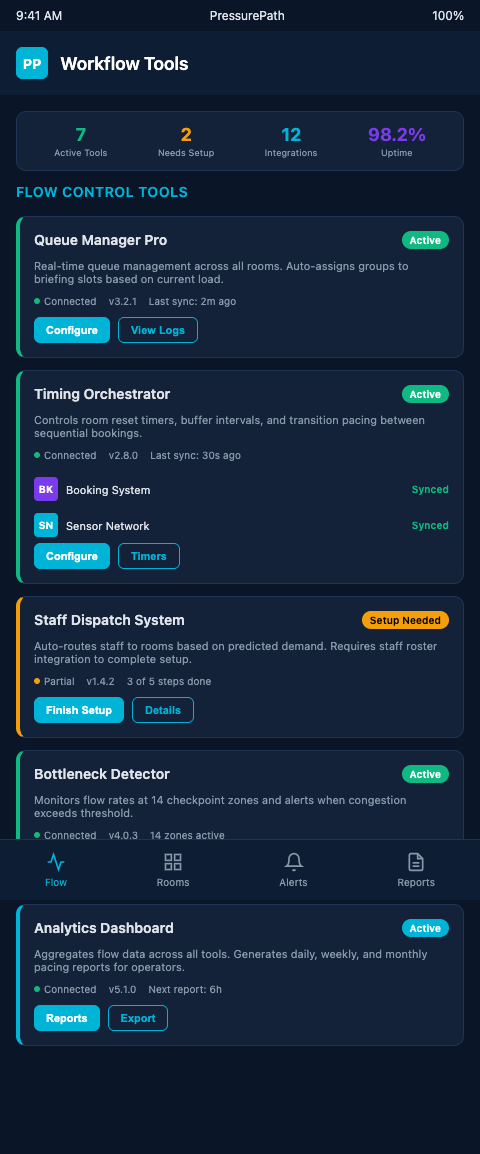
For operators evaluating where to begin, the booking system integration layer is the foundation — it feeds live reservation data into the pacing simulation so the pressure model reflects your actual Saturday grid rather than a hypothetical average.
Selecting Tools That Match Your Operational Scale
The tool stack above isn't equally appropriate at every scale. A single-location franchise with 4 rooms needs Layer 1 (pacing simulation) and a basic version of Layer 2 (a shared Google Sheet with GM timestamping). A 3-location franchise with 10 rooms each needs all four layers with integration between them.
Claromentis's comparison of franchise management software identifies no-code automation as a differentiating feature for mid-size franchise operators — the ability to set up automatic alerts (reset lag exceeds 4 minutes → Slack notification to GM) without engineering resources. That capability is the bridge between Layer 1 (simulation) and Layer 2 (live dashboard) for operators who can't invest in a fully integrated platform immediately.
Wrike's workflow management software rankings include enterprise tools with deep automation and real-time visibility. For a 30-room franchise operation, that level of automation investment is justified. For a 10-room single location, it's overbuilt — the right tool is the one that surfaces the right signal at the right moment, not the most feature-complete platform available.
Goldratt's Theory of Constraints provides the selection criterion: every system has one binding constraint, and the right tool is the one that surfaces that constraint. For most 10-room franchises, the binding constraint is briefing room throughput on Saturday afternoons. The pacing simulation (PressurePath) is the tool that surfaces it. Everything else in the stack addresses what happens once you know where the constraint is.
Game master load balancing is the staff-level constraint that the tool stack must accommodate — if the GM assigned to the briefing room is simultaneously responsible for monitoring three parallel rooms, the operations dashboard needs to route alerts to a second GM rather than compounding load on the already-stressed one.
For operators building out cross-location visibility, scene density tracking tools used in immersive theater offer a reference point for how to measure occupancy intensity at shared venue nodes — a methodology that translates directly to escape room briefing room and photo wall monitoring.
Prioritizing the First Tool You Actually Deploy
Multi-room escape room franchise operators who are building their flow control stack for the first time should deploy in this sequence: pacing simulation first (PressurePath gives you the Saturday pressure map from your booking grid), operations dashboard second (even a shared spreadsheet with 4 tracked metrics), Kanban task routing third (whiteboards work at small scale). The staffing optimization layer can wait until you have two months of pressure data. The reason this sequence matters is that each layer depends on the one before it — you cannot build meaningful dashboard alerts without knowing which pressure events to track, and you cannot define pressure events without running the simulation against your actual booking grid first.
Skipping straight to Layer 3 or Layer 4 without the simulation foundation means automating responses to signals you haven't validated. If your franchise is currently running Saturday shifts where traffic jams are discovered in real time by GMs without early warning, join the waitlist — the pacing simulation is the first tool that changes what your team knows before the shift begins.