Fundamentals of Game Master Load Balancing Across 8-12 Rooms
One GM and 12 Rooms Is Not a Ratio — It's a System Failure Waiting to Happen
Saturday 2:15 PM. Your lead GM is watching the monitor feed for Room 8, where a group appears stuck on the electromagnetic lock puzzle. Room 3's group just completed an escape and needs the post-game photo escort. Room 11 is 4 minutes from its scheduled start and the previous group hasn't fully exited the corridor yet. Room 6 needs a hint given — the group hasn't pressed the button yet, but the GM can see from the feed that they're about to give up.
All four of those events are happening simultaneously. Your GM is one person. They have to triage.
What they choose defines whether Saturday runs or implodes. And the fact that a single experienced person is making those triage decisions in real time, under stress, with incomplete information — that's not operations management, it's load-based failure hiding behind competence.
Wikipedia's span of control research establishes that optimal quality supervision occurs at 5-7 direct reports. Beyond that threshold, supervisory attention degrades non-linearly. At 12 rooms with simultaneous active groups, a single GM is operating at roughly twice the ceiling for quality supervision — and your Saturday operations quality reflects that ceiling being exceeded regularly.
Financial Models Lab's escape room KPI research identifies labor as 48% of gross revenue in escape room operations. GM load balancing drives directly to margin: an over-loaded GM misses hint cues, delays post-game escorts, and absorbs reset coordination that should be delegated — all of which show up as overtime costs, guest satisfaction scores, and repeat booking rates.
The Structural Logic of GM Load Distribution
Load balancing across 8-12 rooms requires three structural decisions: zone assignment, rotation scheduling, and coverage logic for non-standard events.
Zone assignment divides your room network into GM responsibility zones that each fall within the 5-7 supervision limit. For a 10-room franchise, two GMs covering 5 rooms each is the structurally sound configuration. For a 12-room franchise, two GMs covering 6 each — or three GMs covering 4 each during peak windows — maintains the supervision quality ceiling.
Zone boundaries should be drawn along shared asset lines, not just room count lines. If rooms 1-5 all feed the same central briefing hub and rooms 6-10 feed a secondary briefing room, your zone boundary should align with that asset division. A GM whose zone straddles two briefing hubs spends their attention on coordination between hubs rather than on the rooms themselves.
StaffConnect's research on multi-location event staff scheduling establishes that multi-zone staffing pools with skill matrices and rotation schedules are proven for concurrent-zone operations. The escape room equivalent: a skill matrix that documents which GMs are trained on which rooms' hint libraries, emergency protocols, and prop-failure contingencies. Zone assignments should match GM skills to zone requirements, not just fill coverage numbers.
Rotation scheduling prevents any single GM from holding a zone assignment through an entire peak shift. Rotation creates recovery windows, prevents fatigue-driven attention failures, and cross-trains staff on both zones. A rotation cycle of 2-3 hours on a 10-hour operating day gives each GM one full rotation break per peak wave. The key constraint: rotation handoffs must happen between active group waves, not during them. A GM who rotates out while three groups are mid-hint-session leaves their replacement without context.
PressurePath models rotation scheduling as part of the GM load balancing output. When you configure your zone assignments and rotation schedule, the simulator verifies that no rotation handoff falls within a high-pressure window (where three or more rooms in the zone are within 15 minutes of their expected completion) and flags handoff windows that carry cascade risk.
The pressurized pipe network metaphor applies to GM attention the same way it applies to group flow: each GM has a defined attentional throughput capacity. When the number of simultaneous supervision events in their zone exceeds that capacity, pressure builds — and unlike physical pipeline pressure, the overflow manifests as missed hints, delayed escorts, and reactive redeployment that compounds across the shift.
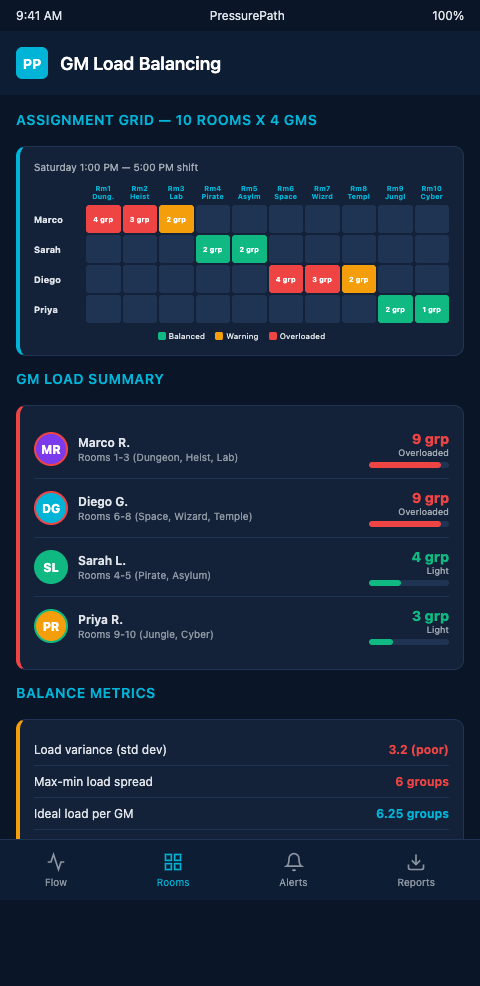
Coverage logic defines what happens when a non-standard event consumes a GM's attention for longer than the normal attention budget. A group that needs multiple extended hints, a prop failure that requires physical intervention, a medical hold — any of these can occupy a GM for 10-20 minutes while their zone continues running. Without pre-defined coverage logic, the remaining GM absorbs double-zone supervision temporarily, which pushes them past the quality ceiling.
The solution is a coverage protocol: when any single event exceeds 8 minutes of exclusive GM attention, the rotation partner automatically assumes monitoring of the occupied GM's primary zone for the duration. This requires pre-briefing and clear role definition — not spontaneous heroics from staff who read the situation.
Multi-venue event coordination best practices from myshyft.com define exactly this structure: zone-by-hour coverage blueprints with defined rotation and supervision responsibilities. The conference staffing model they describe maps onto escape room franchise operations with minimal adaptation.
A mathematical framework for multi-server queue allocation from MDPI formalizes the underlying optimization problem: allocating shared attention capacity across parallel queues minimizes total wait time when each server (GM) has a defined throughput ceiling. The practical translation is that zone assignment and rotation scheduling are not intuition problems — they're combinatorial optimization problems with calculable solutions.
What Load Imbalance Looks Like in Operations Data
Three patterns in your operations data reveal GM load imbalance.
First: hint frequency spikes in the 2-4 PM window. If your groups request more hints per session in peak hours than in off-peak hours — controlling for room difficulty — the signal is GM attention lag, not group difficulty. Groups who haven't received a proactive GM check-in by minute 30 request hints at higher rates because the relationship cue that "help is available" has been delayed.
Second: post-game escort delays. If your photo wall queue starts building not because the photo wall is slow, but because groups are waiting for the GM escort to materialize after completion, your GM is over-loaded in their zone. The escort task is being triaged below other simultaneous demands.
Third: end-of-shift GM debrief length. GMs who've been operating at load ceiling debrief with significantly more incident detail than those at balanced load — because they've been making real-time triage decisions all shift and need to download them. Track debrief duration as a proxy for shift-level GM load.
The time-block group starts approach is inseparable from GM load balancing: the booking cadence that determines how many groups a GM supervises simultaneously is the scheduling input, and the load calculation is the output. Calibrating one without the other produces a schedule that looks clean on paper but overloads staff in execution.
The flow control tools every franchise operator needs provide the operational infrastructure that makes load balancing sustainable: real-time room status visibility, alert thresholds, and delegation protocols that allow GMs to distribute their attention systematically rather than reactively.
Production stage management offers the clearest structural parallel. Stage manager duties in live theatrical production involve coordinating multiple concurrent zones using cue sheets and coverage protocols — exactly the GM rotation and coverage logic described here. The practice of assigning assistant stage managers per zone in large productions maps directly onto the divide-and-conquer GM zoning model, and escape room franchise operators who've studied production management report that the vocabulary translates almost verbatim.
The stage manager pacing workflow from immersive theater production formalizes the same coverage and rotation principles in a higher-density multi-zone environment — the SM's zone handoff protocols and attentional triage rules carry direct operational relevance for escape room GMs managing 10+ rooms.
Join the Waitlist for Load Balancing Analysis
Escape room franchise operators running 8-12 rooms on peak Saturdays and relying on one or two experienced GMs to absorb every coordination gap are carrying recoverable labor cost in a form that doesn't show up on a timesheet. PressurePath models your GM zone assignments and rotation schedule against your Saturday booking grid and flags every window where load exceeds the quality supervision ceiling. Join the waitlist and indicate your room count and current GM staffing level — we prioritize franchises where the GM load analysis can surface actionable rotation changes.
The load balancing analysis maps your current GM zone assignments against the simultaneous supervision events generated by your Saturday booking grid and identifies every window where a GM's attention demand exceeds the 5-7 room quality supervision threshold. The output includes optimized zone boundaries aligned to your shared asset topology, rotation schedules that avoid high-pressure handoff windows, and coverage protocols for non-standard events that would otherwise push a single GM past their attentional capacity ceiling. Operators who implement the recommended zone and rotation changes typically report measurably fewer missed hint cues, faster post-game escorts, and a reduction in the end-of-shift debrief load that signals sustained GM overextension.