The Stage Manager's Pacing Workflow for Multi-Room Shows
The Problem With Calling a Multi-Room Show Like a Single Stage
At minute 34 of the second act, the calling SM fires the Scene 7 underscoring cue. Simultaneously, the deck supervisor in the east corridor is holding a cluster of 22 viewers who want to enter the archive room, which is at 41 occupants against a sightline ceiling of 30. The calling SM does not know this. The cue was written for 18 viewers in the archive. The deck supervisor improvises a redirect. The blocking arc for the next 12 minutes plays to a fractured audience that was never positioned where the director blocked it.
This is not a failure of the deck supervisor's judgment. It is a workflow failure: the calling SM had no mechanism to monitor real-time scene density, and the deck supervisor had no pre-agreed redirect protocol to execute. The production had a cue workflow and a scene workflow. It did not have a pacing workflow.
Stage Managing Immersive Theatre (HowlRound) frames the immersive SM's challenge precisely: the audience is a new cast member every show, and every performance is an intricate negotiation between the scripted arc and where 200 autonomous people choose to stand. A multi-room SM calling off a standard prompt script is managing two-thirds of the show. The other third — audience position — is going unmanaged.
Research on pedestrian bottleneck flow at crowded entry points (ScienceDirect) documents how architectural geometry and crowd management protocols directly affect navigation delays at bottlenecks — delays that in a multi-room immersive show can compress an entire act into an unrecognizable shape. The absence of a pacing workflow has measurable consequences for running time, audience experience, and the integrity of the director's blocking arc.
Building the SM Pacing Workflow Layer by Layer
A pacing workflow for multi-room shows does not replace the calling script — it runs alongside it as a parallel operational layer. The calling SM who manages a 12-scene immersive show without a pacing layer is making density-related decisions continuously during the running call — they just lack the data to make those decisions well. Every time the calling SM asks a deck supervisor "how's the library?" they are trying to perform a pacing function with inadequate tooling. The pacing layer replaces that ad-hoc inquiry with a structured protocol.
The design of the layer matters as much as its existence. A pacing workflow that requires the SM to consult a second screen, switch between applications, or log data manually during a running call will be abandoned within the first week. The most durable implementations embed pacing data into the documents and routines the SM already uses — the running sheet annotation, the headset check-in protocol, the standard post-show report. PressurePath's pacing layer is designed for this kind of ambient integration rather than as a standalone dashboard that competes for the SM's attention. The calling SM's primary job remains unchanged: fire cues on time, support actors, maintain the show's technical spine. The pacing layer adds three elements: scene density monitoring, pre-scripted redirect protocols, and mid-show cue adjustment authority.
Think of the show's audience mass as pressurized fluid in a pipe network. The calling SM is the pressure regulator: when one scene node exceeds its capacity ceiling, the regulator opens an adjacent valve — a light shift, an audio cue, a deck supervisor hold — to redistribute flow before the overloaded node collapses. Without pressure readings, the SM is regulating blind. With them, every intervention is a planned response to a known condition.
Scene density monitoring starts with PressurePath's pre-show simulation outputs loaded into the running sheet. Each scene block carries an expected headcount range and a pressure threshold. During the show, deck supervisors report current headcounts to the calling SM via headset at pre-determined check points — not continuously, which would overwhelm comms, but at the minute marks when the model predicts highest variance. The calling SM logs deviations on a running tally alongside the cue script.
Pre-scripted redirect protocols are written in tech, not improvised in performance. For every scene with a pressure threshold, the SM script includes a redirect instruction: which adjacent scene has capacity, which corridor or environmental cue fires, which actor receives the non-verbal extension signal. Cueing in Theatre: Timing and Temporal Variance in Rehearsals of Scene Transitions (Springer Human Studies) argues that SMs must build room-specific cue frameworks and rapid-decision protocols during the preparation phase, not during running — the coordination of sound, light, scenography, and actor position in multi-scene transitions is too complex to improvise. The same principle applies to redirect protocols: they must be rehearsed before they are needed.
Mid-show cue adjustment authority gives the SM a defined decision window — typically a two-cue span — in which they can delay a scene transition or hold a corridor entry to allow density to normalize. This authority must be explicit in the SM agreement with the director. Without it, the SM fires cues on schedule while the audience drift continues uncorrected. How Stage Managers Shepherd Tech Rehearsals (Dramatics) notes that multi-scene SM workflows require deck SMs to relay scene-set status to the calling SM continuously — the pacing layer formalizes that relay into a density-specific channel.
Audience behavior in immersive theatre: environment-behavior analysis of Sleep No More (Tandfonline) describes SM pacing as choreographed attention shifts rather than fixed cues — the SM directing audience attention through environmental interventions timed to the flow model's pressure readings, with place-schema theory providing the behavioral framework for how viewers route through site-specific immersive venues.
The IUSB Stage Management Handbook's standard scene-by-scene running logs can be adapted by adding a density column alongside the existing scene-set and cue columns. This requires no new software for the SM — just an additional field in the document they already use. PressurePath exports the expected headcount ranges in a format designed to paste directly into that column during tech prep.
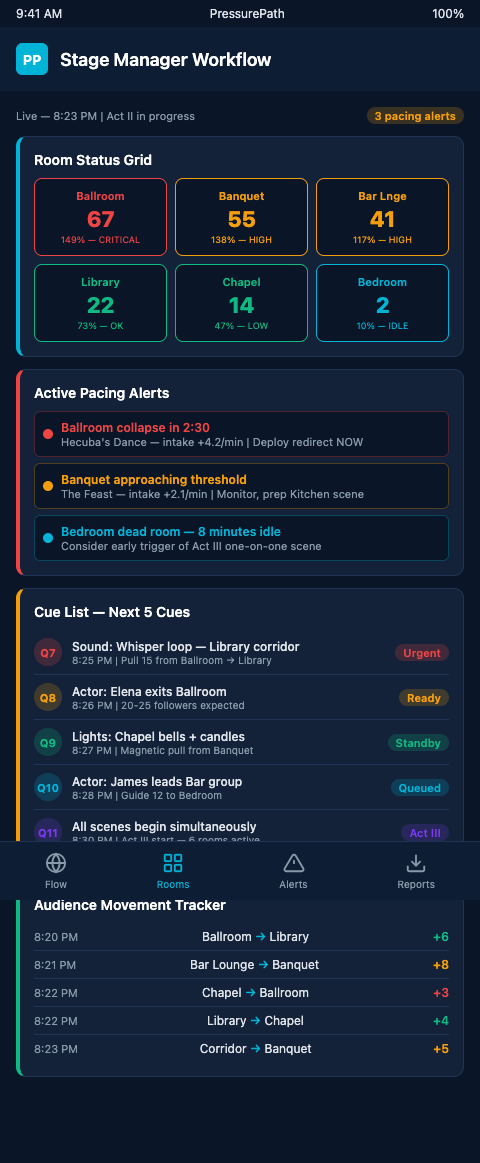
The call sheet modeling workflow covers how flow data gets embedded in the production documents before the pacing layer activates; the mid-show cue adjustments post covers what happens when the SM exercises that authority and needs actors to adapt in real time.
Advanced Tactics: Load-Balancing Labor Against Density Forecasts
Once the pacing layer is operational, the SM has one more planning tool available: labor positioning. Deck supervisors are not positioned by habit or by the location of the last show — they are positioned where the flow model predicts highest pressure variance.
The game master load balancing approach from escape room operations applies directly: staff are deployed to the nodes where audience redistribution is most likely to be needed, not distributed evenly across all rooms. In a 12-scene production, the density model will identify three to five scenes that generate disproportionate clustering. Those are the deck supervisor positions for the night.
Labor positioning can shift between performances based on post-show deviation logs. If Scene 6 ran at amber for three consecutive nights during the Act 1 finale sequence, the SM adds a deck supervisor to the Scene 6 entry corridor for night four. That staffing decision takes 30 seconds when the density data is already in the running sheet.
The practical consequence of density-informed labor positioning is that deck supervisors spend less time reacting to unexpected crowds and more time executing pre-planned protocols. A deck supervisor who knows their scene runs hot on weekend nights above 175 total attendance arrives at their position already prepared for amber conditions — they do not discover the problem when 40 viewers are already wedged against the back wall.
Density-driven labor planning also creates a feedback loop between the pacing model and the staffing budget. When PressurePath's post-show deviation logs show that three specific scenes require deck supervisor intervention on 80% of nights, the production has evidence to justify those positions as permanent running crew rather than on-call coverage. That budget conversation becomes evidence-based rather than impressionistic.
IUSB Stage Management Handbook establishes standard SM running report and scene-by-scene log structures that can be adapted to carry the density layer. Adapting an existing document is faster and creates less institutional disruption than introducing a new system — which is why the pacing layer's integration into existing SM documentation is the correct implementation path rather than a standalone pacing dashboard.
The Ultimate Stage Management Guide (Ticket Fairy) positions the modern SM as the chief operational executive of the running show. For multi-room immersive productions, that executive role requires operational data — scene density, pressure thresholds, redirect protocols — structured into the workflow the SM already owns. PressurePath provides that structure.
Adopt the Pacing Layer Before the Run Begins
Retrofitting a pacing workflow mid-run is possible but difficult: deck supervisors need to learn new protocols during live performances, and the SM must recalibrate their calling rhythm while the show is already running. The workflow installs cleanly during tech, when the production is already building its cue structure and running protocols from scratch.
The tech week integration path has three concrete checkpoints. First, during the initial paper tech, the calling SM reviews the expected headcount ranges for each scene and confirms the pressure thresholds against the director's blocking intent. This is a thirty-minute conversation that replaces hours of week-three diagnostic work. Second, during the first dry tech, deck supervisors walk their positions with the pacing layer annotations in hand and verify that the redirect instructions are physically executable from each position. Third, during the first dress rehearsal, the SM runs the pacing layer as a parallel track against the standard running call — observing where the annotations would have fired without taking action on them — and calibrates the thresholds before the first preview. By the time paying audiences arrive, the pacing layer is a validated operational system rather than an untested theory.
Productions that skip the tech week integration and attempt to bolt a pacing layer onto a running show report consistent difficulties: SM resistance to mid-run workflow changes, deck supervisor confusion about new authority boundaries, and calibration errors that manifest as false alarms during the first week of adoption. The technical friction is not the pacing layer itself — it is the mid-run timing of its introduction. Tech week integration avoids all of those friction sources.
Stage managers at immersive theater companies producing multi-room work with live audience routing need a pacing workflow that travels with the calling script — not a separate system that competes for attention. Join the PressurePath waitlist for SM-ready pacing playbooks built specifically for multi-room immersive productions.