Best Practices for Actor Cue Adjustments Mid-Show
The Actor as the Last Pressure Valve
At 9:41 PM, the calling SM is watching Scene 6 spike to 52 viewers. The blocking arc requires a hard transition at 9:43 to move the audience into Act 2. If the transition fires on schedule, 52 viewers enter Act 2 clustered and will compress Scene 8's sightline allocation within the first four minutes. The SM has two minutes and one option: extend Scene 6 by cuing the actor to hold their current beat while the deck supervisor in the Scene 8 corridor manages the early-arriving clusters.
This scenario is not an edge case. In a multi-room production with promenade movement, the Act 2 transition is one of the highest-variance moments in the show. Audience position at the end of Act 1 is the accumulated result of 60 minutes of autonomous movement — and that accumulated position is the starting condition for every Act 2 scene. Mid-show cue adjustment at the Act transition is not a repair for unexpected problems. It is a regular operational function that the SM should expect to exercise on most performances.
The actor does not know the headcount in Scene 6. They are performing their blocking. The SM's two-minute window depends entirely on whether the actor has been rehearsed for the extension signal and knows how to execute it without breaking the scene's narrative logic.
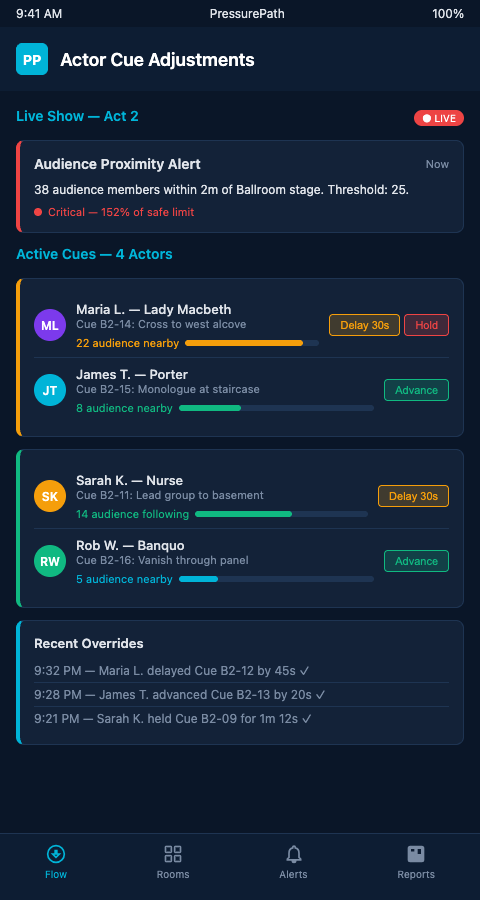
Mid-show cue adjustments are not improvisations — they are pre-rehearsed contingencies that require three elements: a defined signal system between SM and actor, a rehearsed actor response that maintains scene integrity, and a flow trigger condition that tells the SM when to deploy the signal. Without all three, the SM watches the pressure spike and fires the transition on schedule because they have no other tool.
Immersive Theatre, Defined (HowlRound) articulates the defining tension of immersive work: director control versus audience freedom demands that the production develop dynamic mid-show cueing capacity rather than relying on linear cue execution. A show that cannot adapt its cue timing to audience distribution is not fully designed for immersive conditions.
Building the Mid-Show Cue Adjustment Protocol
The protocol has four components: the trigger condition, the signal, the actor response, and the flow recovery.
Trigger conditions come from the pacing model. PressurePath's scene density monitoring assigns each scene a pressure threshold — the headcount at which sightline density exceeds the director's blocking specifications. The trigger condition for mid-show cue adjustment is defined as a percentage above that threshold, typically 20 to 30%, sustained for at least 90 seconds. Short spikes do not trigger; sustained overloads do. This prevents SM overreaction to momentary clustering while ensuring structural overloads are caught before they carry into the next scene.
Think of the audience mass as pressurized fluid in a network of pipes. The extension cue opens a pressure-holding chamber — the Scene 6 actor holds the beat, audiences do not transition yet — giving the downstream pipe time to clear before flow resumes. Without the chamber, the fluid compresses continuously through the transition point and the Scene 8 pipe floods.
The signal must be non-disruptive to the scene's audience experience. Pre-agreed non-verbal signals — a specific earpiece vibration pattern for wired actors, a hand signal from a positioned deck supervisor, an environmental cue only the performer can identify — are more reliable than any live verbal communication during performance. Theatrecrafts — Calls and Cans and Comms identifies communication infrastructure as the operational backbone of real-time cue adjustment: the signal system must be robust enough to function under performance conditions without compromising the audience's experience.
The actor response must be rehearsed before deployment. Extension beats — a repeated physical sequence, an extended atmospheric moment, an improvised environmental interaction — must feel intentional to the audience. An actor who receives an extension signal but has not rehearsed a response either rushes through the signal or breaks character to buy time visibly. Cue (theatrical) — Wikipedia describes cue-hold practices as a core part of theatrical vocabulary — extending a cue rather than firing it is a standard technique that immersive productions underutilize because extension conditions are rarely pre-scripted.
The flow recovery is the transition cue fired once pressure normalizes. QLab — Figure 53 allows cue lists to be reordered or held mid-show without disrupting the overall cue sequence, meaning the SM can hold a transition cue, monitor density normalization, then fire the held cue once Scene 8 has space for the incoming audience. ETC Eos Show Control (Control Geek) enables OSC-based integration so the lighting transition fires in coordination with the QLab audio hold — the technical infrastructure for mid-show adjustment exists in standard show-control software.
The full protocol — trigger, signal, actor response, flow recovery — should be rehearsed at least three times in tech before the first preview. The rehearsal creates the muscle memory in the actor and the SM simultaneously. When the SM fires the extension signal in performance for the first time under pressure, both parties have already executed the sequence in controlled conditions and know what a successful recovery looks like. Without that rehearsal, the first live execution is also the first time either party has practiced the protocol.
The stage manager pacing workflow covers how the SM monitors scene density during the running call; this post covers the specific protocol for when that monitoring triggers a mid-show cue adjustment rather than a usher redirect.
Advanced Tactics: Cue Extension Windows and Block Cue Safety
Mid-show cue adjustments require one additional safety layer when the show uses complex technical cue sequences: block cues. The challenge is that immersive productions often use time-locked technical cue sequences — underscoring that was composed to sync with specific actor movement, lighting states that support a precise actor position — where holding a transition cue disrupts the relationship between technical and performer elements. Block cue safety planning during tech identifies which transition cues are safe to hold without cascading technical disruption and which cues have downstream dependencies that require alternative interventions if a hold is needed. Blocking and Block Cues (On Stage Lighting) describes how block cues protect key state values from mid-show updates, allowing safe live cue edits without corrupting the downstream cue sequence. Before the SM holds a transition cue mid-show, the console operator must confirm that the hold will not trigger any dependent cues downstream.
This is a tech-note item, not a running-night decision. Every scene with a defined extension protocol should have its transition cue block-protected in the board programming during tech, so the SM can hold it in performance without console operator intervention.
The practical limit on extension duration is the actor's beat capacity and the audience's tolerance for extended atmospheric moments. Most extension protocols work effectively in the 90-second to 3-minute range. Extensions beyond 4 minutes typically require a more elaborate actor response and risk audience awareness that the show has paused. PressurePath's pressure normalization tracking tells the SM when Scene 8 has cleared sufficiently to fire the held transition — the extension ends as soon as it is safe, not at a fixed duration.
The blocking notation approach includes a notation convention for extension beats in the blocking script — marking the moment in the actor's score where an extension signal can land without breaking the scene's narrative arc. Chaperone scripts flow model applies comparable scripted-response logic to docent and chaperone teams: pre-scripted responses to density conditions reduce decision latency under live pressure. The same principle applies to actors managing extension signals.
Mid-show cue adjustments represent the most granular level of flow control available to an immersive production — they require the most preparation but deliver the most precise intervention when structural gating and usher redirects have not been sufficient to normalize pressure.
Rehearse Extensions Before You Need Them
Productions that introduce mid-show extension protocols after opening night face a rehearsal deficit: actors have not practiced the extension beat in performance conditions, and the SM has not calibrated the trigger threshold against live data. Both calibrations are most effective during tech and first previews, when the flow model and the live performance data are being aligned simultaneously.
The rehearsal sequence for extension beats has three phases that can be integrated into existing tech schedule without adding significant time. First, the director walks each extension-eligible scene with the actor and identifies the specific beat where an extension signal can land without breaking the scene's narrative logic. Second, the SM and actor run a dry signal test during a regular tech rehearsal — the SM fires the signal, the actor executes the extension response, and both parties observe how the beat reads against the full scene. Third, during the first preview, the SM runs extension protocols as shadow rehearsals: the SM mentally rehearses the trigger condition and signal deployment without actually firing, tracking how often the extension would have been appropriate and whether the live conditions match the trigger thresholds. By the third preview, the extension protocol is calibrated against real audience data and ready for live deployment.
One practical note on rehearsal discipline: extension beats feel artificial during dry rehearsals because the audience pressure that motivates them is absent. Actors sometimes resist rehearsing extensions because the beats feel hollow without the live density context. The rehearsal is still worth running, because the physical and vocal mechanics of the extension need to be muscle memory before the actor attempts them under live pressure. The director should frame the rehearsal as a craft exercise — the extension is a tool the actor needs to own — rather than as a realistic simulation of the performance condition.
Immersive theater companies managing long runs of multi-scene non-proscenium work need mid-show cue adjustment protocols that actors and SMs can execute without improvisation under live pressure. Join the PressurePath waitlist for flow-triggered cue adjustment tools built for immersive running workflows.