Building Chaperone Scripts That Match Your Flow Model
The Unbriefed Chaperone Problem
At 10:15 AM, a bus from P.S. 142 unloads 32 third-graders and four chaperones into your atrium. The chaperones know two things: don't let kids run, and keep your group together. By 10:22 AM, all four chaperones have interpreted "keep your group together" identically — they're standing at the back of a dense cluster of 28 kids compressing around the Electricity wall, watching the group rather than distributing it. The Water Cycle puzzle, 40 feet away, has zero visitors.
Research on museum chaperones consistently identifies the same pattern. A Journal of Museum Education study on school group chaperones found that chaperones fill eight distinct roles in museum settings but are typically underutilized and under-briefed — they default to crowd management rather than facilitation because no one has told them what facilitation looks like in this specific museum on this specific floor layout.
The IMLS-funded chaperone effectiveness study makes the productive case: scripted inquiry guidance transforms chaperones from passive supervisors into active facilitators. The word "scripted" is precise — general orientation ("be curious with the kids") produces inconsistent results, while role-specific cues tied to specific stations produce measurable engagement increases.
The design challenge for exhibit teams is that chaperones vary in confidence, subject knowledge, and experience. A first-time chaperone from a Title I school who has never visited a science museum needs a very different script than an experienced parent who has chaperoned this same floor three times. Without a flow model underlying the script, exhibit designers can only write one generic version and hope it applies.
The generic version consistently fails at the exact moments that matter most: when a sub-group approaches a high-magnet station that's already at capacity, and the chaperone has no scripted alternative. Without an alternative, the chaperone does what unbriefed adults reliably do — waits at the crowded station, reinforcing the compression rather than routing around it. The Water Cycle puzzle continues to receive zero visitors while the Electricity wall receives 31.
Mapping Scripts to the Flow Model
Think of four chaperones as four independent flow channels within the high-pressure burst of a 30-kid school wave. Unscripted, those channels follow the path of least resistance — toward the high-magnet stations where most kids are already clustered. The clustering intensifies. Scripted to specific cues, each channel diverts a sub-group toward a different station, distributing the pressure burst across four simultaneous exhibit interactions rather than one compressed one.
PressurePath generates the script distribution by reading the flow model's pressure map for the incoming group. If the predicted pattern shows compression risk at the Electricity wall and bypass risk at the Water Cycle puzzle and Erosion table, the model produces three distinct sub-group routing assignments — one chaperone stays with the natural cluster at Electricity, one routes their sub-group to Water Cycle with a specific opening prompt, one takes the Erosion table with a prompt calibrated to third-grade vocabulary.
The scaffolded role-specific cue research (Springer) confirms the mechanism: role-specific cues significantly improve student exhibit engagement over generic facilitation. The word "role-specific" is the operative constraint — a chaperone given a prompt for the Water Cycle puzzle performs differently than one given a general "engage the kids" directive, because the specific prompt removes the cognitive load of figuring out what facilitation looks like at that station.
Industry standard chaperone-to-student ratios are 1 adult per 10 students minimum, meaning a 30-kid wave includes at minimum three chaperones and often four or five. That ratio creates a natural sub-group structure: three or four groups of 8-10 kids, each with an adult. Script-based flow management treats that existing structure as a routing asset. Each chaperone becomes the head of a pressure sub-channel, responsible for routing their 8-10 kids to the station their script specifies.
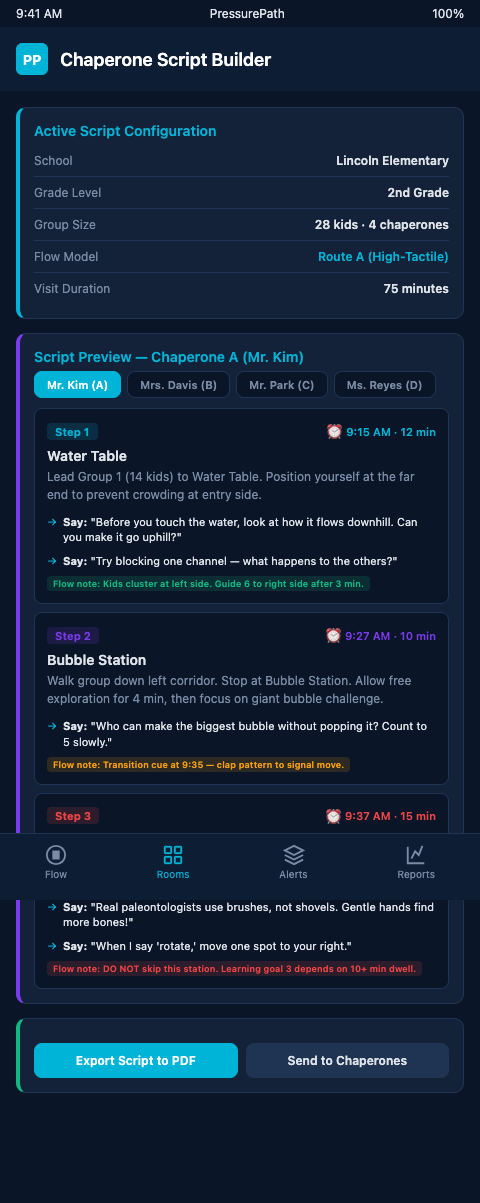
The script delivery mechanism matters as much as the script content. Peoria Riverfront Museum's chaperone guide template and The Henry Ford's zone-by-zone behavioral cue guide both use a zone-by-zone format that aligns with how chaperones physically move through the floor. PressurePath outputs scripts in the same format: one page per chaperone sub-group, organized by zone sequence, with opening prompts, engagement cues, and transition signals for each station.
The transition signal is the critical flow component. "Move to the next station when your group has been at this one for about five minutes" produces inconsistent timing. "Move when two kids have pulled the lever twice" produces consistent timing and a specific engagement criterion that the chaperone can observe without judgment. Transition signals calibrated to specific interactive mechanisms — rather than elapsed time — synchronize sub-group movement with actual engagement completion, which is the flow model's goal.
This connects directly to the broader chaperone choreography fundamentals that underpin effective field trip flow design — scripts are the operational instantiation of choreography principles, translated into the specific cues and transitions that a first-time museum chaperone can execute without prior training.
Advanced Script Configurations
The first advanced technique is pre-briefing scripts that shift the orientation window from the atrium to the bus. Research on guide-centered field trips with scripted storytelling shows that the strongest learning outcomes come from visits where orientation begins before the museum floor. A two-page chaperone brief distributed on the bus — with a station map, the sub-group routing assignment, and three opening prompts per zone — gives chaperones processing time so they arrive at the atrium ready to act rather than still reading the orientation packet.
The second advanced technique is conditional cue branching. A base chaperone script routes the sub-group to the Water Cycle puzzle at Station 2. A conditional branch adds: "if your sub-group has already clustered at Station 2 when you arrive, redirect to the Erosion table using this prompt instead." Conditional branching addresses the most common script failure mode — the chaperone arrives at the scripted station and finds it occupied — without requiring the chaperone to improvise.
For museums integrating real-time actor cue systems from haunted attraction contexts, the parallel is direct: actor cues adjust in real time to group spacing, just as chaperone scripts should have conditional branches that adjust to floor state at the moment of arrival. The underlying logic is the same — a pre-planned response tree that covers the most likely floor conditions without requiring judgment calls.
The third technique is post-visit script feedback. After each field trip, floor team members rate which script elements produced visible engagement versus which produced confusion or redirection. Two rating cycles — covering a dozen groups — identify which prompts work consistently and which need revision. The field trip day learning audit creates the structured framework for collecting that feedback and translating it into script updates.
Over time, script feedback loops produce chaperone guides that are calibrated to your specific floor, your specific station mechanisms, and the grade-level distributions of your recurring school group population. A chaperone script calibrated to eight months of feedback is a fundamentally different instrument than the generic chaperone orientation packet that most museums distribute.
Calibrating Scripts Across a School Season
The first version of a chaperone script is a hypothesis: these prompts, at these stations, in this sequence, will produce the routing pattern the flow model predicts. After eight to ten field trip sessions, the script is a calibrated instrument — because the floor team has been collecting feedback on which prompts generated engagement, which generated confusion, and which generated redirection.
The calibration process is low-cost if it's built into the end-of-session workflow. A 90-second debrief with each chaperone — four questions, recorded on a card — produces actionable data: which station prompt did you use, did kids engage with the mechanism, did you use a conditional branch, why or why not? Across 10 sessions with three or four chaperones per session, that data identifies the two or three prompts that consistently fail and need revision.
PressurePath connects script calibration to the wave-pressure data: if a chaperone's sub-group shows a 72% stop rate at the Water Cycle puzzle after following the script, and the group without the script shows 11% stop rate, the script is working at that station. If the scripted group and the unscripted group show similar stop rates, the prompt needs revision. That comparison, run across sessions, produces the evidence base for iterative script improvement.
Over a full school season, a museum operating with calibrated chaperone scripts develops a measurably different flow pattern than one relying on generic orientation. The difference is not just better engagement at bypassed stations — it's a predictable, repeatable floor pattern that allows PressurePath to refine its pressure predictions and produce increasingly accurate pre-configurations for incoming groups.
Scripts Are Flow Infrastructure
Chaperone scripts are not a visitor services nicety — they're a flow engineering tool. Each briefed chaperone is a pressure-distribution mechanism that shapes where a 30-kid wave goes. Each unbriefed chaperone is additional mass following the wave's natural path, amplifying the compression at high-magnet stations and deepening the bypass at grant-funded exhibits that were never designed to compete visually with an Electricity wall.
The framing matters because it changes how chaperone programs are budgeted, staffed, and evaluated. A visitor services framing treats chaperone orientation as a courtesy: nice to have, low priority, first to be cut when the program budget tightens. A flow engineering framing treats chaperone scripts as infrastructure: a capital investment in the floor's operational capacity, as load-bearing as a rope partition or a sensor deployment. The infrastructure framing makes the case for sustained investment even in lean budget years, because infrastructure that isn't maintained degrades quickly.
The measurable difference appears in longitudinal tracking data. Museums that treat chaperone scripts as infrastructure — with dedicated budget lines, recurring calibration cycles, and documented evaluation against bypass metrics — show compounding improvements in school-group engagement rates over multi-year windows. Museums that treat chaperone orientation as a discretionary program see those improvements stall or reverse as staff turnover and program fatigue erode the scripts' operational quality.
PressurePath generates scripts from your flow model, updating them as wave-pressure data accumulates across your field trip seasons. Children's museum exhibit designers who want to turn their chaperone population into a flow management asset should join the PressurePath waitlist and see how your current floor model maps to a distribution of specific, actionable scripts.