Chaperone Choreography: The Fundamentals of Adult-Assisted Flow
The Adult Who Moved the Wave Past the Exhibit
At 10:31 AM, the chaperone from P.S. 142's third-grade field trip was standing at the exit of the science wing, 15 feet past the Water Cycle puzzle, telling kids to "keep moving, we have to see everything." Eight children were approaching the puzzle. Seven of them looked at the chaperone, looked at the puzzle, and kept moving. One stopped, pulled a lever, and was called away by name 40 seconds later.
The chaperone was not negligent. She was doing exactly what most chaperones do on field trips: managing forward momentum to stay on schedule. But her position—past the exhibit rather than at its entry—converted her authority into a bypass signal. The wave read her stance as "this exhibit is behind us" and flowed past.
That's the chaperone choreography problem in its simplest form. Adult placement is a flow variable, and most children's museums treat it as incidental. The pre-visit chaperone instructions most museums provide say nothing about where adults should stand during the visit. They cover logistics—meeting points, lunch procedures, bathroom locations—and leave the in-exhibit adult behavior entirely unspecified. The result is the behavior the research documents: guard stance and forward-walking, neither of which produces station contact.
A choreographed chaperone who knows where to stand and what to say at each priority station converts the same field trip group into a fundamentally different wave. The physics don't change. The children don't change. The adult authority signal changes, and the peer contagion dynamics from child pacing basics do the rest.
What Chaperone Behavior Data Actually Shows
NAAEE research on chaperone roles in field trips documents "guard stance" as the most observed chaperone behavior at 36% of observation intervals—standing with arms folded or crossed, physically positioned at the perimeter of the wave's current location. "Walking past exhibits" is the second most observed behavior at 31%. Together, those two behaviors characterize two-thirds of chaperone activity on field trips as wave-pushing rather than station-engaging.
The "educator" role—where a chaperone actively queries children about exhibit content, introduces the learning goal, or physically demonstrates station interaction—was observed at low rates in the research. This isn't because chaperones don't care. It's because nobody told them what to do at each station or where to stand to make it happen. Chaperones are parents or community volunteers, not museum educators. Without specific instruction, they default to the behaviors that feel socially appropriate in a crowd management context.
School field trip review research establishes that students learn significantly more when accompanied by a knowledgeable adult who shares information at exhibits. Scripted chaperone involvement is the evidence-based intervention—it's not a nice-to-have, it's a documented learning outcome variable. The research doesn't say "chaperones are good to have." It says specifically that structured adult guidance at exhibits is a primary predictor of learning outcome quality.
Parent-child interaction research in children's museums produced a specific finding: adult interaction that peaked at a station correlated with child dwell time of 3.9 minutes, versus 2–3 minutes for unguided child exploration. The adult isn't just directing the wave—they're extending the stop duration by nearly double. A 4-minute stop at the Water Cycle puzzle is the difference between surface contact and genuine engagement with the learning content.
The Choreography Framework
Chaperone choreography applies to three moments in a field trip: the approach, the hold, and the exit.
The approach. A chaperone positioned at a station's entry point—rather than past it or beside it—signals to the wave that this is a destination, not a waypoint. The physical authority of an adult facing the station, rather than facing the crowd, creates a directional cue that peer contagion amplifies. When the leading 6–8 children in the wave see an adult at the station entry, their social default is to approach that adult rather than continue past. That default is exactly what the chaperone's position should exploit.
Pre-visit preparation research shows that when chaperones receive specific station-level instructions before the field trip, their on-floor behavior shifts from guard stance to active guidance. The instruction doesn't have to be elaborate—"stand at the puzzle entry and say 'let's see what happens when you pull the lever'" is sufficient. The specificity of the instruction matters more than its length. A chaperone told "be engaging with the exhibits" will default to guard stance. A chaperone told "stand at the rope partition at exhibit 3, facing the entry, from 10:25 to 10:40" will be where they need to be.
The hold. Once the wave stops at a station, the chaperone's role is to sustain engagement long enough for the learning content to activate. A 30-second stop doesn't generate measurable outcomes. A 3.9-minute stop does. The hold technique that Smithsonian group visit programs use in their Exhibit Explorations framework is repeatable inquiry: "What do you notice? What do you wonder?" Those two questions require no prior content knowledge, work at every exhibit, and generate 60–90 seconds of additional engagement per iteration. Ask them twice and you've held the wave for 3+ minutes.
The exit. When the chaperone ends the station stop, their exit cue determines whether children are ready to move or frustrated at being interrupted. A clean exit cue—"we're going to see one more thing before lunch, and it's right over there"—preserves momentum and leaves the children with a completed interaction. An abrupt "time to go" exit creates resistance and emotional friction that reduces engagement at the next station. The exit cue is the last thing that station teaches: that stopping at exhibits is rewarding, and the next one is worth stopping at too.
Research on parental awareness of learning opportunities shows that caregivers who understood exhibit goals actively guided children into station engagement. The briefing that museums provide to chaperones before field trip days is the mechanism for creating that understanding. A chaperone who knows that the Water Cycle puzzle is the centerpiece of an NSF grant and that their job is to ensure each child pulls the lever will behave very differently from a chaperone who was told to "make sure the kids have fun."
The Smithsonian's Middle School tour program data shows that chaperone scripting directly determines station stop rates. Museums with structured chaperone programs—specific positioning, specific language, specific timing—report higher per-station contact rates than museums with unstructured chaperone presence. The effect size is large enough to matter for grant evaluations.
Integrating Choreography with PressurePath's Flow Model
PressurePath models chaperone position as a flow variable alongside partition placement and station spacing. A chaperone at a station entry functions as a soft redirect in the pressure model—not a physical barrier, but a behavioral one that changes the wave's effective path choice.
The simulation shows the difference in bypass rate for a given station with and without a positioned chaperone. For most mid-floor stations, the chaperone effect reduces bypass by 40–60% compared to unguided wave movement—a larger effect than most physical partitions of equivalent cost. This is because the chaperone redirect operates on the social dynamics that drive school-wave movement, not just the physical ones. A rope partition stops the wave's body. A chaperone at the entry stops the wave's social momentum, which is what actually determines whether a third-grader chooses to engage.
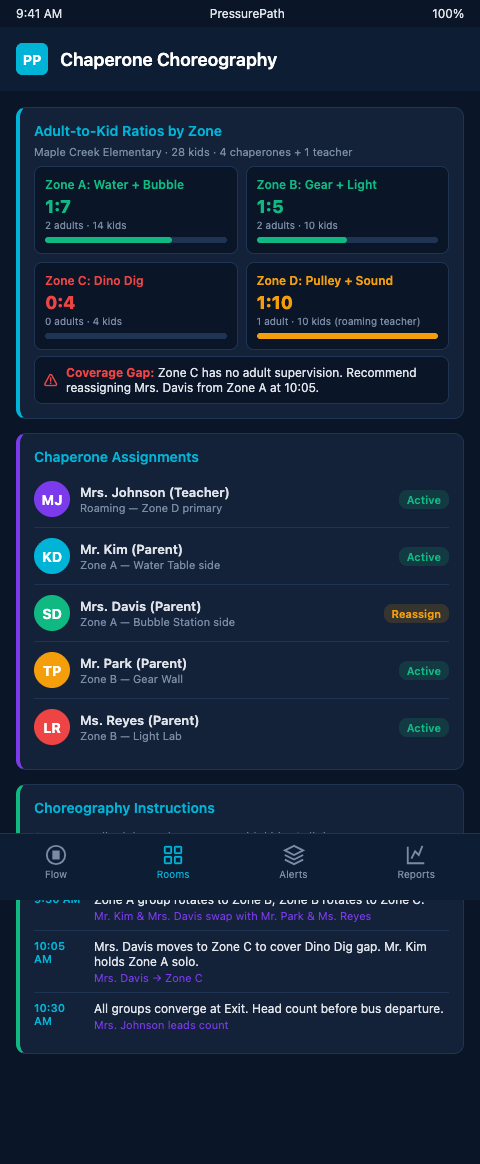
For chaperone scripts flow model, PressurePath's advanced module generates station-level scripts calibrated to your floor plan's specific bypass risk points. The scripts tell each chaperone where to stand, when to arrive at each station, what to say during the hold phase, and what exit cue to use. The output is a one-page field guide per chaperone group, customized to the school wave's entry time and the museum's priority stations.
The child pacing fundamentals that explain why chaperone position has such a large effect on wave movement center on peer contagion and adult-imposed time pressure dynamics—those specific behavioral mechanics are what make adult placement disproportionately influential on school-wave behavior compared to individual visitor flow.
Pre-show briefing methodologies from haunted attraction venues use structurally similar choreography logic—pre-show briefing and pacing models covers how briefing the adults in charge of groups before entry changes throughput patterns in ways that map directly to museum chaperone pre-briefing effects. The core insight is the same across both venue types: how you use the five minutes before the group enters the space determines more of the outcome than anything you do once they're inside.
The Pre-Field-Trip Chaperone Brief
The single highest-leverage intervention available to most children's museums costs almost nothing: a 10-minute chaperone briefing before the group enters the floor. The briefing covers three points: which stations are the learning priorities for today's visit, where each chaperone should be positioned when the wave approaches each priority station, and what the hold technique is.
That brief converts 36% guard stance into 60%+ active guidance. It converts 31% "walking past exhibits" into deliberate station-to-station routing. And it converts 12% contact with the NSF-funded exhibit into 70%+ contact—the difference between a successful grant evaluation and an explanation letter.
PressurePath generates the chaperone brief automatically from your floor plan and learning goals. The brief maps chaperone positions to specific stations, specifies timing windows for each position, and includes the two-question hold script appropriate for each exhibit's content. Children's museum educators and exhibit designers who want to run that generation for their next field trip day should join the waitlist.