Integrating Pacing Models With Your Pre-Show Briefing Process
The Briefing Gap That Shows Up at 9 PM
Most haunted attraction pre-show briefings run the same script regardless of what Saturday's ticket count looks like. Actors learn their zones, safety rules get reviewed, radio channels get confirmed. What rarely gets covered: which rooms will hit actor-compression risk first, what batch interval is needed to preserve each zone's strike timing, and at what point the Clown Alley corridor becomes a pinch-point that degrades every downstream scare.
Nevermore Haunt's actor prep guide makes the point directly: actors need pre-shift context on crowd volume to calibrate scare timing for incoming groups. Without that context, every actor starts the night with the same assumptions regardless of whether 200 or 450 tickets were sold. By 9 PM, the assumptions that held at 7 PM have collapsed — but the briefing never equipped the cast to anticipate that shift.
The HAA 2025 State of the Industry Seminar noted that CHAOS safety training expansion now includes documented pre-shift briefings as a certification criterion. That's a compliance driver — but it also creates the infrastructure for something more operationally useful: a briefing process that embeds pacing data so actors arrive on floor with crowd-specific timing adjustments, not generic instructions.
The core problem is that pre-show briefings are prepared in advance without the density forecast that a pacing model generates. Integrating the two closes that gap.
How a Pacing Model Changes What Gets Said in the Briefing Room
A pacing model converts ticket count, batch interval, and room layout into predicted density per zone across the night. The output isn't just useful for floor managers — it's directly actionable for every actor in every room. The briefing integration question is: how do you translate model outputs into briefing language that actors can actually use during a 400-person surge?
Think of it in fluid dynamics terms: when you run 450 people through a haunted attraction with two narrow corridor bottlenecks, pressure builds upstream before it reaches the relief of a wider scare chamber. The pacing model identifies where those bottleneck points are and at what crowd level the pressure starts compressing group spacing. That's information your Clown Alley actor and your Butcher Room actor need before the doors open — not after the first scare fails.
A briefing integrated with a pacing model covers three specific items that generic briefings skip. First, the density threshold for tonight: at 450 tickets with 20-minute batch intervals, the Clown Alley section will approach actor-compression risk around the 90-minute mark. Everyone in that zone knows to tighten hold timing after 8:30 PM. Second, room-specific timing adjustments: if the pacing model shows Room 7 routinely accumulates 30% more density than adjacent rooms, the Room 7 actor's strike zone window shortens and they should be briefed to hold an extra beat before executing. Third, the escalation protocol: when does a zone actor radio the floor manager, and what's the adjustment — hold groups at the previous room, widen the batch interval, or call for a runner to re-space?
TheatreFolk's research on pre-show routines shows that pre-show routines unify casts, set energy level, and lock in blocking and timing before doors open. The same mechanism applies to haunts: a briefing that gives actors specific density-adjusted timing locks in the correct behavior for tonight's crowd conditions, not last week's.
Queuing theory fundamentals from ResearchGate formalize this: Little's Law provides the quantitative basis for briefing staff on expected throughput. If your batch interval is 8 minutes and each group averages 6 people, your arrival rate is predictable. Building that number into the briefing gives every actor a concrete density anchor rather than an abstract "it's going to be busy tonight."
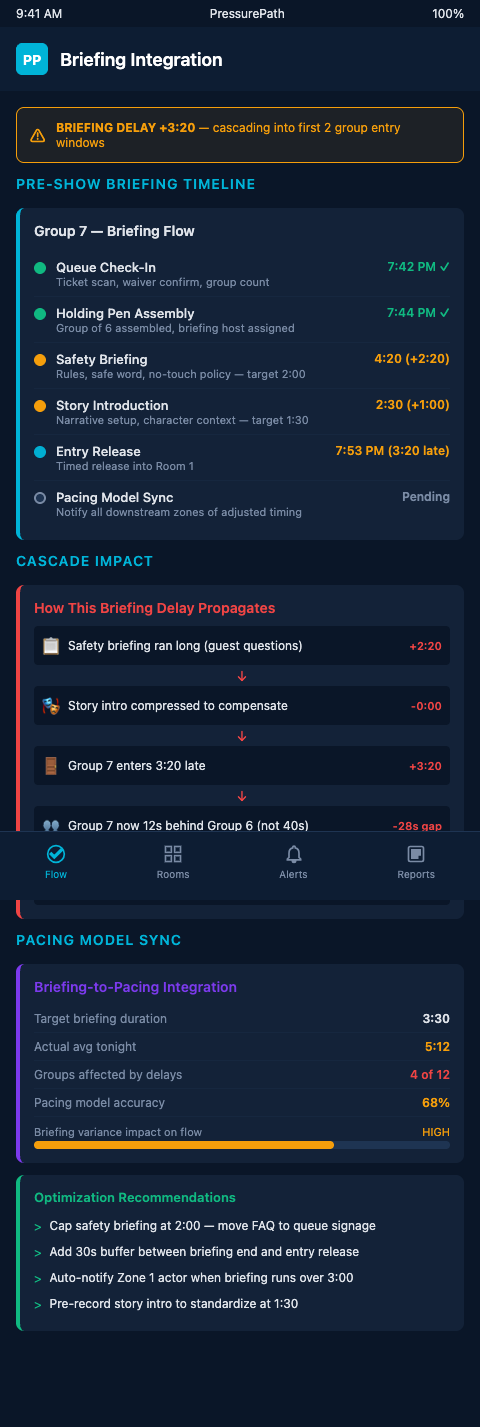
PressurePath generates that briefing anchor automatically from the pre-season flow model. The pre-opening pressure check output feeds directly into a briefing template: room-by-room density forecast, timing windows for each zone, and the threshold at which each actor should adjust their beat. That's not a new document to prepare — it's a formatted export from the model you already built.
Standardizing the Integration Across a Season
A one-time briefing integration is useful for peak Saturday. A standardized integration across a full season is what creates consistent scare quality — and that's where the operational investment pays off across 40 peak nights.
The seasonal flow standard for a haunted attraction locks in the briefing variables that stay constant (room capacities, strike zone dimensions, safety protocols) and separates them from the variables that change nightly (ticket count, batch interval, weather-driven arrival distribution). A pacing model integrated with the briefing process updates only the variable layer — the constant layer stays static in the standard brief document every actor receives at the season start.
This separation matters for cast consistency. New actors joining in week three shouldn't need to rebuild their mental model from scratch every night. The standard brief gives them the fixed parameters; the nightly density update gives them the adjustment for tonight. According to academic work on stage management and pre-show protocols from ETBU, formalized pre-show walk-throughs with departmental sign-off reduce offstage errors — the same discipline applied to haunts means briefings that systematically close the density information gap rather than hoping floor instinct fills it at 9 PM.
The booking system integration connection matters here too: when ticket sales data feeds the pacing model in real time, the briefing document can be auto-generated for each night based on actual confirmed attendance rather than projected estimates. That means the briefing room gets tonight's real density forecast, not a calendar average.
Haunted attraction designers building for multiple peak weekends benefit most from this integration. The pre-show briefing becomes the operational lever that translates a pre-season pacing model into per-night actor behavior — and that's the difference between a crew that guesses at density and one that walks onto the floor calibrated for the specific crowd arriving in two hours.
The standardized briefing document should also include a tiered escalation tree keyed to ticket count. At 275 tickets with 12-minute batch intervals, the briefing flags three rooms as peak-compression candidates and the escalation protocol requires a radio check every 20 minutes from those positions. At 400 tickets, the same document flags seven rooms, tightens the radio check cadence to 10 minutes, and pre-authorizes the floor manager to widen batch intervals by 90 seconds without consulting the operator. At 475 tickets, the tree activates a pre-positioned runner between Clown Alley and the Butcher Room corridor whose sole job is to log group spacing every 4 minutes and radio compression alerts to the zone actors.
Every tier of that tree is derived from the same pacing model that feeds the initial density forecast — no improvisation, no new documentation to read during a surge. The cast simply executes the tier that matches tonight's ticket count, and the briefing document tells them which tier is active before the doors open.
Make Tonight's Density the First Slide in Every Briefing
The integration pays off the first time a briefing room cast walks onto the floor already knowing which 15-minute block their strike zone will compress and which batch interval tier the floor manager will activate. At 420 tickets, that context is the difference between a cast that holds its beats through the 9:15 PM surge and a cast that fires three scares into compressed crowds before the floor manager radios in a correction. The briefing itself takes no more time than the old generic version — it takes the same 12-minute pre-show slot — but the content shifts from static safety review to tonight-specific density calibration. Over 40 peak nights, that shift is measured in missed-scare logs, actor voice fatigue, and fire marshal compliance documentation that accumulates as an operational byproduct rather than an emergency scramble.
PressurePath generates nightly briefing data — room-by-room density forecast, timing windows per zone, escalation thresholds — directly from the crowd model haunted attraction designers build before the season opens. Stop running peak Saturdays on the same briefing deck you used for a slow Tuesday. Join the waitlist to bring pacing model outputs into your pre-show workflow before the next surge catches your cast without the right context.