Building a Repeatable Flow Standard for Seasonal Haunt Seasons
The Rebuild Tax Every Seasonal Haunt Pays
Every September, the haunt industry runs the same quiet calculation: how much institutional knowledge was lost when the seasonal crew departed in November? The answer, for most operations, is most of it. The experienced gate operator who had the spawn interval memorized. The Butcher Room actor who knew the exact moment to slow their approach based on corridor echo. The floor manager who caught groups stacking in Clown Alley before it reached the scare chambers.
That knowledge is not documented. It is carried by individuals. When those individuals leave — and seasonal staff turnover is near-total for most haunts — the operation rebuilds from observable behavior rather than engineered standards.
2025 Haunt Season Post-Mortem (HauntPay) shows that average haunt sales rose more than 8% in 2025, but refunds ticked up — a pattern consistent with non-standardized operations that cannot sustain quality as volume increases. Eight Reasons to Be Concerned About Haunt Industry (HAN) frames the financial stakes: with expenses rising 15% year-over-year, season-to-season consistency is not a quality-of-life issue — it is a margin survival issue.
The rebuild tax compounds across seasons. An operation that starts from scratch each year does not accumulate the three-plus seasons of comparative data needed to distinguish genuine pacing improvements from year-to-year anomalies. Understanding Seasonal Sales Patterns (Peasy) confirms this: a minimum of two to three seasons of data is required to distinguish seasonal patterns from statistical noise. Without a repeatable flow standard, haunt operators cannot build that dataset.
The Midwest haunt complaint spike case study shows what rebuilding after a failure costs — under $400 in physical modifications, but a full off-season of diagnostic work that a documented flow standard would have made unnecessary. The standard is cheaper than the post-mortem.
What a Repeatable Flow Standard Contains
A repeatable flow standard for a seasonal haunt is four documents: a spawn interval specification, a chamber reset window library, a density threshold map, and a season baseline report. Together, they are the institutional knowledge that survives staff turnover.
Spawn interval specification. This is a table: for each entry point in your haunt, at each target ticket count, what is the minimum spawn interval in seconds? The specification distinguishes between baseline nights (weekdays, early-season), standard peak nights, and maximum-capacity nights. It is not a single number — it is a range with a hard floor. A haunt running 400 baseline tickets uses a 55-second interval; at 600 peak tickets, the interval floor rises to 48 seconds; at maximum-capacity nights, the floor is 44 seconds and the gate operator is required to hold rather than release early.
Standardize Service Processes in Multi-Location (Qminder) establishes why this specificity matters: standardized workflows reduce confusion and let multi-site operations maintain consistent quality. For a single-location seasonal haunt, the same logic applies — a new gate operator in September can execute the spawn interval specification on opening night without needing three weeks of on-the-job calibration.
Chamber reset window library. For each active scare chamber, the reset window specification captures: minimum exit time from chamber before actor clears strike zone, minimum reset time from clear to ready-to-perform, and the combined floor that the spawn interval must honor. PressurePath's simulation generates this library as a byproduct of the spawn interval modeling — every time you run a flow simulation, the system records the reset window requirements each chamber imposed on the upstream spawn interval.
Think of these reset windows as the pressure ratings for each pipe junction in your flow system. A pipe junction rated for 60 PSI that regularly receives 75 PSI will eventually fail. A scare chamber rated for a 50-second reset window that regularly receives 35-second intervals will eventually produce contact incidents, flat scares, and actor fatigue complaints. The reset window library is your pressure rating reference.
Density threshold map. This documents the maximum acceptable group density per square meter at each corridor segment and scare chamber, at each ticket count tier. It is the fire marshal density compliance document and the scare-quality density compliance document in one. When a new floor manager needs to know whether the current Clown Alley density is acceptable, the answer is in the map — not in the head of the returning experienced staff member.
From Chaos to Consistency (AG Management Consulting) frames this as the standard transition from craft-based to systems-based operations. Quality at scale requires codifying informal processes into repeatable documented systems — not because the informal knowledge is wrong, but because it cannot survive the transition between seasons.
Season baseline report. At the end of each October, a PressurePath flow summary captures the actual spawn interval data, the nights where intervals deviated from specification, and the correlation between those deviations and complaint or incident records. This is the calibration document that improves the specification each year. After three seasons of baseline reports, the spawn interval specification is no longer theoretical — it is empirically validated against your specific floor plan and guest profile.
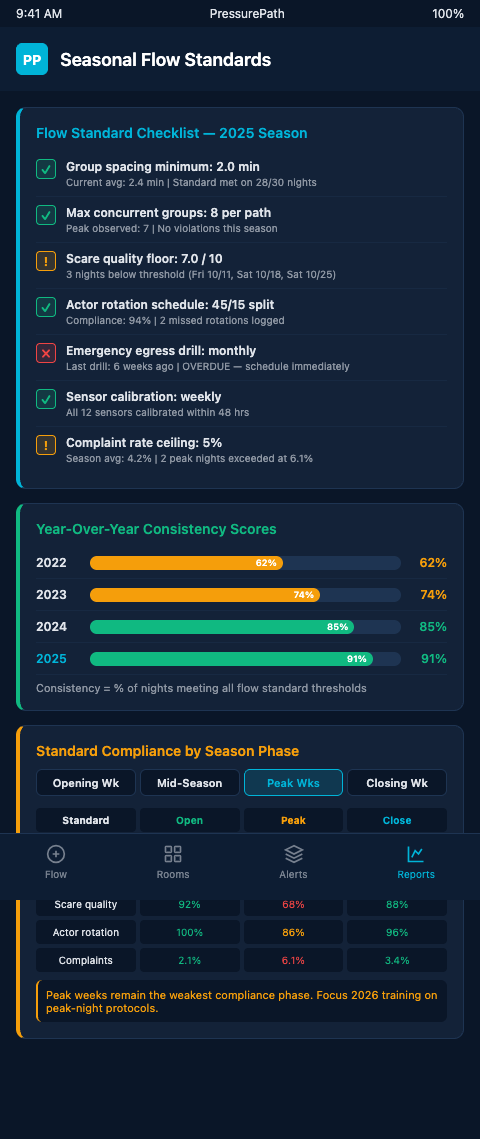
HAA Certifies 67 Top Haunts for 2025 (HAN) shows that HAA certification requires documented emergency programs and training handbooks. A repeatable flow standard is the operational complement to those safety documents — it is the pacing handbook that the certification framework does not yet explicitly require, but that every consistently well-reviewed haunt effectively maintains.
Advanced Tactics: Multi-Season Standard Refinement
The flow standard becomes most valuable in its third and fourth season, when you have enough comparative data to make deliberate design changes and measure their effect. Year one is establishing baseline. Year two is validating baseline against a different season's conditions. Year three is running a controlled test: change one variable — the Butcher Room reset window, the Clown Alley corridor width — and measure its effect on the season baseline report.
5 Reports to Run Every Monday (HauntPay) documents the in-season monitoring cadence that feeds this multi-season standard: operators running weekly reviews against prior-season benchmarks identify pacing degradation early. Without the prior-season benchmark — which only exists if you built the flow standard — the weekly review has no reference point.
For actors, the benefit of a flow standard is predictability across seasons. When actors return from a previous year and are handed a spawn interval specification and chamber reset window library, their training time drops significantly — they are learning performance positions, not also deducing the spacing from experience. The flow-aware actor safety implications of consistent spacing are substantial: a documented reset window floor is also a documented safety minimum.
The multi-season refinement loop has a compounding effect that is not obvious in year one. The spawn interval specification in year one is based on the simulation model — theoretical, calibrated to the floor plan geometry but not yet validated by actual guest behavior data. By year two, the season baseline report reveals where the theoretical model diverged from actual performance: which chambers ran 6 seconds tighter than predicted because guests walked faster than the model assumed, which transition corridors ran wider than predicted because guest groups spontaneously spread out. Each of those deviations is a calibration input that makes the year-three model more accurate than any model built from geometry alone could be.
Haunts that do not build the standard never accumulate that calibration data. Each September they start from the same geometry-based estimate. The flow standard is how you turn one season's operating data into three seasons' worth of prediction accuracy improvement.
For seasonal operations with rotating scenes — haunts that add or replace themed rooms each year — advanced simulations for rotating seasonal exhibits shows how simulation-first planning for rotating content preserves flow standard continuity even when the physical layout changes.
Transferring the Standard to New Staff
The ultimate test of a repeatable flow standard is not whether it holds for returning staff — it is whether a first-season gate operator can execute it correctly on opening night with two days of training. That test exposes gaps in the documentation that experienced staff never encounter because they fill those gaps from memory.
Running a pre-season new-staff simulation using PressurePath is how that gap-detection happens before it costs you a peak night. You put a first-season gate operator in front of the simulation, give them the spawn interval specification, and watch where their decisions diverge from the specification under simulated peak-night pressure. Each divergence point is a documentation gap: the specification did not tell them clearly enough what to do in that specific density state.
After two cycles of this simulation-based onboarding, the spawn interval specification will be detailed enough to train a new operator reliably in under three hours. The institutional knowledge that used to live in one experienced person's intuition will live in the document. That is the actual measure of a repeatable standard.
The transfer test also exposes which specifications are written for experienced operators and which are written for new ones — a subtle but important difference. An experienced gate operator reading "tighten interval when Clown Alley approaches capacity" will apply the right correction based on memory. A first-season operator reading the same line will not know what "approaches capacity" means in practice. The remediation is specificity: the document must define "approaches capacity" as a numeric threshold tied to the density threshold map. "When Clown Alley density exceeds 1.8 per square meter at the entry monitor, widen the spawn interval by 8 seconds and hold for two cycles." That language is executable on opening night by someone who has never seen a peak Saturday. The flow standard's quality is measured not by how much it contains but by how executable each line is for someone encountering it for the first time.
Build Your Season Standard Before October Arrives
The season standard is not a single document — it is a living set of specifications that should be updated between seasons and carried forward indefinitely. Year one establishes baseline. Year two refines against observation. Year three delivers empirically calibrated specifications that outperform any single-season geometry-only estimate. The compounding value is real: operators running the same haunt against a three-year calibrated standard typically observe 15-20% fewer pacing incidents per peak night than operators running from scratch each October.
The practical starting point is the current season's flow simulation. Run PressurePath against your specific floor plan at the ticket volumes you intend to sell, export the spawn interval specification as a PDF, file it in the same folder as your safety documentation and actor training materials, and treat it as a first-class operational artifact. Next September, when you onboard new staff, that document is what they read first. When they execute the specification on opening night, they are operating from documented standards rather than reinventing the spawn interval from an experienced colleague's muscle memory. That is the difference between a craft operation and a systems operation — and at 8% year-over-year revenue growth, it is the difference between a haunt that scales and a haunt that stalls.
PressurePath generates your spawn interval specification, chamber reset window library, and density threshold map as outputs of the flow simulation — so the repeatable standard exists before opening night rather than being reconstructed after the season ends. Join the waitlist for haunted attraction designers and start building the institutional knowledge that survives your next crew transition.