Advanced Simulations for Rotating Seasonal Exhibits
Why Seasonal Rotations Reset Your Bypass Map
At 10:30 AM on the second Tuesday after your new Ocean Explorers seasonal exhibit opens, P.S. 142 sends 32 third-graders through the door. This group's teacher has visited before with a prior class and knows the floor layout. Except now the floor layout is different. The temporary gallery that ran the butterfly collection last semester has been replaced by the Ocean Explorers installation, and it's positioned where the approach corridor to the Water Cycle puzzle used to dead-end. The teacher expects to find the Water Cycle cluster after the right-turn junction. The Ocean Explorers installation has changed that junction's traffic flow entirely.
Why Consider a Temporary Museum Gallery (Exhibit Concepts) documents the core tradeoff: temporary galleries drive repeat visits and create news-cycle programming opportunities, but they reset visitor flow patterns each rotation. Every time a seasonal exhibit goes in, your docents lose their accumulated tacit knowledge of which approach corridors funnel school waves most effectively. Your bypass baselines need to be rebuilt.
Seasonal Art Rotation (MOMAA) frames this as "art blindness" prevention—collections rotated regularly keep the experience fresh—but introduces new bypass risks at every rotation point. The preventive strategy isn't to stop rotating; it's to run a simulation before each rotation's opening so you know where bypass risk will be highest in the new configuration.
Temporary and Travelling Exhibitions (UNESCO) establishes the operational variables that flow simulations must account for: installation footprint, approach corridor width, adjacency to permanent exhibits, entry sequencing for docent-led groups, and exit routing. Each variable shifts when a seasonal exhibit rotates in or out.
Pre-Opening Simulations With PressurePath
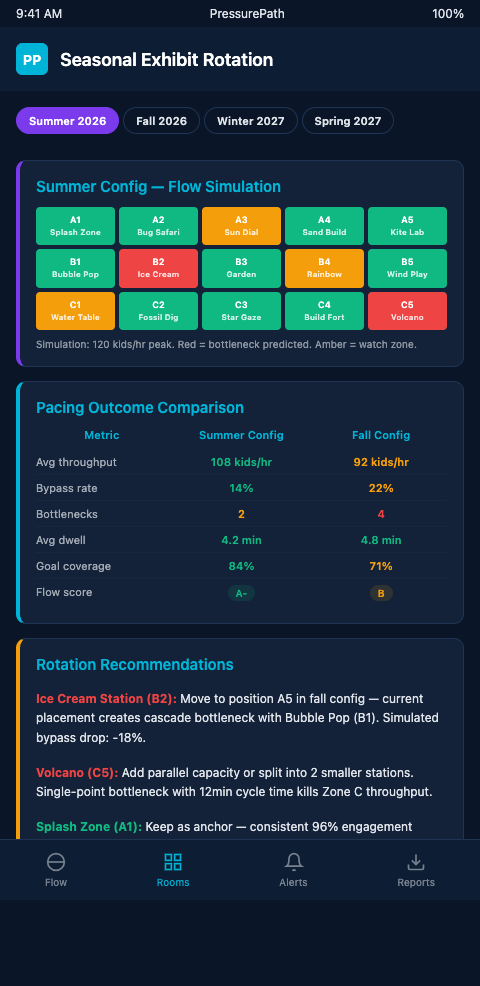
PressurePath treats a seasonal exhibit rotation the same way a pipe engineer treats a valve reconfiguration: before the system goes live with real pressure, you model the new configuration to find the choke points, bypass routes, and over-pressure zones that the reconfiguration creates.
The simulation input for a new seasonal exhibit includes the physical footprint, the approach corridor geometry, the station type (hands-on interactive vs. display-heavy vs. performance-based), and the expected dwell time distribution based on comparable prior exhibits. PressurePath's pressurized-water-in-pipes metaphor is particularly literal here: the new exhibit is a new pipe segment inserted into an existing network. Its resistance to flow—how effectively it captures and holds school waves—determines whether it draws pressure away from adjacent permanent stations or creates a bypass-inducing bottleneck.
A high-resistance new exhibit—one with strong visual draw, a large footprint, and developmentally matched content—absorbs a significant portion of school-wave pressure and reduces bypass at adjacent permanent stations that were previously the leading targets. A low-resistance new exhibit—one with a confusing approach, a small footprint, or content that doesn't match the visiting grade bands—adds nothing to floor-wide absorption capacity and may actually increase bypass at adjacent permanent stations by disrupting the established flow patterns that docents and students had learned.
Managing Crowded Museums (ScienceDirect) shows that stochastic digital-twin modeling captures flow dynamics as configurations rotate—the key word being stochastic. Seasonal exhibits introduce new randomness into visitor behavior because novelty attracts some visitors (especially older grades and return visitors) while confusing others (first-time visitors who built mental maps from a friend's description of the old layout). The simulation needs to model both response types.
CGAN-Assisted Museum Floor Plan Design (MDPI) demonstrates that AI-assisted floor plan modeling can predict how spatial reconfiguration alters visitor routing before any physical installation. For a children's museum planning a seasonal rotation, this means running a PressurePath simulation on the proposed layout before committing to the installation contractor's floor placement—not after the first school wave has already found the bypass route.
Visitor Perception with Machine Learning (PLOS One) adds the sentiment layer: analysis of 64,000-plus reviews shows how visitor satisfaction shifts measurably with exhibit changes. Seasonal rotations that create new bypass conditions—kids racing past the signature installation to reach familiar permanent exhibits—show up as satisfaction drops in post-visit feedback within two to three weeks of opening. The simulation is an earlier warning system.
The multi-grade predictive models built for your permanent floor need to be re-initialized for each seasonal rotation: second-graders and fifth-graders will respond differently to the new exhibit's novelty, and those grade-level behavioral differences will affect bypass rates at both the new seasonal station and the adjacent permanent stations whose approach corridors were disrupted by the rotation.
Building Seasonal Sim Protocols Into Your Design Process
The most effective use of pre-opening simulations is to make them a standard step in the seasonal exhibit planning process, not a post-installation diagnostic. That means running the simulation when the exhibit is still in layout-review phase—when changing the approach corridor geometry or the adjacent permanent station positioning is still a design decision rather than a renovation project.
Exhibit Strategy as Foundation (Exhibit Concepts) makes exactly this point: strategic planning must account for how layout changes ripple through visitor flow. A seasonal exhibit that looks strong on content but disrupts the approach geometry to three permanent stations is a net negative for your school-wave bypass rates even if the seasonal exhibit itself achieves high capture rates.
For operational protocols, three practices make seasonal simulations actionable. First, run the pre-rotation simulation four to six weeks before installation, when layout changes are still reversible. Second, use the simulation's bypass-risk map to set docent positioning for opening week—before you have real flow data from the new configuration. Third, compare simulation predictions against actual flow data from the first two weeks of operation to calibrate the model for future rotations.
A fourth protocol applies specifically to your relationship with the exhibit fabrication contractor: share the PressurePath pre-rotation simulation results before the installation footprint is finalized. Fabricators typically optimize for installation logistics—ease of assembly, stability, sight lines from the building's HVAC grid. Those priorities sometimes conflict with the flow-optimal placement. If the simulation shows that positioning the exhibit three meters to the left of the fabricator's preferred location would increase wave-capture probability by 18%, that's a conversation worth having before the anchor bolts go in.
The seasonal flow standard developed for seasonal haunted attractions provides a useful protocol template: the same challenge of resetting flow baselines at each seasonal rotation applies in the attraction design context, and haunted-attraction designers have built repeatable simulation protocols that museum exhibit teams can adapt.
The future exhibit design trajectory points toward exhibits that are designed from the start to accommodate rotation without disrupting permanent floor flow—modular installation footprints, standardized approach corridor interfaces, and pre-integrated sensor positions that allow the bypass model to update automatically as the new exhibit's actual data comes in.
For children's museum exhibit designers managing two or more seasonal rotations per year, the cost-benefit calculation for pre-rotation simulation is straightforward. The simulation requires approximately four to eight hours of analyst time to set up and run. The first two weeks of a seasonal exhibit's operation—when bypass patterns from the new configuration are highest and visitor satisfaction from those bypass events is lowest—represent the highest-cost period in a seasonal exhibit's lifecycle. If the simulation prevents even one significant structural bypass pattern from going unaddressed during opening week, the return on the simulation time is clear.
The simulation also supports a conversation that children's museum exhibit designers often need to have with their program leadership: the question of whether a proposed seasonal exhibit is a good fit for the space it's been allocated. A simulation that shows an extremely high-resistance seasonal exhibit (one requiring a dedicated approach corridor, a large footprint, and significant docent time) generates an unacceptable bypass cascade for the three adjacent permanent stations isn't a rejection of the exhibit—it's a case for a different installation location or a modified footprint before the contract is signed.
Simulate Before You Install
There's one more benefit to pre-rotation simulation that extends beyond bypass prevention: it creates institutional memory for your rotation decisions. Over time, as each rotation's simulation results and actual performance data are recorded, your museum builds a database of exhibit configurations and their flow outcomes. A proposed seasonal exhibit that shares characteristics with a previous exhibit that created significant bypass issues gets flagged automatically by the simulation model—pattern recognition across your rotation history becomes as valuable as any individual simulation result.
PressurePath's rotation history database is particularly useful for the conversation with program leadership about seasonal exhibit selection. When a proposed exhibit's physical characteristics match a previous rotation that created cascade bypass problems, you have documented evidence—not just a hunch—that the proposed installation requires approach-corridor modifications or a different floor position before it can be successfully deployed. That evidence changes the programming conversation from "we're worried about flow" to "our simulation data from three prior comparable rotations shows a median 34% bypass cascade at Station 7 under this configuration."
If your museum runs two or more seasonal exhibits per year, you're resetting your bypass map multiple times each school visit season without any preview of where the new failure points will be. PressurePath gives children's museum exhibit designers a pre-opening simulation that maps those failure points before the first school bus arrives. Join the waitlist to run a simulation on your next seasonal rotation plan.