The Future of Pacing-Aware Museum Exhibit Design
The Design Brief That Doesn't Include Flow
Most interactive exhibit briefs for children's museums contain a content objective, a developmental target audience, a budget range, a footprint specification, and a fabrication timeline. Most do not contain a wave-pressure specification: the expected daily school-group throughput rate, the approach corridor geometry, the adjacency relationships to existing bypass-heavy stations, or the docent-to-student ratio during peak field trip hours.
That omission is partly historical—flow analytics infrastructure wasn't affordable or accessible when most exhibit design practices formed their brief templates. But it's increasingly a design gap that shows up in real bypass rates. A 32-foot interactive installation designed for a corner of the atrium without knowing that the atrium's peak-hour school waves arrive from the west entrance and never turn into that corner is a $140K bypass waiting to happen.
Top 5 Museum Exhibit Design Trends 2025 identifies intentional technology integration, immersive environments, and modular design as defining 2025-2026 directions for the field. Modular design is the most directly relevant to pacing-aware exhibit work: modular installations can be repositioned relative to approach corridors based on observed flow data rather than being permanently fixed to a location that may prove structurally bypassed.
Emerging Tech Enhancing Museum Experience (Blooloop) highlights hyper-personalization via AI and spatial audio as technologies redefining visitor pacing. For school groups specifically, hyper-personalization creates a new pacing variable: if an exhibit can adapt its presentation to the approaching group's grade level in real time, the effective capture radius of the station increases without any physical repositioning.
Designing With Pressure in Mind
PressurePath's vision for pacing-aware exhibit design is that the pressurized-water-in-pipes model becomes a design tool, not just an operations diagnostic. Before a new station is fabricated, before the floor plan is submitted to the capital campaign committee, exhibit designers run a wave simulation with the proposed station in position. The simulation answers three questions: What percentage of a 30-kid third-grade wave will reach the station's approach corridor? What percentage of those kids will stop? And what happens to the wave's remaining pressure after it passes the station—does it flow toward the next intended station or does it find a bypass route to the back of the floor?
Digital Transformation in Museum Exhibition (ACM/CHB) provides a systematic review of how AR and VR, AI personalization, and multi-sensory innovations are reshaping exhibit design. The pattern across these technologies is consistent: they increase the station's individual engagement quality but don't automatically address the wave-pressure problem. An AR exhibit that delivers compelling content to the 30% of students who reach it still leaves 70% bypassing if the approach corridor geometry is wrong.
This is a key tension in the near-term trajectory of museum exhibit technology: as exhibit content becomes increasingly sophisticated and expensive, the cost of structural bypass events at those exhibits rises proportionally. A $250K AR installation that gets bypassed by 65% of school-wave students is a more consequential failure than a $40K passive display panel at the same bypass rate. Pacing-aware design doesn't become less important as exhibit technology advances—it becomes more important, because the cost of getting the approach geometry wrong scales with the sophistication and expense of the exhibit itself.
The Museum Experience Revisited – Falk & Dierking establishes the foundational framework: personal, social, and physical context all drive visitor experience quality. The physical context—floor layout, approach geometry, corridor width, adjacency—is the variable that pacing-aware design most directly controls. Falk and Dierking's model predicts that improving the physical context of a station (its approach, its visibility, its position relative to school-wave entry points) improves learning outcomes independently of content quality.
Dexibit: Data Analytics for Visitor Attractions represents the analytics infrastructure layer that makes pacing-aware design iterative: visitor analytics platforms that deliver real behavioral data let designers close the loop between a new exhibit's installed configuration and its actual flow performance. The design brief of the future isn't static—it updates as flow data from the installed exhibit feeds back into the model.
Learning Frameworks in Children's Museums (informalscience) ties this together: frameworks that connect exhibit design to measurable developmental outcomes treat pacing as a design-quality variable. An exhibit that's developmentally excellent but structurally bypassed is failing on the pacing dimension of design quality, not just the operations dimension.
Practically, this means pacing-aware design asks different questions at the brief stage than traditional exhibit design does. Instead of "what will children learn at this station," the brief adds: "what percentage of the school groups we expect will reach this station under normal wave-pressure conditions?" and "if that percentage is below our educational impact threshold, what approach geometry or docent positioning would bring it above threshold?" Those questions have quantitative answers in PressurePath—they're not design philosophy questions, they're flow modeling questions.
The exhibit investment economics implications are significant: pacing-aware design reduces the risk that a capital investment delivers theoretical engagement quality to the fraction of students who happen to find the station. The design brief that includes approach corridor geometry, school-wave pressure specifications, and docent positioning assumptions is spending the same capital more efficiently.
What Children's Museum Designers Need to Build Now
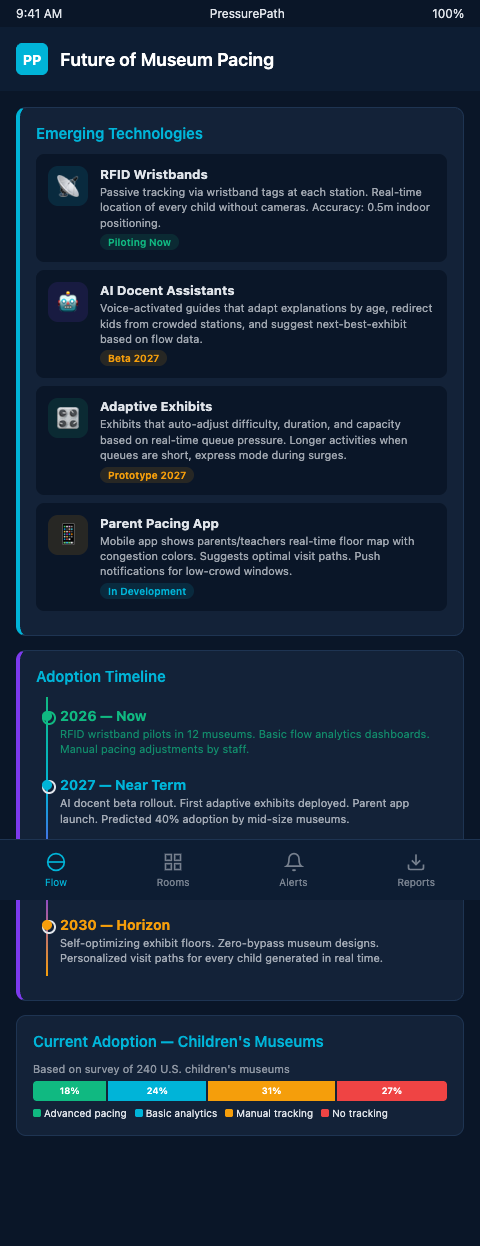
Three capabilities define the pacing-aware exhibit design practice that leading children's museums will have built by 2027. First, flow data infrastructure that covers the full floor rather than individual rooms—the sensor network that feeds a floor-wide wave-pressure model throughout school visit hours. Second, a pre-design simulation practice that runs wave models on proposed exhibit configurations before fabrication decisions are locked. Third, a design brief template that includes pacing specifications alongside content objectives, developmental targets, and budget parameters.
Museums that build these three capabilities in sequence will have a compounding advantage: each new exhibit installation comes with a wave-pressure forecast, actual performance data from the installed exhibit calibrates the model for the next installation, and the design team's brief process gets progressively better at predicting flow behavior before fabrication. The early adopters in this practice are accumulating institutional knowledge—a calibrated floor model that reflects their specific building, their specific student populations, and their specific docent configurations—that will take late adopters years to replicate.
Museum Technology Trends (Electrosonic) notes that museums are shifting toward community co-creation models—the school group experience is a primary community engagement vector, and pacing tools that improve school-wave engagement directly advance the community impact mission. Funders and grant programs are increasingly asking for evidence that capital investments reach the intended audiences. Pacing data is that evidence.
The scaling 40-exhibit floor challenge is the infrastructure prerequisite: floor-wide flow data collection at scale is what makes the pre-design simulation possible. Museums that invest in sensor infrastructure now are building the data asset that makes pacing-aware design feasible for future capital projects.
For context from a parallel field, experimental theater tech is converging on similar design principles: productions that integrate pacing data into the spatial design brief before construction rather than diagnosing flow problems after opening night. The children's museum context adds the school-group complexity—docents, chaperones, rope partitions, NSF grant accountability—but the design-first pacing logic is identical.
There's also a grant-funding angle to the pacing-aware design trajectory: NSF and IMLS are increasing their emphasis on broadening participation and demonstrated reach for informal STEM programs. A museum that can demonstrate in its grant application that each new exhibit was designed with wave-pressure specifications—ensuring that school groups from Title I schools reach and engage with the funded station at a documented rate—is making a methodologically stronger case than a museum that describes content quality without addressing the structural access question. The design brief's pacing specifications become part of the grant deliverable, not just an internal ops tool.
Build Pacing Into Your Next Design Brief
The transition to pacing-aware design doesn't require overhauling every existing brief template overnight. It starts with adding three questions to every new exhibit brief: What is the expected wave-pressure profile for the groups that will visit this station most frequently? What percentage of those groups need to engage with this station for the exhibit to deliver its stated educational impact? And what approach corridor geometry and docent configuration would produce that engagement percentage under realistic wave-pressure conditions?
Those questions don't require a full PressurePath deployment to answer—they require a flow analysis of the proposed location before fabrication begins. For museums already running PressurePath on their floor, the analysis is a model run. For museums in earlier stages of flow infrastructure development, it's a structured observational study of how school waves move through the proposed station's location under current conditions.
Either approach produces better capital decisions than the current standard brief, which asks none of these questions and leaves the bypass probability entirely to chance. The children's museum exhibit designers who will be most effective at capturing school-wave engagement over the next five years are those who integrate pacing specifications into their design process before capital decisions are made. PressurePath is designed for that integration—a wave-pressure simulation tool that speaks the language of exhibit briefs, floor plans, and school booking calendars. Join the waitlist to bring pacing-aware design thinking to your next installation.