The Future of Pacing Tech in Experimental Theater
The Tech That Shapes the Stage Has Never Included Flow
Walk into any experimental theater production today and you'll find technology at every level of the experience: 3D projection mapping on non-proscenium surfaces, binaural audio tied to performer position, sensor-reactive lighting that responds to sightline geometry. The one thing you won't find is a system that knows where the audience is, what that distribution means for the director's arc, and what it recommends doing about it in the next 60 seconds.
AI and digital media are reshaping what happens on stage (Technological Theatre Experimenters, HowlRound) — but that reshaping has concentrated on performer-side technology. The audience-side infrastructure is still walkie-talkie reports and SM instinct.
Stanford research on digital technologies transforming audience experience identifies audience agency and spatial data as underexplored dimensions of theatrical technology. The research framework describes what pacing tech needs to solve: audience members move unpredictably, their positions carry narrative significance, and the production can respond to their distribution only if it knows the distribution in real time.
The global immersive entertainment market is projected to grow by over $340 billion through 2030 (BusinessWire) — that capital will fund production infrastructure investment at a scale the sector hasn't seen before. Pacing technology is positioned to absorb a meaningful portion of it.
The Stack: From Sensing to Recommendation
The emerging pacing technology stack has four layers, and experimental theater companies are currently operating at layer one while the top three layers mature.
Layer one is manual data collection: SM head-count logs at fixed checkpoints, walkie-talkie coordination, cast-position tracking on paper call sheets. This is today's standard. It works at 80 audience members with an experienced SM; it fails at 300 audience members in a three-floor venue with 12 scenes running simultaneously.
Layer two is passive density sensing: anonymous position tracking via BLE beacons, infrared sensors, or floor-pressure plates. These systems are available now in venue-management contexts — AI camera networks and IoT density sensors provide real-time crowd management dashboards (Smart Crowd Management 2026, Ticket Fairy) — and the cost has dropped to where smaller productions can deploy them. The output is a live heat map of audience positions, updated continuously, routed to the SM's console. Cross-format comparison with future pacing-aware exhibit design in children's museums is instructive here: museums have been investing in this sensing infrastructure for exhibit effectiveness research, and the theater sector can adopt similar methodology without rebuilding the research base.
Layer three is predictive modeling in real time: taking the current density map and projecting forward 15-20 minutes to identify which scenes are trending toward sightline floor violations or density ceiling breaches. This is what PressurePath adds on top of the passive sensing layer. The simulation treats the venue as a pressurized pipe network — each scene room has a target pressure range defined by its sightline floor and density ceiling, and the Layer 3 model projects which rooms are trending out of that range given current flow rates through the corridors. The simulation model built before the show opens becomes the prediction engine during the show: as actual distribution data flows in, the model updates its forward projections continuously.
Layer four is adaptive cue triggering: the pacing system recommends — or in higher-automation configurations, automatically triggers — adjustments to cue timing, performer positioning, and corridor lighting intensity based on the real-time density forecast. Co-design produced six design guidelines for technology-mediated theater (Technology-Mediated Theatre, ACM) — one of those guidelines is that automated adjustments require clear override protocols for the SM, so the system functions as a recommendation engine rather than an autonomous controller.
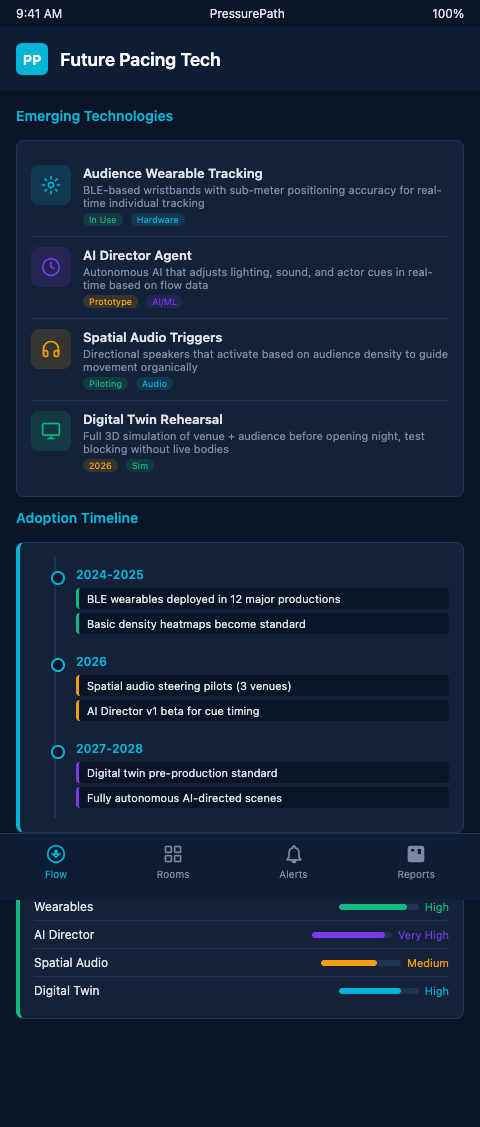
3D projection mapping, AI performance control, and interactive storytelling are reshaping pacing in 2024 (5 Digital Trends in Theater, Captitles) — but these tools affect performer-side timing. The audience-side pacing equivalent — systems that respond to where the audience is rather than where the performer is — is the next design frontier.
Three dimensions of digital theater — creation, technology, audience experience — are converging (Present and Future of Digital Theatre, ResearchGate) — the third dimension, audience experience, has historically been the least instrumented. Pacing technology is the infrastructure for instrumenting it.
Where Experimental Productions Can Adopt Now
Not every experimental theater company needs to build the full four-layer stack. The ROI analysis looks different for a 30-performance run than for a 300-performance run. But there are adoption points at every scale.
One dimension that doesn't get enough attention in theater technology discussions is the consent and transparency framework for audience sensing. Layer 2 sensing — anonymous position tracking — is technically straightforward, but it requires clear audience communication protocols. The word "anonymous" needs to be specific: what data is collected, how long it's retained, whether it's associated with any ticket-purchase identity. Audiences at experimental productions tend to have a higher-than-average tolerance for unconventional production elements, but they also have a higher-than-average sensitivity to privacy-adjacent practices that feel undisclosed.
The productions that have implemented Layer 2 sensing most successfully describe an upfront disclosure model: a brief note in the pre-show communication (email, program insert, or lobby signage) that describes the tracking infrastructure as "anonymous audience movement tracking to help our production team optimize the experience." This disclosure is brief, non-alarming, and frames the technology as an audience-benefit tool rather than a surveillance system. No productions using this disclosure model have reported audience objection.
PressurePath's privacy framework is designed around this disclosure model: all position data is anonymized at the sensor level, never associated with ticketing identity, retained only for the duration of the production run, and deleted following the final performance unless the production team requests aggregated behavioral data for research purposes. This framework meets the transparency standard that experimental theater audiences expect and keeps the production's ethical posture aligned with its experimental values.
Productions at 80-150 audience members can operate at Layer 2 with three BLE anchor points and a free-tier location aggregator, feeding a manual version of Layer 3 in which the SM receives a dashboard update every 5 minutes and cross-references it against PressurePath's pre-built distribution forecast. This configuration costs less than a day-rate for a motion designer and runs throughout the production.
Productions at 200+ audience members should build Layer 2 fully and integrate Layer 3 during production design — before the show opens, not after a problematic week. The ML audience prediction system for long-run productions becomes valuable here because each performance generates labeled data that improves the Layer 3 prediction accuracy for subsequent performances.
The comparison with advanced promenade simulations shows where the technology branches: promenade and path-choice shows require agent-based simulation in Layer 3, while more spatially linear experimental formats can use fluid-dynamics models. PressurePath supports both architectures.
Museums are further along the sensing infrastructure curve than theater, having invested in anonymous visitor tracking for exhibit effectiveness research. The theater sector can adopt the methodology without rebuilding the research base.
Pacing Tech Will Separate Experimental Productions From Experimental Shows
The distinction matters. An experimental show tries something new in one night. An experimental production builds the infrastructure to test new things, learn from the results, and iterate intentionally. Pacing technology is what turns a single night's exploration into a repeatable research process.
The experimental theater sector's relationship to technology has historically been extractive rather than reciprocal: productions borrow technology from adjacent fields — VR from gaming, projection from cinema, haptics from theme parks — without contributing audience-behavior data back to those fields. The pacing technology stack changes this. A production that runs Layer 2 and Layer 3 infrastructure across a 60-performance run generates a dataset about non-proscenium audience behavior that doesn't exist anywhere else. That data is intrinsically valuable to researchers studying spatial theater, architects designing flexible venues, and exhibit designers building interactive experiences.
Productions that understand their datasets as assets — not just operational tools — are positioned to publish behavioral research, attract academic partnerships, and build institutional credibility that translates into better grant positioning. This is a concrete benefit that pacing technology delivers beyond the night-to-night operational improvements, and it's specific to the experimental theater sector, which has both the audience-behavior complexity to generate rich data and the academic adjacency to leverage it.
The Stage Manager's role also changes in a pacing-tech-enabled production. Layer 4 — adaptive cue triggering — doesn't replace the SM; it changes what the SM monitors. Instead of actively tracking head counts and making judgment calls about whether to send a usher to redirect a clustering crowd, the SM monitors the prediction model's confidence intervals and approves or overrides its recommendations. The skill set shifts from spatial memory and pattern recognition to decision-making under quantified uncertainty. That's a different discipline, and productions building toward Layer 3 and 4 infrastructure should think about how to train their SMs for it.
PressurePath is designed for directors and technical directors who think about their shows as systems — where the relationship between audience distribution and narrative outcome is something to be modeled, tested, and refined. Experimental theater companies interested in building toward Layer 2 and 3 infrastructure are invited to apply for PressurePath's experimental theater program, which pairs simulation setup with advisory support from production technologists who have worked in non-proscenium venues.
The experimental theater sector has more to gain from pacing technology than any other format in immersive entertainment — because its productions ask the most of the relationship between spatial distribution and narrative outcome. A haunted attraction can succeed with generic crowd flow. An escape room succeeds with puzzle mechanics. An experimental theater production succeeds only when the spatial choreography the director designed is what the audience actually experiences. Pacing technology is the infrastructure that makes the director's spatial intention repeatable rather than accidental.
The companies that build this infrastructure now — in a period when it's still a differentiator rather than a baseline expectation — will have a 3-5 year data advantage over the companies that wait. That advantage compounds: more data means better model calibration, which means better predictions, which means better production decisions, which generates better shows, which attracts repeat attendees whose behavior provides further data. PressurePath exists to help experimental theater companies start that compounding process in the current production rather than the next one.