Advanced Simulations for Promenade and Choose-Your-Path Shows
The Show Had 12 Possible Paths. The Director Had Modeled 3.
Third Rail Projects' Then She Fell ran for 4,444 performances with 15 audience members per show, each on a meticulously designed individual path across three floors. The precision required at that scale — 15 people, 3 floors, highly controlled routing — is an extreme case of what every promenade production faces: the space of possible audience configurations grows exponentially with the number of path choice points.
A production with 4 path branches and 80 audience members has a theoretical configuration space in the millions. Most directors model the 2-3 canonical paths — the ones they followed during technical rehearsals — and assume actual audience behavior will cluster near those paths. It doesn't. Branching narrative reframes the author-audience relationship (Branching Beyond the Author, Denison) — when the audience has genuine path choice, the distribution of choices tends to flatten toward uniform rather than cluster at designed pathways, particularly when no path is visually dominant.
The practical consequence: scenes positioned at branches that directors assumed would be less-traveled fill up. Scenes at assumed-heavy paths run sparse. The blocking arc that required 30 sightlines gets 11, while the ambient scene designed for 10 viewers receives 40 and the spatial choreography collapses. Queue-free scene entry design becomes the operational companion to path simulation when entry crowding compounds with the branch-level distribution problem.
Agent-Based Simulation for Multi-Path Shows
The simulation methodology for promenade shows requires modeling each audience member as an agent with individual path-choice logic rather than simulating the aggregate crowd as a fluid. Agent-based models simulate pedestrians with varying room knowledge and herding behavior (Agent-Based Simulation of Pedestrian Behaviour, JASSS) — this is the right architecture for promenade theater because individual path agency is the defining feature of the format.
Each simulated agent carries three attributes: a preference coefficient (novelty-seeking vs. crowd-following behavior), a scene knowledge state (has the agent visited a given room or not), and a corridor resistance response (how the agent responds to visual and auditory signals at branch points). Running 10,000 simulation passes with agents randomized across these attribute distributions produces a probability density function for each scene: the expected range of head counts across the realistic population of path-choice behaviors.
The pressurized-water-in-pipes metaphor applies at the path-branch level. Each branch point is a valve with two outlet pipes. The relative resistance of each outlet — determined by lighting, audio signature, visible crowd presence, and physical corridor width — determines the flow split. Path-choice design shapes spectator commitment and emotional engagement (Staging Spectators, Routledge) — which means the resistance coefficients at branch points are also artistic decisions, not just engineering ones.
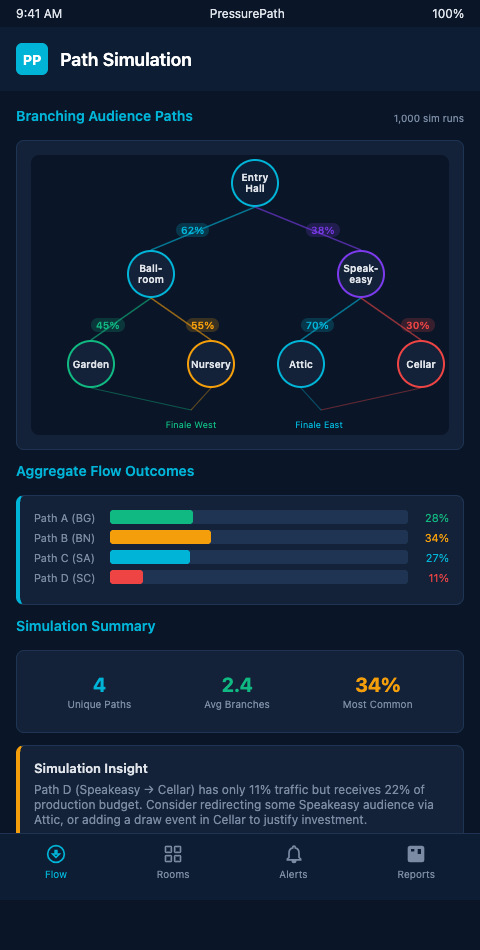
PressurePath models branch points explicitly. The director specifies the visual and auditory signature of each corridor at each branch, the expected percentage of crowd-following agents based on historical data from similar productions, and the scene-knowledge cutoff (how many visits does it take before an agent treats a room as familiar and routes away from it). The simulation then generates scene population distributions and identifies which scenes are structurally at risk across the realistic range of audience path-choice distributions.
AnyLogic's multi-method pedestrian library models complex wayfinding and density across 2D/3D environments — the commercial simulation toolset validates the approach; PressurePath adapts it specifically for narrative-critical density constraints rather than pure throughput optimization.
The agent behavior in uCrowds' SimCrowds provides the crowd-herding dynamics that PressurePath uses to calibrate the crowd-following coefficient — the percentage of audience members who default to following visible clusters rather than exercising independent path choice.
Designing Path Resistance for Desired Distributions
Once the simulation is calibrated, the director can test path-resistance adjustments before production finalizes. The target is not equal distribution across all scenes — promenade shows are designed with scenes of varying intended populations. The target is that each scene's distribution stays within its sightline range across the realistic population of path choices.
The primary lever is corridor resistance design. A path with a wide, lit corridor, an audible scene beyond it, and visible audience members already inside will draw a high proportion of crowd-following agents. A path with a narrow, dark corridor and no pre-signal will repel crowd-followers and attract only novelty-seekers. The simulation quantifies what percentage of agents each configuration produces, which tells the director whether the resistance differential is large enough to achieve the intended population split.
For audience split thresholds, promenade path simulation provides the baseline: if the simulation shows that a 4-branch structure naturally produces two dominant and two sparse paths, the decision to add a formal split structure and route audiences deliberately becomes quantifiably justified.
Operational companions to path simulation include queue-free entry patterns: the simulation identifies where crowding will occur, and queue-free design eliminates the visible queuing behavior that creates secondary crowd-following bias (agents who follow the queue rather than the path signals).
The cross-format comparison with advanced simulations for mixed-difficulty escape rooms is instructive: in escape room franchises, the path is constrained by puzzle logic; in promenade theater, the path is constrained only by the audience's spatial attention. The simulation challenge is harder for promenade because the constraint is softer, but the methodology is the same.
Run the Simulation Before You Lock the Corridor Design
Path-resistance decisions in promenade theater are set design decisions — the width of a corridor, the placement of a light source, whether a performer is visible from the branch point. These are decisions that directors make in early production design, before the venue is built or dressed. That's exactly when the simulation should run.
A structural consideration for multi-performer promenade shows: the performer distribution interacts with the audience distribution in a way that the fluid-dynamics model alone doesn't capture. In a promenade show where performers move between scenes, a performer's position at a branch point dramatically increases the flow toward the scene they're associated with. Audience members following a performer are exhibiting a specific type of crowd-following behavior — performer tracking — that has a higher coefficient than generic crowd-following because it combines visual pull with narrative investment.
PressurePath accounts for this through a performer-position layer in the path simulation. When the director schedules a performer at Branch Point 3 between minutes 20 and 35, the simulation increases the branch-toward-Scene-7 flow rate during that window. If Scene 7 is designed for 20-25 viewers and the performer tracking coefficient pushes it to 35+ during that window, the simulation flags an overflow risk. The director can then adjust the performer's schedule or Scene 7's density ceiling rather than discovering the overflow problem during technical rehearsal.
The self-organized pedestrian dynamics research (INFORMS) validates the herding effect around moving individuals in a crowd — which maps directly to performer tracking in immersive theater. The simulation parameters for this effect are tunable based on the performer's role: a scene-leading performer commands higher tracking than a transitional performer, and a one-on-one guide commands near-total tracking from their assigned audience member. Each performer type requires a different tracking coefficient in the model.
The repeat-attendance population creates an additional modeling dimension specific to promenade and choose-your-path shows. A first-time audience member routes primarily by novelty signals and crowd-following behavior. A second- or third-time audience member has a scene knowledge state that shifts their routing: they know which scenes they haven't seen, and they actively route toward those gaps. Productions with high repeat-attendance rates — which many successful promenade shows develop over time — see their scene-population distributions shift as the repeat-visitor proportion grows.
PressurePath models this explicitly using a scene-knowledge matrix. Each simulated agent is assigned a history profile — zero, one, or two prior visits — and the routing model adjusts based on that profile. The output is a population distribution segmented by visit number, which tells the director whether the intended distribution holds for first-timers, second-timers, and the mix that actually shows up on a given night. A show that works beautifully for first-time visitors may develop structural problems as repeat visitors accumulate, because the repeat visitors' gap-filling behavior redistributes them away from the paths the director designated as primary.
This is a particularly valuable output for longer-running promenade shows, where the audience composition shift from predominantly first-timers to predominantly multi-timers can happen over a matter of months without anyone in the production noticing the gradual redistribution it causes.
PressurePath gives promenade and choose-your-path directors a tool that hasn't existed before: the ability to test corridor resistance configurations against realistic agent distributions before a single nail is driven. Immersive theater companies building new promenade productions or redesigning existing ones can join the waitlist and apply for early access to test their path architecture before it's physical.
The path simulation also generates an output that directors find immediately actionable in technical rehearsals: a ranked list of branch points by distributional risk. Branch points at the top of the list are the ones where realistic agent variation produces the widest range of scene-population outcomes — these are the locations where corridor resistance adjustments have the highest leverage. Branch points at the bottom are stable regardless of agent variation, meaning the set design decisions there are unlikely to cause flow problems. This ranking tells the production team where to focus design attention and where they can proceed with less scrutiny.
For choose-your-path formats specifically, the simulation also supports a sensitivity analysis on the number of active paths. If a production is considering whether to run 4 paths or 6 paths simultaneously, PressurePath can simulate both configurations against the same agent distributions and compare the range of scene-population outcomes. More paths typically mean lower per-path populations and more variance in individual path experience — the simulation quantifies how much more variance, which tells the director whether six paths is an artistic enrichment or an operational management problem at their intended audience size.