Advanced Simulations for Mixed-Difficulty Room Portfolios
The Hidden Cost of Difficulty Mix
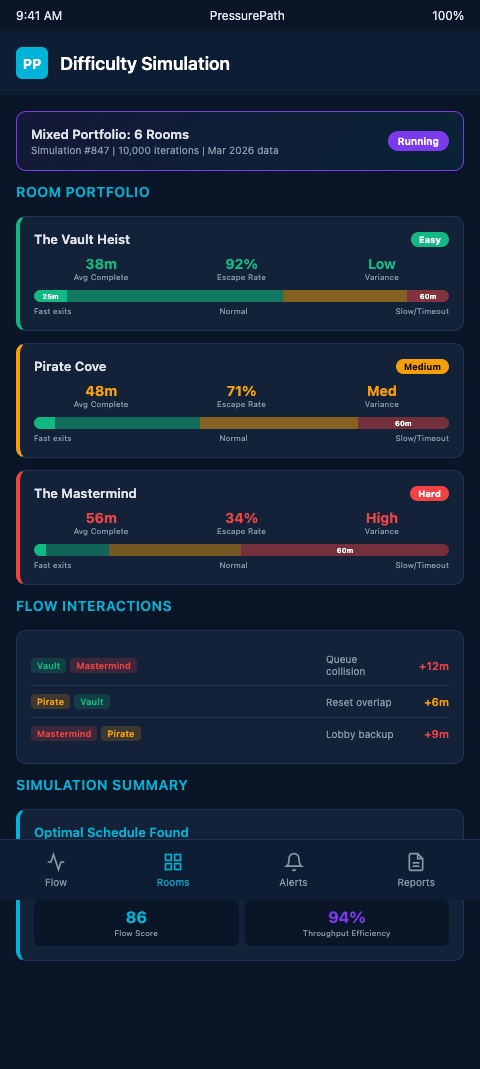
An escape room franchise with ten rooms spread across three difficulty levels runs three different session-length distributions simultaneously. Beginner rooms average 48 minutes to completion. Intermediate rooms average 56 minutes. Expert rooms run 62-65 minutes, with higher variance because groups stuck on a hard puzzle can extend unpredictably. All three flow rates use the same briefing room, the same reset stations, and the same photo op corridor.
A pacing model calibrated to a single average session length — say, 57 minutes — systematically underestimates the reset demand from the three beginner rooms (which turn over faster than the model expects) and overestimates the throughput from the two expert rooms (which hold groups longer than the model assumes). The result is a briefing room that runs out of capacity during the beginner room transition window while simultaneously showing slack during the period when expert rooms are running long.
Escape Room Success Rates and Completion Times documents 20-40% success rates across escape rooms, with difficulty affecting session duration and turnover directly. A beginner room with 70% success rate has a predictable session-length distribution. An expert room with 18% success rate has a much wider distribution, creating higher variance at the exact junction — the reset-to-briefing handoff — where the pacing model is most sensitive.
Running the Mixed-Difficulty Simulation
Advanced pacing simulations for mixed-difficulty portfolios require modeling each room type as a distinct flow element with its own distribution parameters. In the pressurized-water-in-pipes framework, beginner rooms are wide-diameter pipes with steady, predictable flow. Expert rooms are narrower pipes with higher-pressure bursts separated by extended dwell times. Shared infrastructure — the briefing room, reset station 2, the photo op — is the pipe junction where these different flow types converge.
Discrete Event Simulation for Service Businesses (ResearchGate) establishes discrete event simulation as the appropriate modeling tool for mixed-resource scheduling problems — precisely the structure of a multi-difficulty escape room portfolio where each room type creates a distinct event sequence with different timing parameters.
PressurePath's simulation assigns each room a session-length distribution drawn from your historical completion data or, for new franchises, from difficulty-calibrated industry benchmarks. When the simulation runs a Saturday booking grid, it draws session lengths from those distributions rather than using a single average — which means the output shows realistic variance, not just expected-value flow.
The practical output is a risk map per hour. On a Saturday at 2 PM, if four beginner rooms are running and two expert rooms are in their extended-dwell window, the simulation shows that beginner room exits will cluster between 2:48 and 2:55 PM while the expert rooms won't release until 3:15 PM. The briefing room needs to handle a cluster of four groups between 2:48 and 2:55, then has a 20-minute slack period, then handles two expert room exits at 3:15. Staffing for that pattern requires different GM assignments than staffing for a uniform flow assumption.
Data-Driven Dynamic Bottleneck Detection (ScienceDirect) confirms that bottlenecks shift dynamically by product type — directly mirroring how easy versus hard rooms create different constraints at different hours of the same day.
Simulation-Based Scheduling in Industry 4.0 (Simio) frames the broader principle: scheduling across mixed-complexity tasks is NP-Hard, meaning there's no closed-form optimal solution, and simulation is the practical path to near-optimal decisions. For a 10-room franchise with three difficulty tiers, trial-and-error scheduling optimization is intractable — simulation replaces that process with a model you can run in minutes.
The connection to pacing sims buffers is direct: a simulation that models difficulty-specific session length distributions will recommend different buffer sizes per room type rather than a uniform buffer. The expert room may need 20 minutes; the beginner room needs 10. Running them at the same buffer wastes revenue on the beginner rooms and creates cascade risk on the expert rooms.
Franchises currently scaling from 4 to 12 rooms often add difficulty diversity as they expand — going from three beginner rooms to a mixed portfolio that includes intermediate and expert tiers. Each difficulty addition changes the simulation parameters for shared infrastructure, requiring a re-run of the pacing model rather than an incremental adjustment.
Advanced Tactics for Difficulty-Adjusted Scheduling
Once the simulation confirms that difficulty mix creates distinct flow patterns, three scheduling tactics improve throughput without adding staff.
Difficulty clustering by time window. Booking harder rooms consecutively within the same time window reduces the variance mismatch at shared junctions. If expert rooms run between 1 PM and 4 PM while beginner rooms run between 10 AM and 1 PM, the briefing room handles one difficulty type at a time and can be calibrated to that window's flow rate. This isn't always possible with customer-driven bookings, but for the 30-40% of bookings that franchises can steer through pricing and availability display, difficulty clustering reduces junction variance significantly.
Expert-room buffer asymmetry. Assigning longer reset buffers to expert rooms — which have higher session length variance — concentrates the buffer cost where variance is actually highest. An 18-minute expert room buffer versus a 9-minute beginner room buffer costs no more on average than a uniform 13-minute buffer, but reduces cascade risk during extended expert sessions.
Pre-briefing for high-variance rooms. When an expert room group approaches the 55-minute mark without completing, a pre-briefing for the next group allows the briefing to begin before the current session ends if necessary, using a secondary briefing space. This requires physical infrastructure but eliminates the briefing bottleneck during extended expert sessions.
Digital Twin Simulation for Manufacturing (McKinsey) reports digital twins achieving 15-25% throughput increase in manufacturing contexts — applied to mixed-difficulty room portfolios, a similar gain is plausible through difficulty-aware scheduling without any capital investment.
The promenade path simulations used for immersive theater productions face the same difficulty-driven variance problem at a larger scale — audience members choosing different path lengths create the same clustering and void patterns that mixed-difficulty escape room groups create at shared junctions. The simulation architecture handles both contexts.
PressurePath's mixed-difficulty simulation is ready to run with your current room configuration. Input your room list, assign difficulty tiers, and upload your last 90 days of session completion times. The first simulation pass will show you exactly where difficulty divergence is creating junction pressure in your current schedule — and what a resequenced booking grid would do to Saturday throughput.
Validating and Updating Your Portfolio Simulation
Any simulation is only as useful as its calibration against real outcomes. For a mixed-difficulty portfolio, the calibration cycle is a monthly discipline: compare the simulation's predicted bottleneck timestamps against the actual session timing logs, identify where the model diverged from reality, and update the session length distributions for each room tier.
Pedestrian Flow Simulation Validation (SCIRP) establishes that simulation models must be validated against real-life flow data — an undercalibrated simulation becomes less accurate over time as guest behavior and booking patterns evolve. Escape rooms that have redesigned a room, added a new difficulty tier, or changed their booking platform policies need to recalibrate their simulation inputs rather than running the original parameters indefinitely.
The recalibration process in PressurePath requires three inputs: updated session completion time distributions by room (downloadable from most booking platforms), any changes to shared asset configuration (new reset station, modified photo op layout), and the current Saturday booking grid with actual utilization rates. The simulation re-run takes minutes; the value is months of accurate scheduling decisions built on current rather than historical parameters.
For franchises that change their room mix seasonally — swapping a themed room for a holiday variant, for instance — the simulation baseline should be updated each time the difficulty profile changes. A beginner room converted to an intermediate Halloween variant has a different session length distribution and a different reset requirement. Running that room through the simulation with its original beginner parameters produces staffing recommendations calibrated to the wrong throughput rate.
The franchise that builds a regular simulation recalibration cadence — monthly during peak season, quarterly otherwise — maintains consistently accurate pacing forecasts as the portfolio evolves. That cadence doesn't require a dedicated analyst; it requires 30 minutes of input updates and a simulation re-run. PressurePath makes that process repeatable enough that it becomes a standard part of the monthly operations review rather than a special project.
The long-term operational return on a calibrated mixed-difficulty simulation isn't just better scheduling — it's better room design decisions. When the simulation consistently shows that one beginner room's session length distribution creates disproportionate pressure at the photo op, the next design iteration can address that structurally: a wider exit corridor, a dedicated photo op zone for that wing, or a room redesign that reduces early-exit clustering. Those are capital decisions, but they're made from data rather than from intuition about why Saturday afternoons feel chaotic in that wing.
Operators who maintain an up-to-date mixed-difficulty simulation are the ones who can answer the expansion question with precision: "Adding an expert room to Wing B will increase briefing room pressure between 3 PM and 5 PM on Saturdays by approximately 12% — we need to add a second briefing zone before opening that room." That sentence comes from a simulation run, not from a gut feeling, and it changes the capital planning conversation entirely. Join the waitlist to get started with your first mixed-difficulty simulation pass and receive a calibrated baseline for your current room portfolio.