Pacing Simulations vs Booking Buffers: Which Actually Works
The Buffer Assumption That Costs Revenue Without Solving Problems
State-of-the-Escape-Room-Industry survey data shows operators reporting slowing sales and pressure on operations, with suboptimal scheduling cited as a persistent stressor according to the 2024 State of the Escape Room Industry Report. In that environment, adding uniform booking buffers feels responsible — but it has a direct revenue cost. A 10-room franchise running 8-hour Saturdays with 15-minute buffers between every slot loses approximately 2.5 bookable hours per room per day. At an average ticket value of $28 per person, the math compounds quickly.
The core problem with buffers isn't their existence — it's their uniformity. Research from ScienceDirect on buffer scheduling for on-time performance found that 260 minutes of buffers cut delays 30% and raised reliability from 37% to 52%. That's a meaningful improvement — but it still leaves 48% of slots unreliable despite padding every one. Static buffers help, but they're blunt instruments applied to a system that isn't uniform.
A 10-room franchise has rooms with different difficulty tiers, different reset requirements, and different group-size patterns. Room 9 runs hard and averages 68 minutes for a 60-minute session. Room 2 runs easy and averages 54 minutes. A 15-minute buffer after room 9 is barely adequate. The same 15-minute buffer after room 2 is excessive — it's 9 minutes of unnecessary dead time that could be a bookable slot.
What Pacing Simulations Do That Buffers Can't
Buffer strategy asks: "How much padding should I add to every slot?" Pacing simulation asks: "Which specific slots will create briefing room collisions, reset station overloads, or photo wall queues under this exact booking configuration?" The questions aren't the same, and the answers diverge significantly at a multi-room franchise.
The simulation treats your 10-room franchise as a pressurized pipe network. Each booking slot is a unit of fluid entering the system at a specific pressure and flow rate. Room 9's 68-minute average is a high-pressure input. Room 2's 54-minute average is a lower-pressure input. The shared assets — briefing room, reset stations, photo wall — are junction nodes with finite capacity. PressurePath runs the entire Saturday booking grid through the network and identifies exactly which junction nodes will receive more simultaneous pressure than they can handle, and when.
Consider the revenue impact at concrete scale. A 10-room franchise running 8 peak Saturdays per month at 4 slots per room per peak day has 320 slot decisions per month. Uniform 15-minute buffers eliminate roughly 80 of those as bookable capacity. A simulation-driven approach, after identifying which 22-28 slots genuinely need a buffer and which 52-58 can run without one, recovers approximately 58 of those 80 sacrificed slots per month — roughly 232 bookable player-hours at 4.58 average group size. At a typical $32 per-player ticket, that's recoverable monthly revenue in the $7,400-8,200 range per location, without any staffing change or briefing room modification.
The buffer-versus-simulation comparison isn't academic; it's a specific per-slot decision with a specific per-month revenue delta attached to each configuration choice. A franchise running the simulation monthly and updating its per-slot buffer assignments captures that delta as recurring revenue rather than treating it as a one-time audit finding that decays as booking patterns evolve across the season.
The result isn't a uniform buffer recommendation. It's a slot-specific map: rooms 3 and 7 starting at 2:00 PM will both exit around 3:05 PM and send simultaneous cohorts to the briefing room — add 15 minutes to room 7's start or shift it to 2:15 PM. Room 5's 1:45 PM slot exits at 2:48 PM into a clean briefing room window — no adjustment needed. Room 9's 2:30 PM slot needs a 20-minute buffer because of its higher average duration and the group size booked.
Airline scheduling optimization research from Oxford Academic found that fixed-percentile buffer assignment has not delivered significant on-time improvements, and that dynamic simulation outperforms static buffer allocation in high-variability environments. Escape rooms are exactly that environment — service durations vary by room, by group, and by day-of-week booking patterns.
Research on buffer allocation in manufacturing from MDPI confirms that buffer placement and sizing must be tuned per-station; generic buffers produce suboptimal flow. Per-room buffer calibration, informed by simulation data, is the mechanism that converts a blunt tool into a precision one.
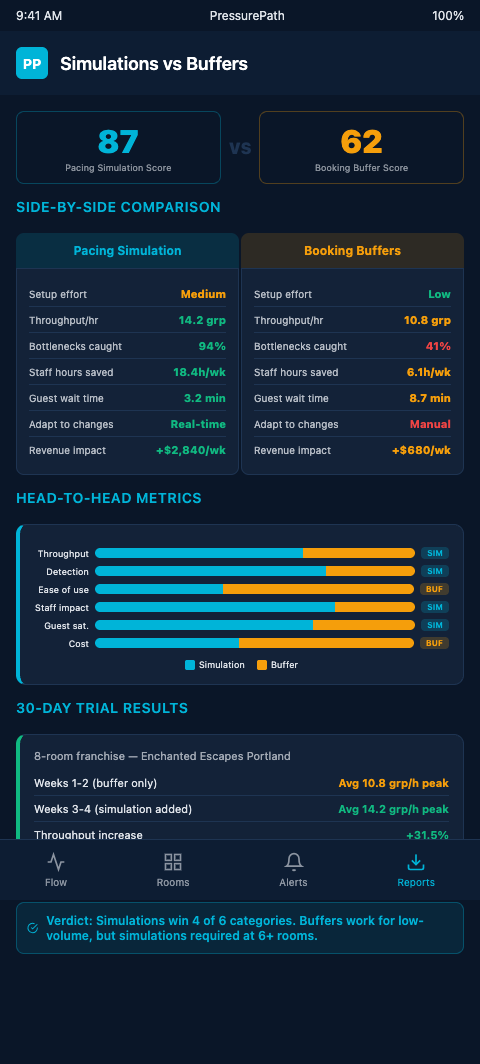
For operators already using booking system integration, the simulation layer is where booking data becomes actionable — the simulation identifies which of the calendar's slots need a buffer and which don't, so the booking system can implement targeted adjustments rather than blanket ones.
Advanced Comparison: When Buffers Beat Simulations
The honest answer is that buffers and simulations aren't competing tools — they serve different operational moments. Buffers are appropriate when you lack the room-by-room duration data needed to run a meaningful simulation, when you're opening a new location without historical pacing data, or when your booking system doesn't support variable-length slot configurations.
Appointment scheduling research from ScienceDirect shows that with variable service durations, static buffers fail at the system level — adaptive scheduling is required. The caveat is that adaptive scheduling requires data. A new franchise location without historical duration data by room may be better served by a conservative uniform buffer while it builds that data set.
Once you have 8–12 weeks of historical room duration data, a pacing simulation becomes strictly superior. Discrete-event simulation research from Simio confirms that DES safely models scenarios without disrupting real operations — you can test the "remove buffers from rooms 2, 4, 5" scenario on Tuesday before committing to it on Saturday.
Mixed-difficulty simulations take the comparison further — when your franchise has a mix of beginner, intermediate, and hard rooms in adjacent slots, the simulation layer is the only tool that can model the cascade effects accurately. A uniform buffer makes no distinction between a beginner room exit and a hard room exit feeding into the same shared briefing room.
The comparison matters most for operators evaluating whether simulation tools are worth adopting. Simulation versus ticket-scanner approaches at haunted attractions addresses the same question in a different venue context — whether predictive simulation models outperform reactive measurement tools for managing flow.
Wiley research on flexible scheduling in high-uncertainty environments concludes that process-flexibility outperforms pure mathematical buffer optimization. For escape room operators, process-flexibility means the ability to adjust slot configurations based on simulation output rather than applying a fixed buffer rule and hoping it holds.
Choosing the Right Tool for Your Franchise's Operational Maturity
Multi-room escape room franchise operators running peak Saturdays with uniform 15-minute buffers across all rooms aren't wrong — they've taken a reasonable precaution. But they're likely leaving revenue on the table in low-pressure slots while still experiencing collisions in high-pressure ones. The operational maturity question is straightforward: if you have enough historical data to know which rooms run long and which run short, a simulation will outperform a uniform buffer every time.
PressurePath runs your actual booking grid as a pressure simulation, identifies which slots need buffers and which don't, and outputs a per-slot adjustment recommendation before each peak weekend. If your franchise is at the point where you have 8+ weeks of historical session data and a Saturday booking pattern that feels either overly cautious or still producing briefing room queues, the simulation comparison is exactly the analysis you need. Join the waitlist and test your current buffer strategy against a simulation-optimized schedule.