Integrating Pacing Data With Your Booking System Calendar
When Your Calendar and Your Flow Model Live in Separate Worlds
At roughly 2,800 US escape room facilities operating as of late 2025 — a figure tracked by Room Escape Artist — last-minute bookings have become the norm rather than the exception. That shift means your Saturday booking grid is often finalized Thursday evening, leaving less than 48 hours to catch scheduling collisions before groups walk in.
The problem isn't that operators lack data. Booking software logs arrival times, slot durations, and group sizes. Pacing models track briefing room turnover, reset station gaps, and photo op queues. The issue is that these two streams sit in different tools with no bridge between them. A 12-person group booked at 2:30 PM creates a very different pressure signature than a 4-person group in the same slot — but most booking calendars treat both identically.
IBISWorld's analysis of the US escape room industry highlights managing parallel room bookings at scale as a central operational challenge. When room 4 and room 7 both finish at 2:45 PM, the briefing room gets hit twice in 90 seconds. If your booking software flagged that collision at schedule-build time rather than at 2:47 PM on the day, your GM has options. Without integration, they don't.
Building the Integration Layer That Surfaces Pressure Before Saturday
The core principle here mirrors how API-connected scheduling tools work in other service industries. Research from myshyft.com found that API-connected scheduling systems report 43% less administrative time, largely because real-time sync eliminates the manual reconciliation between what's booked and what's operationally feasible.
Think of your booking system as the source of inlet pressure and your pacing model as the pipe network that receives it. When you load next Saturday's booking grid into PressurePath, the simulator treats each reservation as a unit of fluid entering the network. The 2:30 PM slot in room 3 sends a pressure wave toward the briefing room at approximately 3:30 PM. The 2:45 PM group in room 6 sends another. If those waves arrive at the briefing room simultaneously and the room is already clearing the 2:15 PM cohort, you've created a junction point where pressure exceeds pipe capacity — a collision that shows up as a timestamp on PressurePath's Saturday dashboard, not as a refund request from a frustrated group.
Technically, the integration works through a read-only API connection or a flat-file export from your booking software into the pacing layer. NetSuite's documentation on API integrations notes that eliminating duplicate data entry alone reduces administrative overhead up to 70%. For escape room operators, the more important gain is that the booking grid becomes a live input to flow modeling rather than a static schedule that's only reviewed after problems surface.
Checkfront's escape-room-specific booking platform handles live calendar availability, time slots, and capacity controls natively. Connecting that reservation layer to a pacing model means the pacing system can ingest actual group sizes, not assumed averages. A 10-person group needs a longer briefing window than a 4-person group. That difference ripples downstream to reset station timing, photo op queue length, and next-slot readiness.
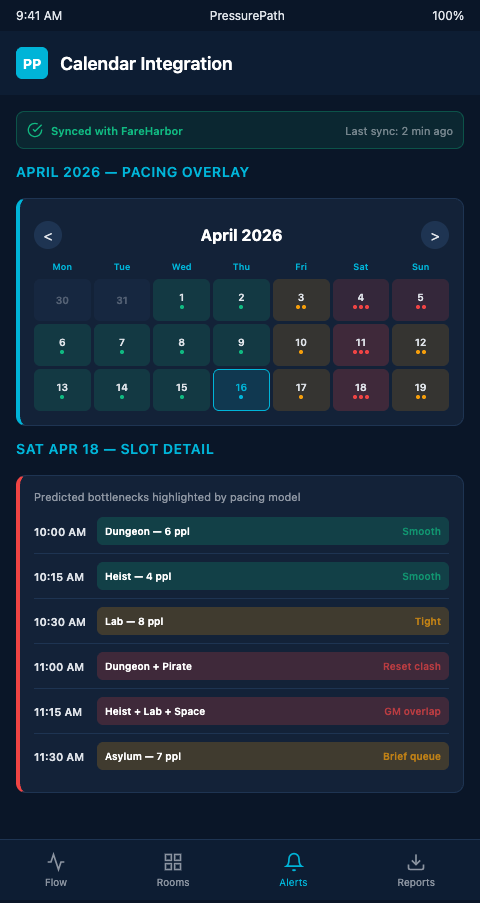
For pacing simulations vs booking buffers, the integration distinction matters: buffers add static padding to slots, but they don't tell you which slot needs padding and which doesn't. A simulation fed by live reservation data can flag the 2:45 PM slot as the one requiring a 15-minute buffer while leaving the 4:00 PM slot alone.
Predictive analytics in hospitality literature shows that booking pattern data enables proactive staffing and supply adjustments tied directly to reservation flow. For a 10-room franchise, that means knowing by Thursday that Saturday's 2:00–4:00 PM window will push reset station throughput past its 12-room-per-hour ceiling — and adjusting staff assignments before the day arrives.
Picture the integration as a pressure gauge wired into the booking system itself. Each new reservation raises the pressure reading at the downstream junction it feeds, and each cancellation drops it. Without that gauge, the only signal operators have is the physical pressure they feel at 2:47 PM when a briefing room already holds three groups and a fourth is walking through the lobby door. With the gauge live, the 48-hour pre-Saturday review surfaces every projected pressure spike — typically 8-12 per Saturday for a 10-room franchise at 75% utilization — and turns each one into a 3-6 minute start-time nudge that releases pressure before it builds.
The integration's practical value is that these nudges happen during Thursday scheduling rather than Saturday firefighting, which is a labor cost difference of roughly 10:1 per adjustment. Across 4 peak Saturdays monthly, that ratio compounds into 30-45 labor hours of structurally preventable coordination work, most of which currently lives invisibly in the shift debrief notes rather than in any scheduling report.
Advanced Integration Tactics for Multi-Room Operators
Once the basic API connection is live, the next layer is variable-duration modeling. Most booking systems assume fixed session lengths — 60 minutes per room, regardless of difficulty tier. Your pacing data probably shows room 9 (the hardest room) averaging 68 minutes while room 2 averages 54 minutes. Feeding those empirical durations back into the booking system's slot calculations changes which back-to-back slots are actually safe.
Research on appointment scheduling from PMC documents that service time variability is a primary driver of scheduling failures, and that real-time data integration is the critical correction mechanism. For escape room franchises, that variability isn't random — it's predictable by room and by group size. Integration makes that prediction actionable.
A second tactic is threshold alerting. Once your booking-to-pacing bridge is live, set pressure thresholds: if the briefing room has three exits projected within any 20-minute window, trigger an automatic alert to your GM at the start of shift. That alert costs nothing to send and potentially saves a Saturday's worth of guest complaints.
No-show predictive models add another dimension — if your booking history shows that 3-person groups on rainy Saturday afternoons no-show at 22%, the integration layer can automatically loosen spacing constraints for those slots while tightening them for the 8-person corporate team that has a 97% show rate.
For operators exploring how other venue types handle reservation intake integration, the children's museum model offers a useful parallel: timed-entry slots fed directly into floor capacity models, with alerts firing when incoming reservation volume would exceed station throughput.
The baseline investment for any multi-room franchise is modest: a CSV export from your booking system, a defined mapping of room IDs to pacing nodes, and a weekly review cadence. Start there before building the full API pipeline.
From Calendar Sync to Operational Precision
Multi-room escape room operators who integrate pacing data with their booking system stop managing Saturdays reactively and start building them on Tuesday. PressurePath accepts your real booking grid as the pressure source and runs it through your 10-room pipe network before a single group arrives. The difference between a franchise that catches the 2:45 PM briefing room collision on Thursday and one that discovers it in real time is not staffing quality or GM experience — it's whether the booking calendar feeds a pacing model or sits in isolation.
Operators who've made this connection consistently report that their Thursday scheduling reviews surface 8-12 actionable pressure points per peak Saturday, each resolved with a minor start-time adjustment rather than a day-of scramble. If you're running a franchise where briefing room collisions are costing you refunds and five-star reviews, connecting your reservation layer to a pacing model is the first structural fix — not a software upgrade, but a change in when you find out about problems. Join the waitlist and bring your Saturday booking grid; the simulation runs in under three minutes.