Predictive Models for No-Show and Late-Arrival Flow Disruption
How No-Shows and Late Arrivals Actually Disrupt Flow
Most escape room operators track no-show rates as a revenue metric. Fewer track the operational cost that no-shows impose on the rest of the day's flow across the full booking grid.
Every scheduled escape room session is a scheduled pressure event in the pipe network. The briefing room, reset stations, and photo op are all sized around the assumption that groups arrive roughly when they're expected. When they don't, the pressure distribution across the network changes — and the system responds reactively, meaning GMs make real-time decisions under information constraints that a predictive model could have resolved hours earlier.
A no-show at Room 3 on a Saturday afternoon creates a pressure drop in the system. Reset staff assigned to Room 3 after the session either wait for a walk-in decision or reset early and get reassigned. If a walk-in fills the slot, they arrive without the advance booking context that helps GMs calibrate the briefing. If no walk-in materializes, the room sits idle — and the physical gap in the booking grid creates irregular spacing that throws off the briefing room rhythm downstream.
Late arrivals impose a different cost. A group that arrives 10 minutes late for a 60-minute session faces one of two GM decisions: start them late and push the reset into the next booking window, or shorten their session and manage the guest experience fallout. Both options disrupt the pipe. State of the Escape Room Industry Report 2024 identifies last-minute booking norms as a top operational challenge — and those same late-booking customers show elevated late-arrival rates because they have less schedule investment in the reservation.
The operational cost compounds at multi-room franchises because parallel rooms share briefing capacity and reset station staff. A single late arrival that triggers a delayed start in Room 5 can push the subsequent reset into a window where Room 7 is also finishing — creating the double exit that the briefing room can't absorb cleanly.
Consider the concrete arithmetic: a 10-room franchise on a Saturday with 85% utilization has 8-9 rooms running in each time slot. If 15% of bookings carry elevated late-arrival risk — a conservative estimate based on last-minute reservation patterns — that's one or two rooms per hour where the GM faces the delayed-start decision. Over a 6-hour operating day, that's 6-12 disrupted transitions. Each disruption costs 4-10 minutes of downstream adjustment. The cumulative burden on a single GM managing that floor is 30-90 minutes of unplanned coordination per shift. No staffing buffer can absorb that consistently; only anticipating the disruptions in advance changes the equation.
Building the Predictive Model
Predictive models for no-show and late-arrival flow disruption work by scoring individual bookings against behavioral signals before the day of play. The same architecture that revenue management systems use for hotel overbooking translates directly to escape room flow management.
Hotel Booking Demand Datasets (ScienceDirect) identifies lead time, special requests, and market segment as consistent predictors of no-show behavior. Applied to escape rooms: bookings made within 24 hours of the session have higher late-arrival rates; corporate group bookings have lower no-show rates than social group bookings; first-time visitors show higher late-arrival rates than repeat players.
Prediction of Hotel Booking Cancellations (ScienceDirect) reports XGBoost and Random Forest models achieving AUC 0.95+ for cancellation prediction — indicating that booking-time signals are highly informative even before day-of behavior is observable.
The pressurized-water model integrates the prediction score as a flow coefficient. A booking flagged as high-probability late arrival enters the simulation as a source node with a delayed opening — not the scheduled session time but the expected actual arrival. The simulation runs forward from that delayed state and shows the downstream pressure buildup before it happens.
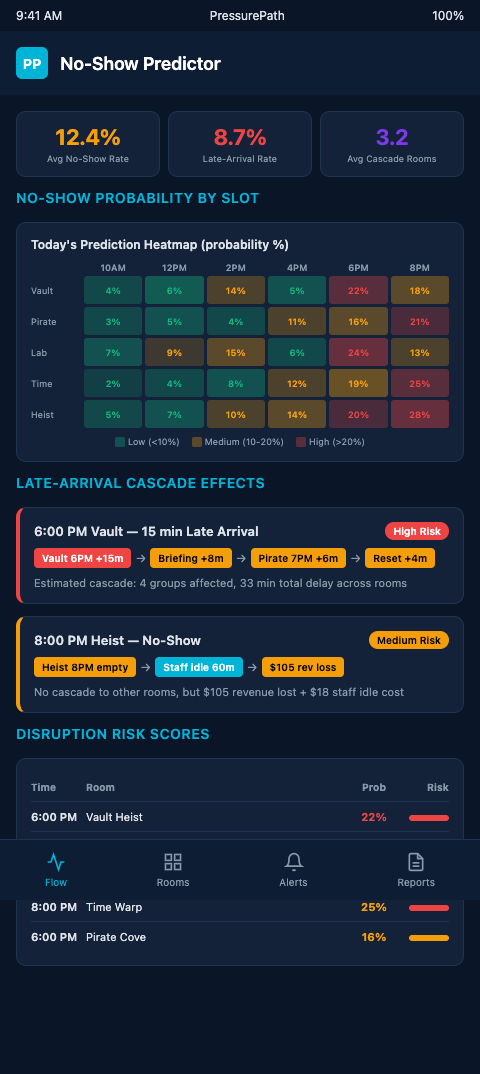
PressurePath takes your booking data and assigns each reservation a flow risk score based on the behavioral signals in your system. High-risk bookings in time slots adjacent to shared asset junctions trigger an alert: "Consider buffer adjustment for 2 PM Room 5 — elevated late-arrival probability." That alert is generated during your pre-shift prep, not during the 2:07 PM scramble.
Modeling No-Shows in Restaurant Revenue Management (Taylor & Francis) describes a conceptual model integrating no-shows and walk-ins to set booking limits maximizing revenue — the same framework applies to escape room scheduling where overbooking one slot can compensate for predicted no-shows without creating guest overlap.
The ML flow forecasting layer adds holiday-specific signals: late-arrival rates increase during holiday peaks when guests have competing family obligations, and the predictive model needs to encode that seasonal shift separately from base-rate behavior.
For franchises with booking system integration, the prediction scores can feed directly into the GM dashboard — so the alert reaches the right person without requiring a separate lookup before each shift.
Tactical Responses to Predicted Disruption
Once you have a flow risk score per booking, the operational response options are concrete.
Pre-confirmation reminders with arrival cues. For bookings flagged as elevated late-arrival risk, a 24-hour reminder that explicitly states the session cannot be extended due to back-to-back bookings changes guest behavior. Dynamic Overbooking with AI (Hostie AI) documents that clear communication about downstream constraints reduces late arrivals in restaurant contexts — the same mechanism applies when guests understand their lateness affects other groups.
Strategic overbooking for predicted no-shows. A slot with two high-probability no-show bookings can carry a third reservation with explicit waitlist language. If both no-shows materialize, the third group plays. If one shows, the third group is offered a future booking at a discount. This requires knowing the no-show probability before the session, which the predictive model provides.
Hotel Overbooking Based on No-Show Probability Forecasts (ScienceDirect) demonstrates that ML classification of customers by no-show probability to determine optimal booking limits produces measurable revenue recovery — the same architecture applied to escape room time slots converts predicted no-shows from pure revenue loss into strategic overbooking opportunities.
Flow buffer reallocation. Rather than building uniform time buffers into every slot regardless of risk, PressurePath allows you to reallocate buffer time toward slots where late-arrival probability is highest. A low-risk 11 AM booking runs with an 8-minute reset buffer; a high-risk 2 PM Saturday booking gets 16 minutes. The total buffer time stays constant; the distribution protects the junctions that actually need it.
Predictive Analytics Improves Customer Service (Clootrack) confirms that forecasting demand surges days ahead enables proactive staffing — the same temporal advantage applies when the demand uncertainty is about who shows up rather than how many bookings arrive.
The multi-grade field trip predictive models used in museum environments handle the same structural problem: groups with varying behavioral reliability entering a time-constrained venue with shared throughput infrastructure. The predictive model architecture differs in input signals but not in core logic.
For franchise operators managing multiple locations, the no-show and late-arrival predictive model becomes more accurate with more historical data. A franchise with five locations can pool three years of booking records to build a model that outperforms any single-location dataset — and that accuracy compounds into better pre-shift briefings, tighter buffer allocation, and fewer Saturday afternoon cascades across all five sites.
The model's outputs feed directly into the pre-shift briefing printout PressurePath generates each morning: a ranked list of bookings by flow risk, with the time slots most exposed to no-show or late-arrival disruption highlighted alongside the specific junctions they will affect if the disruption materializes. That printout gives your GM a decision framework before any guest walks through the door — rather than a series of on-the-spot choices made under peak-hour pressure.
Most franchises discover that 20-30% of their Saturday flow disruptions are predictable from booking signals that were available 24 hours before the session. Once those disruptions are predictable, they stop being emergencies and become scheduled adjustments — handled in the pre-shift briefing rather than in the middle of a busy afternoon when the briefing room queue is already building.
The value of predictive disruption modeling compounds over time. After the first season of running the model, you have a calibration dataset showing which booking signals actually predicted disruption at your location and which were noise. The second season's model is more precise. By the third season, you have a facility-specific risk scoring framework that outperforms any general industry model because it's trained on your guests, your rooms, and your booking platform's behavioral patterns.
PressurePath is built to accept the feedback loop: when a high-risk booking materializes exactly as predicted, that confirmation strengthens the model. When a predicted disruption doesn't occur because the pre-shift protocol handled it, that outcome gets logged as a prevented event — tracking not just the failures but the avoidances that the model made possible. That audit trail is also the most compelling evidence for any franchise-wide rollout of the predictive system: concrete before-and-after data on Saturday flow stability, measured in GM overtime hours, refund requests, and session start variance, at locations where the model runs versus locations where it doesn't.