Predictive Models for Multi-Grade-Level Field Trips
Three Buses, Three Wave Profiles
The problem with treating all school groups as a single "school wave" category isn't just that it produces inaccurate bypass forecasts. It also produces inaccurate intervention prescriptions. A docent-positioning strategy optimized for third-grade waves produces different results when deployed for fifth-grade waves—the social friction that slows a fast-moving third-grade group down at the atrium's T-intersection is largely invisible to a fifth-grade group that's already self-organizing into slower, more deliberate subgroups. One floor configuration cannot be optimal for all grade bands simultaneously. Multi-grade predictive modeling is what allows the floor configuration to be matched to the day's actual booking profile.
On a high-volume Thursday in March, a children's science museum has three school groups arriving within a 40-minute window: 34 second-graders from P.S. 142 at 9:30 AM, 29 fifth-graders from an uptown elementary at 10:00 AM, and a mixed K-2 group of 31 students from a suburban school district at 10:15 AM. The operations team logs these as three school-group visits. On the floor, they're three different fluid dynamics problems.
The second-graders move fast and in clusters. Their leading edge separates from the group within 60 seconds of entering the atrium. Bypass at the Water Cycle puzzle is likely because the puzzle's approach requires a deliberate turn that fast-moving seven-year-olds rarely make without docent prompting.
The fifth-graders move differently. They're more likely to self-organize into small subgroups and read exhibit labels before touching anything. Their bypass pattern is selective: stations that look simple or babyish get passed over quickly, but stations with visible complexity capture the subgroup leaders and pull the rest of the group in.
The K-2 mixed group is the most unpredictable. Kindergarteners and second-graders have different cognitive stages, different physical reach, and different attention spans at the same station. Chaperones in mixed-age groups spend more time managing the age spread and less time directing group flow.
A floor design that performs well for a single-grade group frequently under-serves one or more grades in a multi-grade scenario. The Earthquake Simulator that reliably captures fifth-grade groups becomes a bottleneck when a mixed K-2 group arrives, because the kindergarteners can't reach the controls and cluster near the entry while the second-graders push through. That clustering creates a micro-density event at the station's approach that slows the K-2 wave's exit and creates a corridor blockage for the next group behind them.
Museums and School Group Chaperones (JME) confirms that chaperone behavior varies significantly by grade level: chaperones with younger groups prioritize containment and safety over educational engagement, while chaperones with older groups take a more hands-off approach. Those behavioral differences feed directly into wave-pressure signatures.
Age-Band Modeling in PressurePath
PressurePath treats each grade band as a distinct fluid type in the pipe network. Just as water and a more viscous fluid have different pressure dynamics through the same pipe configuration, a second-grade wave and a fifth-grade wave have different dynamics through the same exhibit floor.
The model parameters for each grade band include: entry velocity (how quickly the leading edge separates from the group), branching factor (how readily the group splits at corridor intersections), station dwell probability (the likelihood that a random student stops at a given station type), and chaperone friction coefficient (how much chaperones slow or redirect the wave).
Age-Adapted Painting Descriptions Change Viewing (Nature) establishes the behavioral foundation: children given developmentally matched content showed measurably longer dwell times. For predictive flow modeling, this means station-level dwell probability isn't constant across grade bands—it's a function of how well the station's complexity level matches the visiting group's developmental stage.
Designing Exhibits for Kids (Getty) provides the developmental scaffold via Piaget's four cognitive stages. Second-graders operate in the concrete operational stage: they engage strongly with physical manipulation and cause-effect demonstrations. Fifth-graders are entering formal operations: they engage with inference, data representation, and multi-step processes. A station optimized for one stage produces different engagement rates at the other, which means your bypass predictions need to be grade-specific rather than treating "school groups" as homogeneous.
A Day at the Museum: Middle School Science Achievement (Wiley) provides longitudinal evidence that museum visits produce grade-linked science and math achievement outcomes—which is the educational-impact argument for why getting multi-grade predictive modeling right matters beyond operations. If your fifth-grade groups are bypassing the Earthquake Simulator because it reads as too simple, the learning outcome that justified that station's NSF funding is going unrealized.
For ML wave prediction to work at the multi-grade level, the booking calendar data needs grade-level metadata attached to each group, not just group size and arrival time. That metadata becomes the primary feature distinguishing a high-bypass-risk wave profile from a low-bypass-risk one.
Compound Pressure on Mixed-Grade Days
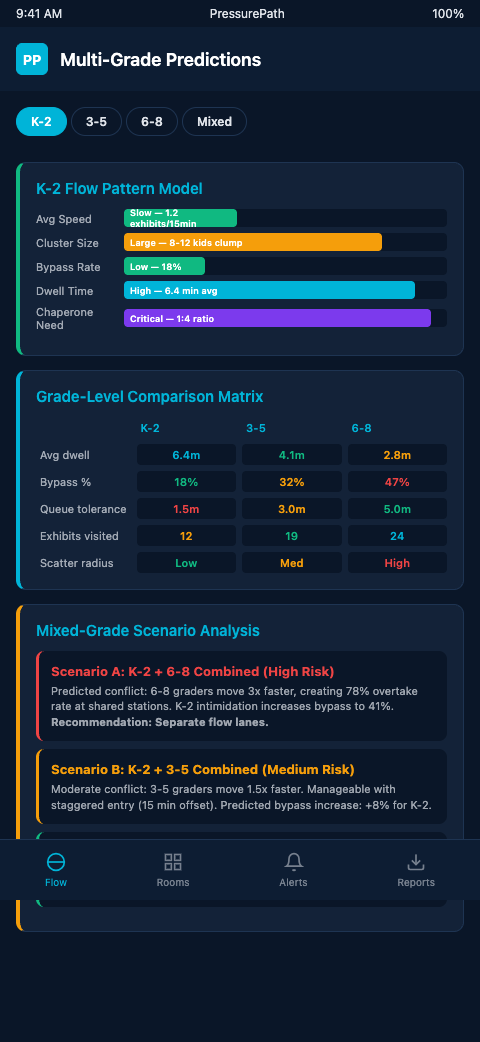
When three school groups arrive within a 40-minute window with different grade profiles, the pressure forecast isn't simply the sum of three individual wave profiles. The waves interact. The fifth-grade group, moving at a moderate pace through the floor's central corridor, creates a social friction point that slows the second-grade wave behind it—but also creates a density peak at the corridor intersection that affects station approach angles for both groups.
LSIE Report and IMLS Informal Learning Proficiencies (Wiley) establishes that IMLS proficiencies are defined by grade level—predictive models need to match expected outcomes to developmental stage. When multiple grades share floor space simultaneously, the compound pressure profile can produce bypass events that neither group would generate independently. The second-grade wave accelerates past the Water Cycle puzzle because the fifth-grade group ahead of it created a density blockage at the puzzle's approach corridor.
The Educational Value of Field Trips documents via randomized study of 10,912 K-12 students that younger and lower-income students gain the most from museum visits. That finding raises the stakes for accurate bypass prevention on multi-grade days: the students with the most to gain are often in the groups—younger grades, Title I schools—that generate the highest bypass rates.
Museum-Managed STEM Programs (National Academies) confirms that STEM museum outcomes vary by age group and program structure. Multi-grade predictive modeling gives exhibit designers the data to structure their programming around those age-group differences rather than designing a single floor experience that inevitably under-serves one or more grade bands.
The connection to rotating seasonal sims is direct: when a new temporary exhibit rotates in, its grade-level bypass profile needs to be estimated before the first school wave arrives. Multi-grade predictive modeling provides the baseline age-band parameters to initialize that estimate from prior comparable exhibit data. Without age-band baselines, the seasonal exhibit's first two weeks of operation are data-collection rather than optimized engagement—and any bypass that happens during those two weeks is bypass that was preventable.
The ops implication is that multi-grade days require grade-specific floor protocols, not a single universal school-group protocol. The docent positioning, partition configurations, and stagger recommendations that work for a pure third-grade morning need to be adjusted for a mixed-grade afternoon. PressurePath's wave-prediction model produces grade-specific pressure forecasts that allow the ops team to configure the floor differently for each time slot rather than using a static school-day setup.
For the multi-act drift prediction parallel: immersive theater productions face compound pressure when multiple audience cohorts with different engagement styles move through the same performance space. The grade-level variance problem in museums is structurally identical to the cohort-behavior variance problem in immersive theater—the solution architecture transfers.
What multi-grade predictive modeling makes possible in practice is a differentiated floor configuration calendar. Rather than setting up the floor the same way every school morning, the ops team uses PressurePath's grade-band forecasts to configure the floor differently for different booking profiles. A morning with two second-grade groups requires a high-resistance main corridor configuration—wider rope partitions, docents at the atrium's primary pressure-drop points, shorter stagger windows to prevent leading-edge separation. An afternoon with two fifth-grade groups requires different configuration—lighter social friction interventions, docents at the stations with visible complexity that fifth-graders respond to, and stagger windows sized for slower-velocity waves. The floor becomes configurable by wave profile rather than fixed by convention.
Model the Grade, Not Just the Group Size
The data infrastructure requirement for multi-grade predictive modeling is more accessible than most exhibit designers expect. You need grade-level metadata attached to each booking record—which most school group reservation systems already collect—and you need floor-sensor data that records which stations each visit session engaged with. The combination of those two data streams, accumulated over two or more semesters, is sufficient to initialize a grade-band predictive model with useful accuracy.
PressurePath builds the grade-band model from your historical data rather than requiring you to manually program age-band behavioral profiles. The model learns from your specific floor—the Water Cycle puzzle's capture rate with second-graders at your museum, in your atrium, under your current docent configuration—rather than applying generic grade-level behavioral norms that may not match your building's geometry or your student population's demographics. That institutional specificity is what makes the multi-grade forecast actionable rather than advisory.
Children's museum exhibit designers who are booking 150 or more school groups per year are leaving significant predictive accuracy on the table by treating all school groups as a single demand type. PressurePath is built to disaggregate your booking calendar by grade band and generate wave-pressure forecasts that reflect how your actual student population moves through your actual floor. Join the waitlist to see multi-grade predictive modeling applied to your school booking data.