Predictive Models for Audience Drift Across Multi-Act Structures
Act 3 Was Supposed to Be the Emotional Peak. Instead, It Was Empty.
The director had spent three months choreographing Act 3 of a two-venue promenade production. The final scene, placed in the basement chapel, required 35 bodies for the spatial blocking to read as intended — a compressed crowd pressing toward the altar as the lead performer descended. On opening night, 14 audience members were in the chapel. The other 56 had re-clustered upstairs in Act 3's first transition space and never descended.
This wasn't a messaging failure. The chapel was lit, the descent was audible from the corridor above it, and ushers had positioned themselves at the stairwell. The failure was drift compounding: the audience members who ended up upstairs during Act 3 had been upstairs-oriented since Act 1. Their position in Act 3 wasn't a choice — it was the accumulated result of three prior scene transitions, each one nudging them fractionally away from the route that would have delivered them to the basement.
Directors redesigning immersive shows mid-run indicates current predictive models fail to anticipate drift (Is Immersive Theatre Broken?, Exeunt) — the redesigns aren't artistic changes. They're corrective responses to drift patterns that weren't modeled before opening.
How Drift Compounds Across Acts
Drift is positional memory. An audience member who ends up in Room A at the end of Act 1 is statistically more likely to begin Act 2 near Room A than near Room F — because they know the route, because the room holds residual sensory interest, and because the path of least resistance from A is corridor A-C, not corridor A-F. This place-schema effect is documented: spatiotemporal models explain how audiences lose track of time and drift toward high-engagement zones (Presence, Flow, and Narrative Absorption, PMC).
By Act 2, this positional bias has compressed the distribution: audience members who started the show uniformly distributed are now clustered according to their Act 1 zone. The director's Act 2 blocking was designed for an approximately uniform distribution, but the population the show has produced is already non-uniform. By Act 3, two acts of compounding have pushed clusters further toward extremes.
Physical negotiation zones showed 60% higher engagement and predict drift toward sensory-dense scenes (The Route to Immersion, Nature HSSC) — this means the magnet scenes in Act 1 don't just pull audiences for Act 1; they establish gravitational priors that affect Act 2 and Act 3 distributions. A scene that draws 70% of the audience in Act 1 will pull residual clusters in later acts even after its content has ended.
Predictive drift models work backwards from this compounding logic. The model's input is the Act 1 expected distribution — based on ticket batch, venue geometry, and the magnetic pull coefficients of opening scenes. The forward simulation runs through each act transition, applying the place-schema drift coefficient and the corridor geometry constraints, and outputs expected Act 3 distributions by scene. For productions with significant performance history, the connection to ML audience prediction for long-run productions is a feedback loop: after 20 or more performances, the drift model becomes calibrated by actual data rather than theoretical coefficients.
PressurePath implements this as a multi-act simulation chain: Act 1 distribution → transition model → Act 2 distribution → transition model → Act 3 distribution. Each transition model accounts for corridor geometry, inter-act pause duration (longer pauses reduce positional memory strength), and scene magnetic pull differentials. The output is a distribution confidence interval for each scene in each act.
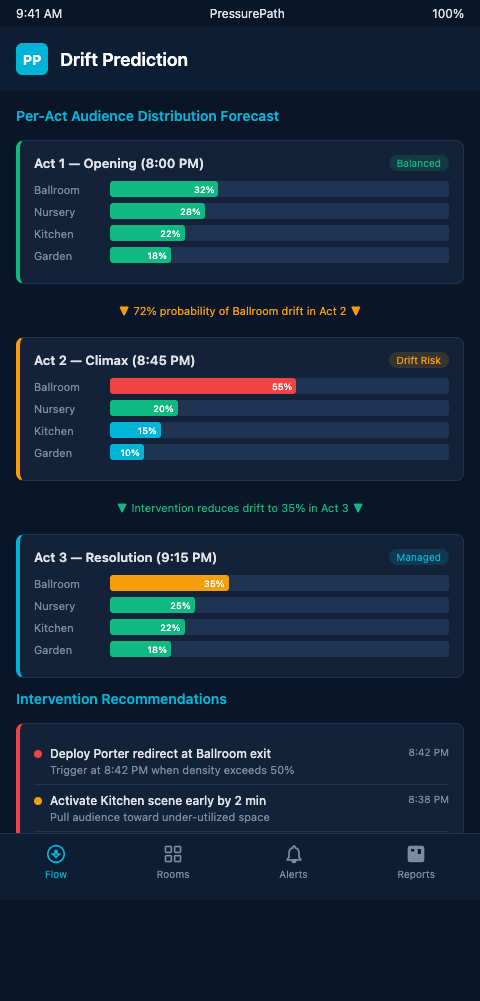
Rule-based learning models predict audience movement between acts in pedestrian flow simulation (ACS2-Powered Pedestrian Flow Simulation, MDPI) — the pedestrian dynamics research is directly applicable to immersive theater act transitions, which are structurally identical to the inter-zone movement in multi-space event venues. The bottleneck and lane-formation patterns identified in INFORMS research appear reliably at immersive act transitions when corridor geometry creates a forced choice point.
Designing Against Drift: Structural Interventions
Once the model generates an Act 3 forecast that shows the chapel running at 40% of its sightline target, the director has a design problem with a quantified magnitude — which is solvable in ways that vague intuition about "getting people downstairs" is not.
Before treating the interventions as a recipe, it's worth understanding the inter-act pause duration variable, because it's the most underestimated drift-reduction lever in the model. The place-schema effect — the spatial memory that keeps audience members near their Act 1 zone — weakens when there is a longer pause between acts. A 10-minute inter-act transition with ambient sound and a drink station gives audience members permission to relocate. A 2-minute transition that immediately cues the next act captures them where they are.
PressurePath quantifies this: in its default drift coefficient table, a 2-minute inter-act transition preserves approximately 75% of the prior-act positional clustering. A 10-minute transition drops that to approximately 45%. For the chapel problem, adding 7 minutes to the inter-act pause and placing an audio cue in the basement stairwell during that pause would reduce the upstairs clustering from 75% retention to 45% — bringing an additional 21 audience members into the lower building and seeding the chapel more effectively.
The 7-minute pause has a runtime cost. PressurePath makes the trade-off explicit: 7 additional minutes per inter-act pause extends the show by 14 minutes for a two-act structure, which may require adjusting house scheduling or ticket pricing. The director and producer make that call with the quantified benefit on the table rather than in the abstract.
Structural intervention Category 1: inter-act magnetic pull inversion. The Act 1 scene that creates the upstairs bias has a high magnetic pull coefficient. Reducing that coefficient — shorter runtime, lower audio signature, less visual spectacle — reduces the positional memory it creates. The simulation re-runs with the adjusted coefficient and projects a flatter Act 2 entry distribution as a result.
Category 2: transition corridor design. If the stairwell descending to the basement is narrow and unlit, it acts as a high-resistance pipe. Adding lighting, widening the visual access, or placing a performer at the landing mid-descent makes the stairwell a lower-resistance path. The pressure difference between upstairs and the basement drops, and more fluid (audience members) flows toward the basement naturally.
Category 3: Act 2 drift correction. Rather than trying to fix Act 3 directly, the model identifies Act 2 intervention points where a small correction in distribution creates a compoundly better Act 3 position. A scene added to the lower building during Act 2 — even a brief transitional scene — establishes a lower-building cluster that then seeds the basement for Act 3.
The feedback loop from ML-based prediction sharpens drift forecasts after 20 or more performances, as the model calibrates to actual behavioral data rather than theoretical coefficients, and predictions sharpen.
60 performances of drift data provides empirical backing for the drift coefficients the model uses — the research corpus shows which types of scenes and corridor geometries produce the most severe compounding drift.
Cross-niche application: predictive crowd behavior in multi-path haunted attractions uses the same compounding drift logic in a higher-throughput, shorter-arc environment. The multi-act structure of immersive theater makes the problem longer in time horizon but structurally analogous.
Model the Drift Before Opening Night
The director who found 14 people in the chapel on opening night didn't have a directorial failure. She had a model failure: Act 3 was designed without a compounding drift projection. The chapel's isolation at the end of a two-act path was a known corridor geometry constraint — but without a model showing its downstream effect, the design proceeded as if the Act 3 distribution would mirror the opening-night seating chart.
One pattern that emerges consistently across multi-act productions with drift data: the scenes that fail in Act 3 are rarely weak scenes. The chapel was praised in solo run-throughs, designer reviews, and technical rehearsals. The blocking worked, the performers were compelling, the spatial design was precise. The scene failed only in the context of two preceding acts of compounding drift that the production had never modeled as a causal chain.
This is why drift modeling is distinct from scene quality assessment. A director reviewing isolated scenes can identify quality issues, pacing problems, and narrative weaknesses. Drift modeling identifies structural failures that are invisible at the scene level and only emerge in the interaction between scenes, acts, and corridor geometry. Both types of assessment are necessary; most productions do only one.
The audience participation choices that predict downstream engagement (Audience Participation in Interactive Theater, ResearchGate) provide additional validation for why Act 1 decisions have outsized downstream effects: early participation choices establish behavioral patterns that persist across the full performance arc. The implication for multi-act design is that Act 1 is not just the opening — it's the seed of the entire distribution. Designing Act 1 without modeling its Act 3 consequences is designing half the show.
PressurePath exists precisely for multi-act structural decisions. Immersive theater companies building or rebuilding multi-act productions are invited to use PressurePath's drift simulation toolset — bring your floor plan, your act structure, and your scene timing sheet, and let the model show you where Act 3 goes wrong before it happens in front of an audience.