Machine-Assisted Flow Forecasting for Holiday Peak Weeks
Why Holiday Weeks Break Standard Pacing Assumptions
The Thursday before Thanksgiving at a 10-room franchise operates nothing like a typical Thursday. And a Saturday between Christmas and New Year's operates nothing like the Thursday before Thanksgiving. Each holiday window has its own demand shape, its own group composition, and its own late-arrival profile — which means a single "holiday pacing plan" is itself an oversimplification. Walk-in rates are higher. Advance booking cancellations arrive late. Groups run 15-20% larger than average. Session overruns increase because holiday groups include unfamiliar players who slow puzzle throughput. And the briefing room, calibrated for a normal weekend flow rate, starts receiving back-to-back groups before the first session even completes its first reset cycle.
Standard pacing models treat holiday peaks as a scaled-up version of a normal Saturday. That assumption fails because holiday demand isn't just higher volume — it's a different distribution. Forecasting Resort Hotel Tourism Demand (PMC) documents that multi-seasonality and high demand variability during peak weeks makes forecasting especially challenging, and that methods calibrated to normal patterns consistently underperform during holiday windows.
The gap between a normal Saturday and Christmas week at a fully booked 10-room franchise can exceed 40% in throughput pressure on shared assets. Reset stations that handle normal weekend flow within their designed capacity need to service more rooms in shorter intervals. The photo op fills faster and stays full longer. Game Masters manage briefings under conditions where three groups have already formed before the prior briefing ends.
Escape Room Market to Grow $31 Billion by 2032 (Allied) projects the market at $7.9B in 2022 growing at 14.8% CAGR — holiday peaks carry an outsized share of that revenue, which makes operational failures during those windows disproportionately costly in both immediate refunds and longer-term review impact.
Building a Machine-Assisted Forecast for Peak Flow
Machine-assisted flow forecasting for holiday peaks works by treating the problem as a time-series prediction layered on top of a pacing simulation. The forecast handles demand uncertainty; the simulation handles operational response. Neither is sufficient alone.
On the forecast side, LSTM neural networks have become the standard for hospitality demand prediction. Forecasting Hotel Demand Using Machine Learning (Cornell) reports 85-92% accuracy for 14-day prediction windows using LSTM models trained on historical booking patterns, prior-year holiday data, and local event calendars. For escape room franchises, those inputs translate to: same-week bookings from the prior two holiday seasons, real-time advance booking velocity in the two weeks before the peak, and group size distributions from comparable holiday periods.
Machine Learning in Peak Demand Forecasting (ScienceDirect) confirms that ML methods achieve superior accuracy over traditional statistical models — specifically on volatile seasonal patterns where SARIMA-based approaches lose accuracy because the signal structure changes shape during peaks, not just magnitude.
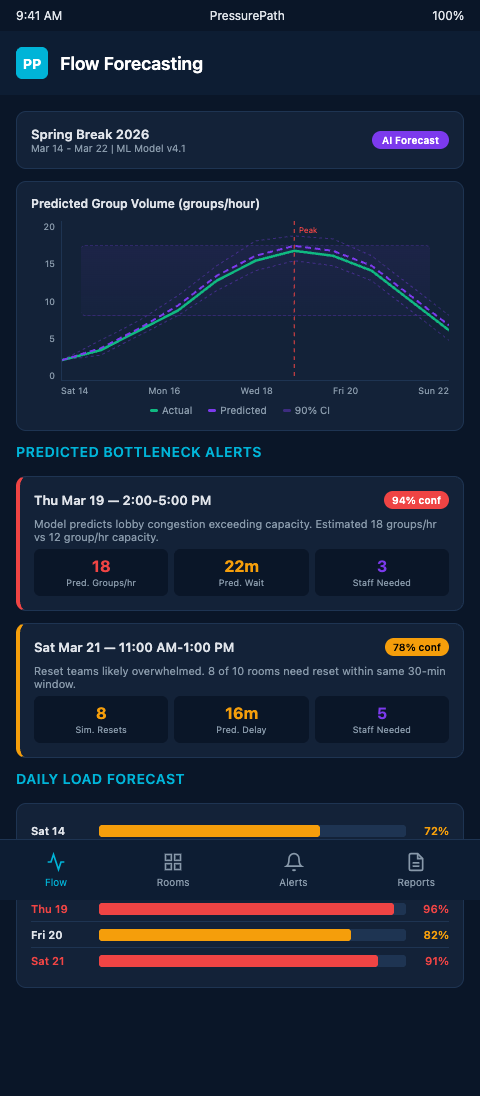
The pressurized-water model integrates the forecast as a pressure input. If the ML model predicts 20% above-average group arrival for Christmas weekend, PressurePath runs the simulation at that elevated pressure and shows you where the first junction fails — not in abstract terms, but at a specific timestamp: Room 4 exits at 2:12 PM while Rooms 6 and 8 are still running, the briefing room receives an unscheduled group at 2:15 PM, and reset station 2 is still working Room 4 when Room 6 finishes at 2:18 PM. The pipe network backs up at that junction.
The GM dashboard then shows pre-shift: "Expect simultaneous pressure at briefing room between 2:10 and 2:25 PM. Assign second briefing GM at 1:55 PM."
Time-Series Forecasting of Seasonal Data (MDPI) validates tree-based ensembles and LSTMs outperforming SARIMA specifically on volatile seasonal patterns — the same structure that holiday escape room booking data exhibits.
For the no-show predictive models layer, holiday peaks introduce a specific wrinkle: cancellation rates drop (people keep holiday bookings) but late-arrival rates rise (family gatherings run over schedule). The ML forecast needs to encode both behaviors separately. A model that uses the normal-day cancellation rate will underestimate the number of groups who arrive 5-12 minutes late on Christmas Eve, triggering delayed starts that compound into reset station pressure later in the afternoon.
Linking the forecast to mixed-difficulty sims matters because holiday group composition skews toward beginner and intermediate players — families rather than friend groups who have played before. Beginner rooms see longer session times during holiday weeks, which changes the flow rate for those specific pipes and creates asymmetric pressure on the junction handling their exits.
PressurePath's simulation accepts holiday-specific session length distributions as inputs, so the pipe network runs with realistic flow rates per room type rather than annual averages.
Applying the Forecast Before the Week Arrives
The operational value of machine-assisted forecasting isn't visible during the peak — it's visible in the two weeks before it. A franchise that runs the ML forecast 14 days before Christmas weekend can make three types of decisions that wouldn't be possible without it.
First, staffing decisions: if the forecast shows briefing room pressure between 12 PM and 4 PM on December 26, adding a second briefing GM for that window costs less than the refunds triggered by a 20-minute delay cascade. AI-Based Demand Forecasting in Hospitality (oxmaint.com) reports AI processing 40+ demand signals achieves 95% forecast accuracy over a 3-month window — the same signal richness applied to a 14-day holiday lead time produces actionable staffing schedules.
Second, booking grid adjustments: the forecast may show that moving the Room 7 start time from 2:00 PM to 2:08 PM on Christmas Day eliminates the exit cluster that creates reset station contention. That 8-minute shift is free to implement and invisible to guests.
Third, reset station pre-positioning: knowing which rooms will have high turnover during the peak window lets you assign reset staff to their first three rooms before shift start rather than assigning by floor proximity.
The approach used for ML wave prediction for school bookings in museum environments follows the same architecture — high-seasonality demand, group size variability, and shared asset contention that can only be managed proactively rather than reactively.
Holiday peaks are predictable. The flow failures they cause are not inevitable. Running a machine-assisted forecast through a pipe-network simulation two weeks before your busiest week turns peak-hour chaos into a pre-shift briefing item — one that your Game Masters can actually act on before the first group walks in.
If your franchise has two or more holiday seasons of booking data, PressurePath can begin building the forecast model now. The first run identifies your most reliable pressure signal; subsequent runs improve accuracy as the model incorporates your specific location's guest behavior patterns.
The Compounding Return on Holiday Forecast Accuracy
A well-executed holiday forecast doesn't just prevent one bad Saturday. It accumulates operational knowledge that improves every subsequent peak period.
After the first holiday season with machine-assisted forecasting, you have a calibration dataset: the model's predictions versus actual outcomes. Where the model overestimated briefing room pressure, you can reduce the pre-allocated GM coverage and recover labor cost. Where it underestimated photo op retention, you can add the 7-minute cue protocol. The second season's forecast incorporates those corrections and performs materially better.
LSTM for Long-Term Time Series Forecasting (arXiv) confirms that LSTM models specifically improve on longer-horizon predictions as training data accumulates — the holiday window is exactly the domain where this compounding accuracy benefit materializes most visibly, because the signal structure of holiday demand is stable year-over-year even as the absolute volume grows.
For a multi-location franchise, the compounding is faster. Pooling holiday booking data across five or eight locations gives the model 5-8x more training examples per holiday type, collapsing the calibration window from three seasons to one. A new location that joins a franchise with an established ML forecast model inherits accuracy that a standalone operator won't reach for years.
The per-location operational value of that accuracy is concrete: fewer last-minute staffing additions, fewer briefing room delays that trigger refund requests, and reset station sequences that were planned rather than improvised. Across a 10-room franchise running three major holiday peaks per year, the difference between a calibrated forecast and a manual plan can represent 40-60 hours of avoided operational chaos annually — staff time that goes into guest service rather than reactive recovery.
A franchise that runs PressurePath's ML forecast before its first major holiday peak this year will arrive at that peak with a specific plan: which rooms need staggered starts, which time slots carry elevated briefing room pressure, and which GM needs to be stationed at which junction between 1 PM and 4 PM. That specificity is what the data-driven approach delivers. The alternative is discovering those facts during the shift, under peak-hour pressure, with a refund request already forming at the front desk. Holiday peaks are the moments that define a season's profitability — and the preparation that protects them starts 14 days before the first group walks in.