Integrating Flow Data With Your Reservation Intake System
When the Booking System Knows Nothing About the Floor
A school administrator from P.S. 142 books 34 third-graders for a Tuesday 10:00 AM slot. Your reservation system logs grade level, headcount, and a teacher contact. By 10:18 AM, 31 of those kids have compressed into the volcano exhibit and your Water Cycle puzzle — a centerpiece of a $180K NSF grant — has drawn exactly four visitors. Your booking data never warned you this would happen, because it wasn't designed to.
The fundamental problem is a data handshake that never occurs. Reservation platforms collect scheduling and demographic information. Floor tracking systems collect movement and dwell-time information. Without integration, the floor team gets no lead time. They react to a school wave rather than shape its path before it arrives.
ASTC Annual Statistics Survey estimates roughly 13 million U.S. school visits annually across science centers alone. At that volume, the gap between what a reservation record knows and what the floor needs to know costs exhibit designers measurable engagement losses every single day. Cuseum's timed ticketing guidance notes that timed-entry systems can correlate booking data with floor occupancy — but that correlation requires the two data streams to actually talk to each other.
When they don't, every 30-kid school wave arrives as a surprise. The floor team reads body language and scrambles. Docents redirect verbally. Rope partitions get repositioned by instinct. None of that reactive work would be necessary if the reservation record had already flagged the wave characteristics — grade level, group size, chaperone ratio — and pre-loaded a flow configuration against the right exhibit zones.
The cost compounds across a full field trip day. Four school groups in a day means four separate instances of a floor team working from zero information at the start of each group's visit. The fourth group of the day is handled the same way as the first — with the same blank-slate reactive posture — even though three prior groups have already generated wave-pressure data that, if captured and applied, would tell the floor team exactly which stations are at risk for bypass with this specific grade level and group size. Reservation intake integration creates the bridge that lets that accumulated data inform each new group's floor configuration, rather than discarding it between sessions.
Connecting Reservation Data to Pacing Models
Think of a 30-kid school wave as a high-pressure fluid burst pushing through your museum's pipe network. The moment that reservation record is created — Tuesday, 34 third-graders, one bus, 10:00 AM arrival — you have the pressure profile before the fluid ever enters the system. Reservation intake integration means reading that profile and pre-configuring your pipe geometry: which partitions open, which stations get docent pre-positioning, which entry corridor narrows to stagger the burst.
PressurePath treats each reservation record as an input parameter to the flow model. Group size determines initial pressure magnitude. Grade level maps to predicted dwell-time ranges by station type — third-graders average roughly one minute per interactive exhibit according to informalscience.org research on children's STEM engagement. Arrival time sets the pipe-activation schedule. Chaperone count sets the number of sub-channels the group can be partitioned into.
The practical connection happens at the intake workflow level. Platforms like Versai and Doubleknot already capture grade level, group size, and arrival windows for school reservations. The integration layer maps those fields to pacing model parameters — not as a manual step, but as an automatic translation that fires when the booking is confirmed. By the time the confirmation email goes to the teacher, your floor configuration for that wave is already drafted.
Tessitura's CRM platform offers API access to booking and transaction data, which means the integration doesn't require replacing your ticketing system. The reservation fields that already exist — headcount, grade, time slot — become the upstream inputs. What changes is how those fields route: rather than sitting in an administrative record until check-in, they feed the pacing model the moment they're written.
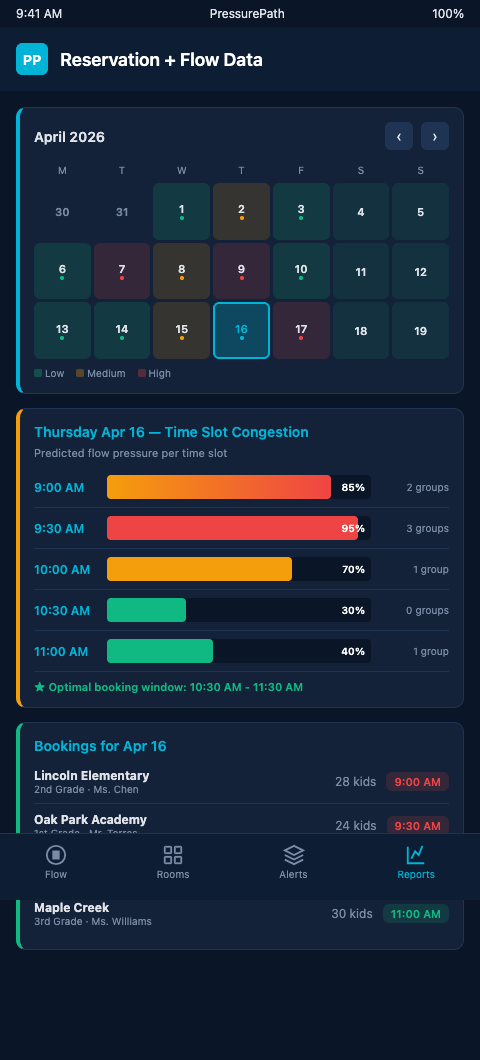
Once reservation data flows into the pacing model, the floor team stops working from a blank slate each morning. They open a dashboard that already shows the pressure profile for each incoming group. Tuesday's 10:00 AM slot has 34 kids, predicted high dwell variance between interactive and static exhibits, and a chaperone ratio that supports two sub-group routing paths. The model recommends a partition configuration and a docent placement before anyone checks in.
IMLS outcome-based evaluation guidelines link reservation and visit data to grant accountability — a connection that strengthens when the two data streams are integrated rather than siloed. Grant-funded exhibits like a Water Cycle puzzle need measurable engagement outcomes. When the reservation system can predict which wave profiles historically bypass that station, the floor team can act pre-emptively rather than post-hoc.
Visitor analytics platforms like Dexibit close the feedback loop: actual floor behavior data from each group visit flows back to calibrate the pacing model's predictions, so each new booking record gets compared against increasingly accurate historical wave profiles.
Advanced Tactics for Reservation-to-Floor Sync
The first advanced layer is wave-profile enrichment at the point of booking. Rather than waiting for check-in to learn anything about the group, build a brief intake questionnaire into the reservation confirmation workflow. Two or three fields — primary exhibit interest areas, accessibility needs, chaperone experience level — materially sharpen the pacing model's configuration. A group that selects "water science" as a primary interest gets a flow configuration that pre-routes them away from the Water Cycle puzzle's entry corridor to create approach spacing, rather than a direct funnel that causes immediate compression.
The second layer is time-slot pressure modeling. Not all Tuesday 10:00 AM slots are equal. A school booking system that also captures whether a group is a first-time or return visitor, or whether they've been pre-briefed on station protocols, can stratify wave-pressure predictions. First-time third-grade groups from Title I schools consistently show higher compression at interactive stations than return visitors, because novelty response drives clustering. A reservation field that tags group visit history unlocks a more precise pacing pre-set.
The third layer is retroactive learning. After each field trip day, match the reservation record against actual floor data: which stations the group engaged with, how long, and which they bypassed. That match produces a wave profile that sharpens the model's prediction for the next similar booking. School district booking integration extends this loop by pulling district-level scheduling patterns, so the model learns not just from individual groups but from recurring district cohorts.
Cross-niche applications confirm the principle: booking system integration for multi-room venues shows that reservation-to-floor data translation reduces reactive floor management by giving staff pre-loaded configuration states rather than blank starting points. The mechanism is the same whether the venue is an escape room franchise or a 14-station children's museum.
The hardest implementation step is usually not the technical integration — API connections between modern reservation platforms and analytics systems are well-documented. The hardest step is agreement on which reservation fields matter. Most museum reservation workflows were designed for administrative purposes: headcount for capacity management, contact information for communication. Translating those fields into pacing model inputs requires a brief audit of what the floor team actually needs to know before a group arrives. Once that audit produces a short field list, the integration is straightforward. Until it does, reservation data and floor data stay in parallel universes, and the Water Cycle puzzle keeps getting bypassed by 28 of every 32 third-graders.
The integration also surfaces patterns invisible to any individual staff member. A single docent working Tuesday mornings will notice that "the big school groups tend to skip the water exhibit." ML wave prediction quantifies that tendency across 200 bookings and identifies which reservation attributes — district, grade level, group size, arrival window — correlate with bypass risk. At that point, the reservation intake system stops being a scheduling tool and becomes a pacing-optimization input.
Start With Two Fields
The integration rollout question that most museum teams ask is: do we need to replace our reservation system to make this work? The answer is no. The integration operates as a layer on top of existing platforms — reading the fields that already exist and routing them to the pacing model. Tessitura, Versai, and Doubleknot all expose API endpoints for reservation data; the integration writes to and reads from those endpoints without touching the museum's core booking workflow. Staff continue using the same booking system; the pacing model gets the data it needs through the integration layer without disrupting daily operations.
If your museum's reservation system currently captures nothing beyond headcount and arrival time, the minimum viable integration is adding grade level as a required field. That single data point maps to predicted dwell distributions by station type, which is enough to generate a basic wave-pressure pre-configuration. The second field is chaperone-to-student ratio. Those two inputs — grade level and chaperone count — are sufficient to distinguish between a group that needs two parallel routing channels and one that can move as a single cohort.
Children's museum exhibit designers who have connected even this minimal reservation-to-flow data link report that floor teams arrive at morning briefings with something to brief from, rather than waiting for the first wave to reveal what the day will look like. That shift — from reactive pattern-reading to pre-loaded configuration — is what reservation intake integration actually delivers. PressurePath is built on that foundation: every booking record is a pressure profile waiting to be read.
If you're a children's museum exhibit designer ready to stop treating your reservation system as a scheduling-only tool, join the waitlist for PressurePath and see how your existing booking data maps to floor pacing configurations.