Workflow Integration With School District Booking Platforms
The Two-System Coordination Gap
A teacher at Jefferson Elementary submits a field trip request through her district's transportation management system — one platform, one approval chain, one bus routing confirmation. Your museum's reservation team receives a separate inquiry through your online booking portal — a different platform, a different confirmation, a different data record. On the morning of the visit, the district system shows the bus departing at 9:45 AM, arriving at 10:15 AM, with 34 students and one driver. Your reservation system shows a 10:00 AM arrival slot for 28 students and three chaperones.
The headcount discrepancy is real. The arrival time gap is real. Neither system automatically knows what the other contains. Someone — usually a coordinator on your end — calls the school to reconcile, gets a voicemail, reconciles from memory or guesswork, and preps the floor based on a number that may be wrong by six kids and 15 minutes.
ASTC research on what teachers told them about field trips identifies bus scheduling fragmentation as one of the primary coordination pain points between schools and museum venues. The teacher manages the district's system; the museum manages its own. The data doesn't flow between them. That gap is where arrival surprises, headcount mismatches, and floor-staffing errors originate.
ASTC Annual Statistics estimate roughly 13 million U.S. school visits per year across science centers alone. At that volume, the integration gap is not a boutique problem — it's a systemic coordination failure that compounds every time a district uses a different booking platform than the museum's reservation system.
The gap's cost is not just logistical frustration. When a museum's floor team configures for 28 kids and 34 show up — because the district's headcount was updated after the museum's booking was confirmed — the wave-pressure configuration is wrong from the first minute. A pacing model pre-loaded with 28 kids underestimates compression at high-magnet stations, under-positions docents, and doesn't flag the stagger risk created by the additional 6 kids' worth of pressure. The floor team reacts rather than manages, and the Water Cycle puzzle's bypass for that session is the predictable result.
Building the Integration Layer
The pressurized-water framing makes the value of integration concrete. Every reservation record is a pressure profile — the specification of an incoming fluid burst before it reaches the exhibit floor. District booking integration means receiving that pressure profile from the district's system rather than from a separate manual booking process that may contain different data.
When the district platform and the museum's reservation system share data, PressurePath reads the combined record: transportation-confirmed headcount (more accurate than self-reported teacher estimates), district-approved departure time (more reliable than informal arrival estimates), and grade level from the district's enrollment data. Those three fields, flowing automatically from the district system to the pacing model, produce a more accurate pressure pre-configuration than the museum's standalone reservation record can provide.
Doubleknot's children's museum software is built specifically for field trip booking, capacity scheduling, and district reporting — the integration layer for museum-side reservation management. BusPlanner field trip management software manages trip approval, routing, and billing from the district side. The integration between those two layers is where data reconciliation currently fails to happen automatically.
busHive school district software operates as the district transportation system feeding scheduling data upstream. The practical integration uses an API bridge between the district platform and the museum's CRM: when a district field trip is confirmed in BusPlanner or busHive, a data push to the museum's Tessitura CRM or equivalent creates or updates the corresponding reservation record with transportation-confirmed data.
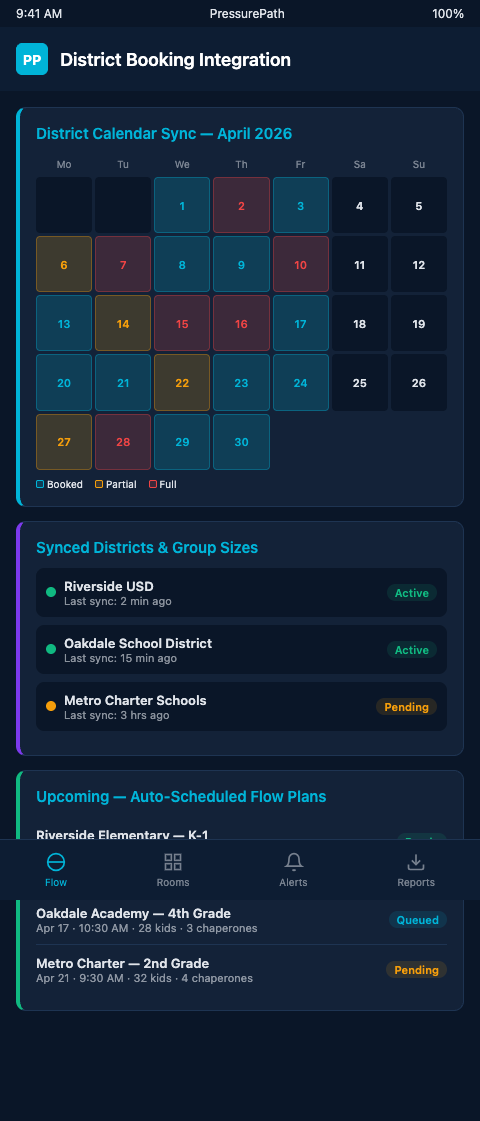
Understanding the technical scope of a full district integration helps children's museum exhibit designers and operations staff make realistic implementation plans. A complete bidirectional integration — district transportation system to museum reservation to pacing model and back — typically takes two to four months and requires API documentation from the district's software vendor, a museum-side API developer or integration consultant, and a data-mapping session where the two teams agree on field definitions and update protocols. That investment is justified for museums with five or more partner districts generating consistent field trip volume. For smaller operations, a simplified integration — district booking confirmation triggering a museum webhook that updates the reservation record — can be built in two weeks and eliminates the most common source of headcount mismatches.
The integration architecture has three data-flow directions: district-to-museum (transportation confirmation and headcount), museum-to-district (confirmation receipt, capacity confirmation, and any pre-visit materials), and post-visit-to-district (attendance actuals, learning outcome summaries for teachers). The third direction — post-visit data flow back to the district — is underutilized but increasingly relevant for grant reporting and district partnership renewals.
PressurePath connects to the museum-side CRM through the same API access points that Tessitura exposes for booking and transaction data. When a confirmed district booking arrives, the pacing model pre-configuration runs automatically: group size sets wave pressure magnitude, grade level maps to dwell-time distributions, arrival window sets the wave timing, and chaperone count sets the sub-channel capacity. By the time the teacher gets the confirmation email from both systems, the floor configuration for that group's wave is already drafted.
The reservation intake flow data post covers the reservation-to-pacing-model translation in detail. District booking integration extends that same translation to a richer and more reliable data source — the district's own administrative records, which contain transportation-confirmed figures rather than estimates.
Advanced Integration Configurations
The first advanced layer is multi-district pattern learning. A museum serving schools from 12 different districts accumulates district-level visit histories: which districts show which wave-pressure profiles, which grade levels tend toward which bypass patterns, which districts reliably book with accurate headcounts versus consistently over-reporting. That district-level history, built from integrated booking data, sharpens the pacing model's predictions for each incoming group.
ML wave prediction extends this district-level learning to predictive modeling: given a new booking from Jefferson Elementary's district, the model predicts wave pressure characteristics from the district's historical profile before the visit occurs. Integration is the data foundation that prediction requires.
The second advanced layer is capacity coordination. When the district system confirms 34 students for a 10:00 AM slot that your floor model rates as a maximum of 30 for that entry window (given the preceding group's predicted dispersal timeline), the integration layer surfaces the conflict at the booking stage rather than at check-in. The museum coordinator can offer a 10:20 AM window or a capacity-split arrangement; the conflict is resolved administratively rather than operationally.
The third layer is reciprocal data sharing for grant purposes. IMLS National Leadership Grants fund technology infrastructure including museum-district integration as a capacity-building investment. A museum that can demonstrate data exchange with its district partners — sharing attendance actuals, learning outcome summaries, and accessibility accommodation fulfillment back to the district — has a stronger grant narrative than one that reports only museum-side attendance figures.
For ticket scanner integration comparisons, the integration architecture question is the same: the ticket scanner or booking platform is the upstream data source, and the pacing model is the downstream consumer. Museum-district integration differs primarily in the upstream source's structure (a school administrative platform rather than a general ticketing system), not in the integration logic.
Partnership Development Through Data Sharing
District booking integration creates the data relationship that makes multi-year school partnerships sustainable. When the museum can provide a district's curriculum coordinator with a year-end report showing which grade levels achieved high stop rates at STEM exhibits, which stations connected to district curriculum standards, and how visit outcomes compared across schools in the district, the museum becomes a curriculum partner rather than a field trip destination.
That distinction matters for booking volume. Districts that view a museum as a curriculum partner prioritize it in field trip planning; districts that view it as a destination book it when budget and schedule align. The difference in visit frequency — and therefore revenue — over three to five years is substantial.
The integration infrastructure that supports booking coordination also supports partnership data sharing. Post-visit reports that include per-station engagement data, grade-level stop rate distributions, and learning-goal coverage percentages flow from the museum's PressurePath dashboard back to the district's curriculum coordinator through the same API connection that delivers booking confirmations. The coordination gap closes in both directions: district booking data flows into the museum's pacing model, and museum visit outcome data flows back to the district's program evaluation.
Close the Data Gap Before the Bus Leaves
District booking integration is the operational step that converts the reservation process from a parallel-systems problem into a single-pipeline one. When the district's transportation confirmation automatically updates the museum's reservation record, the floor team stops reconciling data on the morning of the visit and starts acting on a pre-configured pacing model.
PressurePath sits at the junction of that integration, reading the combined district and reservation data and translating it into floor configurations before the first bus arrives. Children's museum exhibit designers and operations staff who want to close the coordination gap between their booking system and the districts they serve should join the PressurePath waitlist and see how your current booking data maps to a connected district workflow. The first integration typically surfaces headcount discrepancies in past bookings that were absorbed by reactive floor management — and makes visible how much of that management becomes unnecessary when the data is accurate before the bus departs.