Pacing Simulators vs Ticket Scanners: What Each Tool Actually Tells You
The Data Gap Between the Entry Gate and the Butcher Room
A haunted attraction in Michigan ran 387 tickets on a Friday in late October. Ticket scan data showed clean, consistent 8-minute batch entries across the night — exactly as designed. The floor manager's post-night report logged a successful operation. Three actors in rooms 7, 9, and 11 logged missed scares between 8:45 and 9:30 PM. The scan data and the actor experience told completely different stories about the same night.
The scan data was accurate. It measured what it was designed to measure: admission timing. It had no capability to measure what happened between Room 1 and Room 14 — specifically, that a slow-moving family group in Room 6 caused a three-group compression in Rooms 7-9 that eroded strike zone spacing across two actors' zones for 45 minutes. From the scan data's perspective, batches entered on time. From the actors' perspective, every group arrived too close together.
Peer-reviewed pedestrian flow research in ScienceDirect establishes the underlying principle: interior density at any point depends on intake rate, path geometry, and transit-time variance combined — not any single upstream measurement. Ticket scanners capture the intake rate, but the downstream variables that determine where compression actually develops go unmeasured. That's a measurement gap the haunt industry largely treats as acceptable — until a fire marshal citation or a season of degraded scare quality creates pressure to close it. Without a PressurePath simulation overlaying scan data with spatial flow, the operator sees admission numbers but not the compression forming in Rooms 7 through 9.
Evendo's haunted attractions industry analysis shows the industry running substantial ticket revenues on peak weekends — making the quality gap between what scan data shows and what actually happens inside the attraction a revenue problem, not just an operational concern.
What a Pacing Simulator Measures That Scanners Cannot
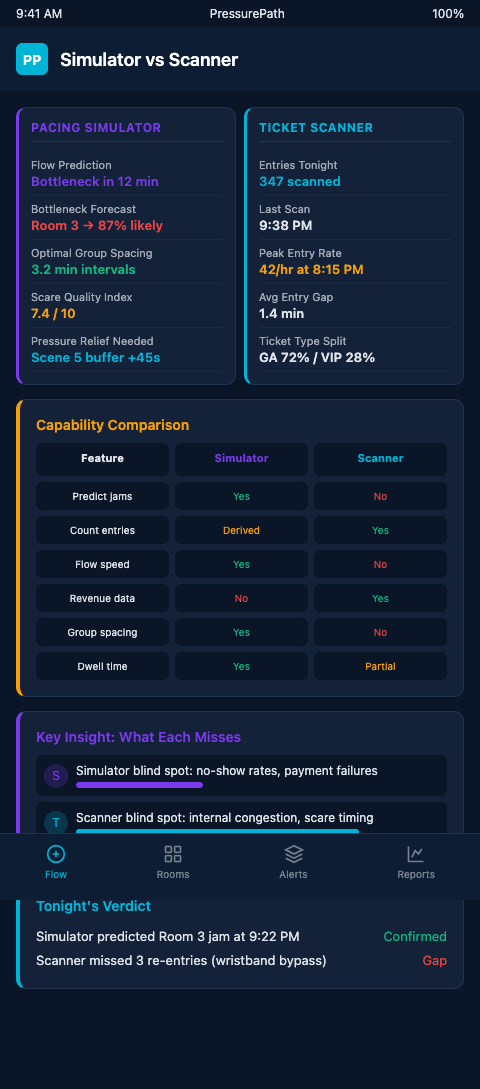
Ticket scanners are measurement tools. They record entry events with timestamps. A pacing simulator is a predictive model: it calculates what will happen inside the attraction at a given arrival rate, batch composition, and room configuration — before the night starts and continuously as conditions change during operation.
The distinction is not that one tool is better than the other. They measure different things. Scanners tell you the input state (who entered and when). A pacing simulator models the throughput dynamics (what density will develop, where, and when, given those inputs). For haunted attraction operations, both measurements matter — but scan data alone leaves the critical questions unanswered.
Think of it as the difference between a water meter on an intake pipe and a pressure gauge on a specific pipe section. The water meter tells you how much water entered the system. The pressure gauge tells you whether a specific section is approaching burst pressure. A haunt operator running only scan data has the water meter but not the pressure gauge. They know how many people entered; they don't know that Rooms 7-9 are approaching strike zone compression three minutes from now.
The fluid-dynamics crowd control model from Bannari Amman Institute formalizes this: density at any interior point is a function of intake rate, path geometry, and transit time variance — not just admission count. Scanners provide the intake rate. The simulator provides the density at each interior point.
AnyLogic's pedestrian simulation tools model real-time interior density, bottleneck formation, and evacuation scenarios — the spatial information that scan data cannot provide. InControl's digital twin simulation integrates scanner entry data with spatial flow modeling — the combined approach that gives operators both measurements simultaneously.
For haunted attractions, the practical implication is that scan data feeds the pacing simulator as an input. The simulator's output — density per zone, compression risk alerts, actor timing windows — is the operational information that scan data can't generate. The safety inspection flow data submission requires exactly this kind of interior density documentation: evidence that the operator knows what density is developing inside the attraction, not just how many tickets were scanned.
Queuing theory research from Governors State University confirms the mathematical gap: queuing models predict interior congestion from arrival rates, but ticket scanners cannot perform this calculation. Little's Law requires three variables — arrival rate, service time, and system capacity — and scanners provide only the first. A pacing simulator provides all three and calculates the congestion state that results.
Using Both Tools: The Combined Operations Picture
The strongest operational setup for a haunted attraction combines scan data and simulation output as complementary feeds. Scan data validates that admission is executing as planned. Simulation output — updated continuously with scan data as input — generates the interior density picture that scan data alone can't provide.
The pacing simulations vs booking buffers comparison from the escape room franchise context maps to a similar divide: booking and scanning data tell you the scheduling picture; simulation tells you the flow state that scheduling creates. Multi-room escape room franchises face the same measurement gap for different reasons — their scan data tells them rooms are filled but doesn't tell them whether room transitions are creating lobby compression.
For haunted attractions specifically, the combined approach produces three operational capabilities that scan data alone cannot generate. First, pre-night density forecasting: given tonight's scan data at T+30 minutes, what will density look like in Rooms 8-12 at T+2 hours? The simulator runs that projection from actual entry data. Second, real-time batch adjustment triggers: when scan data shows batch arrivals are running faster than scheduled, the simulator calculates the downstream effect on actor timing windows and recommends a batch interval correction before density spikes. Third, post-night analysis: the scan data and simulation output combined explain exactly why the actor in Room 7 logged a miss at 8:47 PM — the specific batch composition and arrival timing that produced compression in that zone, documented for next season's interval calibration.
Dexibit's pocket guide to ticketing analytics makes the key observation: ticketing analytics combined with spatial data unlock decisions that scan data alone cannot. "Spatial data" is what the pacing simulator generates — the interior flow state that connects entry events to actor timing outcomes.
The 20-actor scare timing workflow built on pacing simulation data becomes operational rather than theoretical when scan data feeds it in real time. Each actor's timing window is updated not just from the pre-season model but from tonight's actual entry pattern — producing a live coordination picture that pure scan data can never generate.
A concrete example of this combined output at work: a 420-ticket haunt running 8-minute batch intervals scans 240 tickets in the first 35 minutes. The simulator takes those 240 scans and projects interior density forward across the next 90 minutes, flagging that Rooms 7-9 will exceed safe strike zone density between 8:45 and 9:20 PM based on the actual batch composition scanned, not the booked average. The floor manager receives a specific adjustment: hold one batch release at 8:30 PM and widen the interval to 10 minutes for the next three batches. That correction is calculated from the combined feed — scan data alone shows 240 on-time arrivals, pacing simulation alone shows the pre-season density forecast, but neither produces the adjustment recommendation without the other. The combined output is the operational lever that turns entry data into interior flow management, and it updates continuously as new scans come in.
Stop Mistaking Admission Data for Operations Data
The measurement gap between admission data and operations data is not a tooling problem — it is a category error. Ticket scanners measure entry events and do that well. Pacing simulators model interior flow state and do that well. Treating the two as interchangeable, or using one to answer questions only the other can address, is how 387-ticket Fridays end with three rooms logging missed scares despite clean scan data. The operational discipline is straightforward: scan data validates admission, simulation output governs interior adjustments, and the combined feed is the single source of truth for every floor decision during the peak window. That discipline takes one season to institutionalize and saves every subsequent season from the same category error that produces the Michigan haunt's scan-vs-actor reporting mismatch.
PressurePath gives haunted attraction designers the interior density model that ticket scanners can't build — per-zone compression risk, actor timing windows, and fire marshal threshold alerts running in parallel with your admission data. Join the waitlist and add the spatial picture that closes the gap between your entry gate and your Butcher Room.