Workflow Tools for Scare Timing Across a 20-Actor Haunt
When 20 Actors Can't See Each Other's Problem
On October 26th, at a 14-room haunt with a 23-actor cast, the Butcher Room actor fired his chainsaw drop three times in four minutes. Each scare landed flat — the group was still packed from the bottleneck in the Clown Alley corridor two rooms back. He had no signal that spacing had collapsed. His radio was for emergencies only. He just kept executing his beat on instinct while the crowd pressure that killed each scare originated 60 feet upstream.
That's the coordination failure that haunts large-cast operations. According to Actor Safety in the New World (HAN), scare actors must coordinate scares, avoid collisions, and communicate in real time on peak nights — yet most haunt communication systems weren't built for that level of distributed awareness. Each actor occupies a zone and fires on instinct or vague radio chatter, with no shared picture of what the crowd is doing between zones.
Research on actor fatigue adds another layer. A PMC study on stress and fatigue among actors found 55% of actors with 6-10 years of service showed high stress scores — and repetitive physical scares on peak nights accelerate that fatigue. When actors are tired and spacing data is absent, they shorten their hold timing, fire early, and erode each other's setup without realizing it.
HauntPay's 2025 staffing guide notes that haunt operators routinely manage casts of 20-50 actors on peak weekends, and scheduling remains the top pain point — but scheduling is only the surface problem. The deeper issue is that a shift roster gets 20 people into position. It does nothing to synchronize their timing once the doors open and the crowd starts compressing.
Building a Scare Timing Workflow That Accounts for Flow
The tools that exist for large-cast coordination were mostly built for theatrical productions, not haunted attractions. Stage Write, used by 100+ Broadway productions, tracks blocking, cue lists, and calling scripts across large casts. Sithon was purpose-built for haunts and handles actor scheduling, zone management, and shift coordination. These tools solve the pre-show organization problem. None of them tell your Clown Alley actor that the group arriving in 90 seconds is four people too compressed for a clean strike zone.
The scare timing workflow gap isn't documentation — it's real-time density awareness feeding back into individual actor execution. Think of it the way pressurized water moves through pipes: when two pipes connect to a single narrow junction, pressure builds upstream before anything backs up at the junction itself. In a 20-actor haunt, density builds in corridor pinch-points well before it reaches each scare chamber. By the time the compressed group hits the Butcher Room, the actor has already lost the window he needs.
An effective large-cast scare timing workflow requires three connected layers. The first is pre-show density mapping — knowing which rooms are likely bottleneck sources given tonight's ticket count and batch size. If you're running 400-person peak density and your Clown Alley corridor is 42 inches wide, the density calculation is deterministic: group compression will start at that pinch-point within the first 90 minutes. That knowledge should be in every actor's pre-show briefing, not just the floor manager's clipboard.
The second layer is zone-specific timing windows. Rather than giving each actor a fixed beat — "fire every 90 seconds" — the workflow should define timing windows that shift based on incoming group spacing. An actor holding a 6-foot strike zone needs at least one group to clear before the next enters. When spacing drops below that threshold, the correct response is to hold the beat, not fire anyway and log a near-miss.
The third layer is real-time actor cues — signals that update zone actors based on upstream density, not just elapsed time. This is where theatrical cue tools like those reviewed on Theatrecrafts come closest to haunt needs, but still fall short without crowd-density integration.
PressurePath approaches the workflow as a fluid system. Each actor's zone is modeled as a pipe section with a defined safe-flow rate. When upstream pressure (crowd density) exceeds that rate, the system flags it before the compressed group arrives at that zone. The actor doesn't need to guess — the pacing model calculates when their timing window will be compromised and gives them the information to hold rather than fire. For a 20-actor haunt, that means 20 individual timing windows all updating off the same pressure model rather than operating on independent instinct.
Coordination tools like zone-specific cue boards or color-coded runner signals can serve as a low-tech version of this — but they require someone monitoring density at every pinch-point simultaneously. For a 20-actor cast spread across 14 rooms, that's not operationally realistic unless the monitoring is automated.
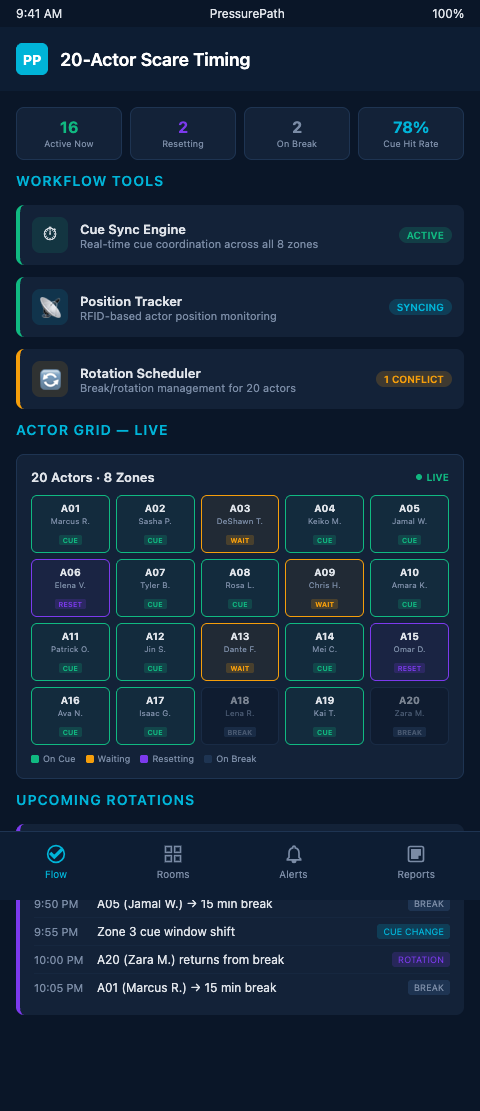
Advanced Coordination: Zone Handoff and Beat Recovery
The scare timing workflow for a large-cast haunt also needs a beat recovery protocol. When a scare fails — because the group was over-compressed, an actor misfired, or a chaperone disrupted the spacing — the downstream actor needs to know the group is arriving in a degraded fear state. Without that handoff signal, the next zone fires its beat into a crowd that has already broken scare immersion, and another scare fails for the same reason.
Stage management workflow principles from immersive theater offer a useful model here. In immersive productions with 30+ cast members, stage managers use verbal cue calls and real-time notation to flag scene state to downstream performers. The equivalent in a haunted attraction is a runner or radio protocol that marks group state — "this group broke spacing in Clown Alley, Butcher Room hold your chainsaw beat until they re-gap."
That protocol doesn't require expensive software. It requires that someone has visibility into upstream scare state and a communication line to downstream actors. The workflow design challenge is building that visibility systematically rather than relying on the floor manager to intuit it during a 400-person Saturday surge.
For large-cast haunts with multiple room types — Clown Alley, Butcher Room, dark corridor, jump-scare alcove — the actor timing flow model built before the season opens is what makes real-time coordination possible. Without a pre-modeled baseline, operators are reacting to failures. With one, they're adjusting to predicted pressure before it collapses a beat.
The goal of a 20-actor scare timing workflow is not to script every actor's beat in advance. It's to give every actor the density context they need to execute their beat correctly given what the crowd is actually doing — and to give the floor team the recovery signals to correct spacing failures before they cascade across the full cast.
Stop Running Peak Nights on Instinct
If your 20-actor cast is executing scare beats without crowd density data, you're asking every actor to make a pacing decision that requires information they don't have. At 420 tickets and 9-minute batch intervals, the density difference between Room 4 and Room 11 can be 30-40% within the same peak window — and no radio chatter substitutes for a model that tells each actor which 15-minute block their timing window is compromised for.
The workflow fix is not more communication hardware. It's a shared reference frame. When every actor in your 20-actor cast starts the shift with a density timeline tied to their specific zone — "your window holds clean from 7:00 to 8:30, compresses 8:30 to 9:45, recovers after 10:00" — the radio traffic drops, the instinctive holds become deliberate, and the beat recovery protocols activate before the first downstream scare fails. That timeline is built pre-season from your haunt's pipe geometry and the ticketing pattern you've already booked.
PressurePath gives haunted attraction designers a pre-season model and a peak-night pressure feed so each actor's timing window is calculated from real crowd flow, not guesswork. Join the waitlist and bring your actor coordination workflow into your density model before this season's peak weekends.