Fundamentals of Actor Timing in Flow-Constrained Haunts
When the Actor's Instincts Are Right and the Flow Is Wrong
Your Butcher Room actor has been doing this for three seasons. They know the timing cold — wait for the lead guest to cross the threshold, read the group size, hold for two beats, execute. On preview weekend, the scare runs perfectly 94 times out of 100. By peak Saturday at 9:45 PM, that number drops to 60 out of 100.
The actor has not changed. The script has not changed. The flow has changed.
This is the central problem in flow-constrained haunts: actor timing fundamentals that are rehearsed under controlled conditions become structurally impossible to execute when group density and arrival velocity shift during peak nights. Professional haunt training programs correctly emphasize timing cues, reset paths, and reading incoming group behavior — but that training assumes a functional spacing window to work within. When the flow compresses that window to zero, even the most skilled actor cannot deliver the beat.
Research on live performer timing confirms the mechanism: live performance timing must adapt to audience micro-timing, but compressed groups shift the beat window itself. When two groups are stacked, the actor's read — the moment when they assess group size, spacing, and lead guest position — becomes ambiguous. There is no clean front, no clear victim, no isolated target. The actor makes a choice, executes, and frequently hits the wrong person at the wrong moment.
The result is not a bad scare. It is a no-scare. The beat window existed on paper — the actor was in position, the group was in the chamber — but the flow conditions rendered the window functionally closed.
Flow Constraints and Actor Timing: The Pressure Model
Picture your haunt's crowd flow as pressurized water through a pipe network. Each actor's position is a functional node in that network — a precision valve that only works when fluid arrives at the right pressure and velocity. When upstream pressure builds and groups compress, the fluid arrives in surges rather than controlled pulses. The valve is not designed for surge conditions. It fails.
Actor timing fundamentals depend on four preconditions that flow constraints directly attack.
Group clarity. The actor needs to read a distinct group with a defined front and back. In a flow-constrained haunt, groups lose their boundaries. The tail of one group overlaps with the front of the next. The actor cannot determine whose reaction to target, which person is the "victim," or how many bodies are currently in the strike zone. Actor-audience interaction research is direct on this point: scare timing is co-created with audience state, and overcrowded flow breaks that co-creation entirely because the audience state becomes a collective social mass rather than a set of individual threat responses.
Reset window. Every scare requires a physical reset — the actor returns to starting position, breathing resets, mental state reframes for the next group. That reset window in a healthy flow scenario is 40-60 seconds. In a flow-constrained haunt during peak night, the reset window compresses to 15 seconds or disappears entirely when back-to-back groups enter without a gap. The Care and Feeding of Actors documents this explicitly: when groups pile up, actors have no reset window — the next group enters before re-positioning completes. By the third consecutive miss, the actor's physical and mental fatigue begins compounding scare failure.
Sightline control. The actor's cue for execution is typically visual — a specific lighting change, the lead guest crossing a marked position on the floor, or a sight line reveal. In a flow-constrained scenario, the sight line is compromised by the group ahead, which has not fully cleared the chamber. The actor fires the cue early to avoid missing the window, the scare lands on a group that is half-in and half-out of the chamber, and neither group gets a clean scare. Sightline control in haunt design confirms that sightline spacing between groups sets the maximum sustainable dispatch interval — and that once sightlines overlap, actor cue reliability collapses.
Physical safety margin. The 6-foot strike zone requires that the actor's scare path does not contact a guest outside the designed interaction zone. In a flow-constrained scenario, guests who have been compressed into the tail of the group ahead are standing in the actor's movement path before the scare executes. The actor hesitates — correctly — and the timing is lost. Or the actor executes and creates a safety incident.
PressurePath models each of these preconditions as thresholds in the pressure simulation. The output for each chamber shows the density level at which each precondition fails — group clarity at one threshold, reset window at another, sightline at a third. Layered against your peak-night arrival curve, the model produces a precise timeline of when each actor position will lose functional timing conditions.
The connection between flow constraints and actor fatigue vs crowd flow is direct: when actors repeatedly attempt to execute in failed timing conditions, the cognitive load of constant recalibration accelerates fatigue onset far faster than a comparable number of clean scares would. Flow constraints do not just break individual beats — they exhaust actors by forcing continuous real-time adaptation to conditions they cannot control.
Managing a 20-actor scare workflow across a full haunt makes this problem multiplicative. Each actor's timing window depends on every upstream actor's successful execution — a missed beat in Clown Alley changes the group's arousal state by the time they reach the Butcher Room, which changes the timing window available to that actor, which changes the group's state at the next position.
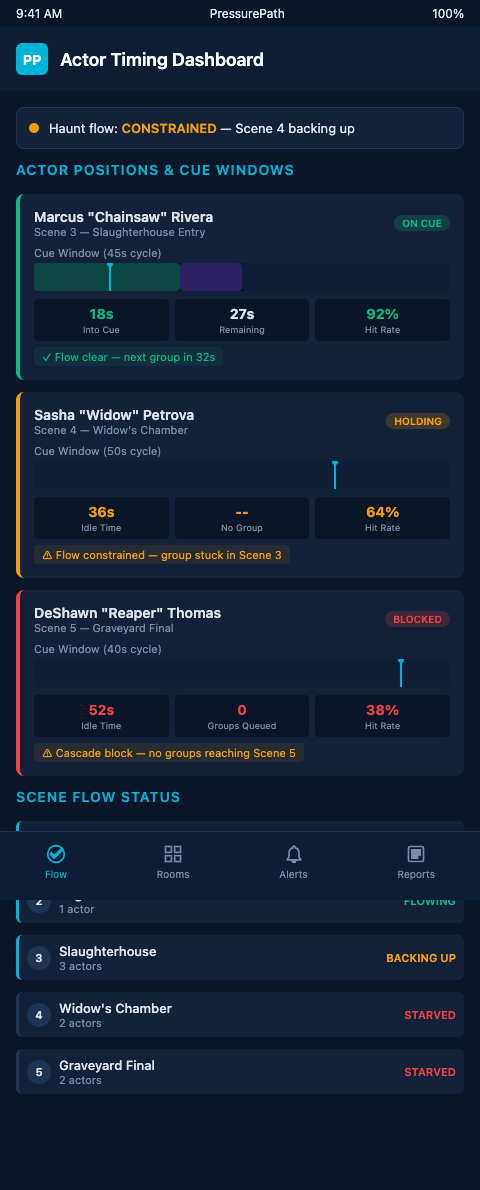
Practical Actor Timing Adjustments for Flow-Constrained Conditions
Given that flow constraints cannot always be fully eliminated on peak nights, actors need adapted timing protocols that preserve scare delivery in degraded conditions.
Density-adjusted cue delay. Actors in high-value chambers should have a secondary cue timing for peak-density conditions — a deliberate 1.5-second additional hold after their primary trigger. This delay accommodates the slower movement velocity of compressed groups, allowing the lead guest to fully enter the chamber before execution. The group is denser, but the lead victim is in the correct position. One clean scare beats six missed ones.
Group boundary signaling. Station a staff member or a dedicated actor at chamber entries during peak windows to visually signal group boundaries to the scare actor via a subtle standardized gesture. This gives the actor the group clarity information that flow constraints have removed — they can execute on a confirmed clear target rather than guessing at group edges in poor sightline conditions. Research on mid-show actor cue adjustments in live performance environments shows exactly this pattern: real-time cue signaling between team members preserves performance quality when audience density exceeds designed parameters.
Abbreviated reset paths. Map shorter physical reset paths for each actor position specifically for peak-night operation. Instead of returning to a starting position 15 feet back in the chamber, the actor resets to a 6-foot secondary position that still provides an effective strike zone but requires 20 fewer seconds. Test these secondary positions during rehearsal and have actors comfortable with both the full and abbreviated reset sequences before opening night.
Fatigue rotation scheduling. In flow-constrained conditions, actor cognitive and physical output degrade faster than under clean spacing. Build actor rotation schedules that account for peak density windows — shorter continuous shifts during the 9:00 PM to 10:30 PM surge window, with 10-minute off-stage recovery periods scheduled at the transition out of peak hours.
The fundamental principle across all of these tactics is the same: you are not fixing the flow in the moment, you are designing actor timing protocols that remain functional within the reduced-window conditions that flow constraints create. The flow model is the upstream tool that tells you exactly how reduced those windows will be. The timing protocols are the downstream response. Neither works without the other.
Build the Flow Model Before You Rehearse the Timing
Actors deserve to rehearse under the conditions they will actually perform in. That means knowing — before the first preview night — how compressed groups will arrive at their position during peak windows, what their effective beat window will be at 9:45 PM on October 25th, and which of their timing protocols will need to shift to the abbreviated version.
The rehearsal benefit of flow model data is concrete. When your Clown Alley actor knows that between 8:45 PM and 10:15 PM their effective beat window will be 40% narrower than the one they trained in, they can build two timing sequences in rehearsal rather than discovering the compressed window for the first time on a live audience. The density-adjusted timing sequence becomes part of their toolkit before it becomes a necessity.
This is also a director's tool. Haunt creative directors who review the flow model alongside blocking notes can identify which actor positions need dual-timing rehearsal versus which will have sufficient spacing throughout the night. Resources are not wasted drilling all 20 actors on compressed-flow protocols when only 6 positions will experience meaningful beat-window compression during peak windows. The flow model focuses the rehearsal investment.
PressurePath gives haunted attraction designers the density timeline for each actor position across the full peak-night schedule. Bring that data into your actor briefing in September. Walk each actor through the flow conditions they will face at their specific position during each hour of peak operation. The timing adjustments are not emergency improvisation — they are designed adaptations to known conditions, rehearsed and ready before opening night.
The scares your guests will remember are the ones that landed clean. Your actors' instincts are already excellent. Give them a flow model that tells them exactly when those instincts will be operating in degraded conditions — and what to do about it. Join the waitlist to run your peak-night density timeline against each actor position before the September briefing, so every cast member walks onto the floor with the compressed-window protocols already rehearsed.